BALTIMORE (WBFF) — Despite massive funding increases over the last eight years, Baltimore City Schools is showing little improvement when it comes to high school graduation rates.
On August 3, 2021, the non-profit People Empowered by the Struggle held a rally outside Baltimore City Hall calling for the resignation of Baltimore City Public Schools CEO, Dr. Sonja Santelises.
“No education. No peace. Resign Dr. Santelises,” the protestors chanted at the time.
One of those protestors was the non-profit organization’s co-founder, Jason Rodriguez.
“Our children have been failed for many decades,” Rodriguez told Project Baltimore in 2021.
Rodriguez, who has five grandchildren in City Schools, said he could see five years ago that Dr. Santelises’ leadership was not significantly improving student outcomes.
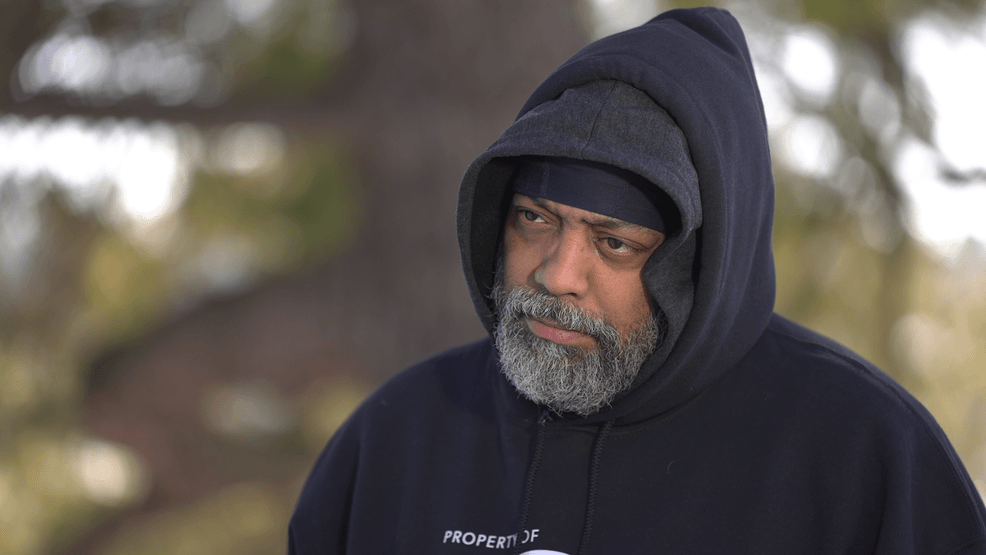
Jason Rodriguez has five grandchildren in Baltimore City Schools (WBFF)
“We’re still seeing the same trajectory,” explained Rodriguez, this week. “We’re still seeing the students struggling, the teachers struggling for resources.”
The four-year high school graduation rate is often referenced by public officials as one of a school system’s primary benchmarks to gauge student outcomes.
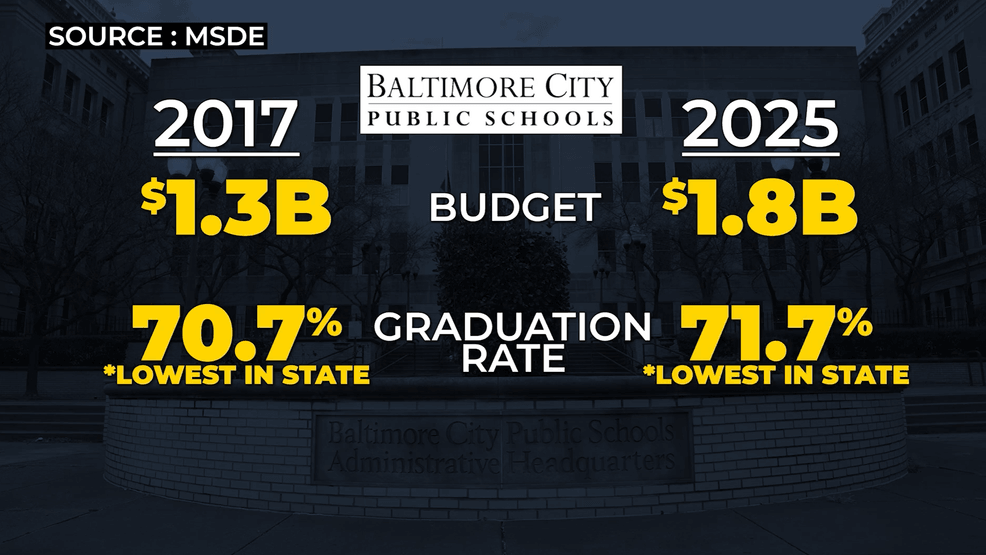
Dr. Santelises took over as Baltimore City Schools CEO in July 2016. The following school year, in 2017, Baltimore City Public Schools had a $1.3 billion budget, with a 70.7% four-year high school graduation rate – the lowest in the state. Eight years later, in 2025, City Schools’ budget grew to nearly $1.8 billion. Taxpayers gave City Schools a 38% increase in funding over those eight school years and the graduation rate increased 1 percentage point during that time to 71.7%, which is still the lowest in the state.
ALSO READ | Baltimore Collegiate School for Boys faces closure, CEO alleges unfair district practices
Keep in mind, Maryland recently changed high school graduation requirements. In 2017, to graduate, Maryland students had to do three things – perform 75 services hours, complete 21 course credits and pass state assessments in core subjects. For the class of 2025, students no longer had to pass state assessments. Instead, students were required to earn one additional course credit.
“What is the return on our investment as taxpayers? We’re not seeing that,” Rodriguez told Project Baltimore.
Dr. Santelises’ contract is set to expire on June 30. The school board is searching for her replacement. But Rodriguez is not optimistic.
“It’s going to be the same upholding of the system and the same protocols in place that have led our children to the failed system that we’re in now, unfortunately,” said Rodriguez.
Rodriguez says history has shown City Schools cannot make meaningful improvement the way it’s currently structured. To improve student outcomes, he believes North Avenue needs to fundamentally change. First, he says, the district needs separate department heads to oversee finances and academics. He believes having a CEO do both has failed.
“Dr. Santelises is right now, in some cases, is doing double duty. She’s the administrator, but then she’s also the educator,” Rodriguez told Project Baltimore. “I think that she wears too many hats as a CEO, and she’s not being held accountable for those hats.”
ALSO READ | Despite $2 Billion funding boost, Maryland’s high school graduation rate barely improves
Second, Rodriguez favors a fully elected board of school commissioners. Currently, only two of the board’s 12 members are elected. Nine are appointed by the mayor. One is a student member.
If board members are not accountable to the people, according to Rodriguez, the people’s voice largely goes unheard – regardless of results.

Rodriguez says history has shown City Schools cannot make meaningful improvement the way it’s currently structured (WBFF)
“The power needs to be returned back to the people, then the people are responsible for what is going on,” explained Rodriguez. “Right now, we don’t have a system that we have power to change.”
In statement, City Schools told Fox45 News it welcomes the opportunity to speak directly with residents to address concerns. Though, City Schools added, “Our current governance model has contributed to steady improvements in graduation rates and other key measures of student achievement over the past decade.”
Graduation rates are up 1% since 2017.
Follow Project Baltimore’s Chris Papst on X and Facebook. Send news tips to cjpapst@sbgtv.com

 Local Story