Safe Money and Income with Adam Waskey
4:00 am - 5:00 am
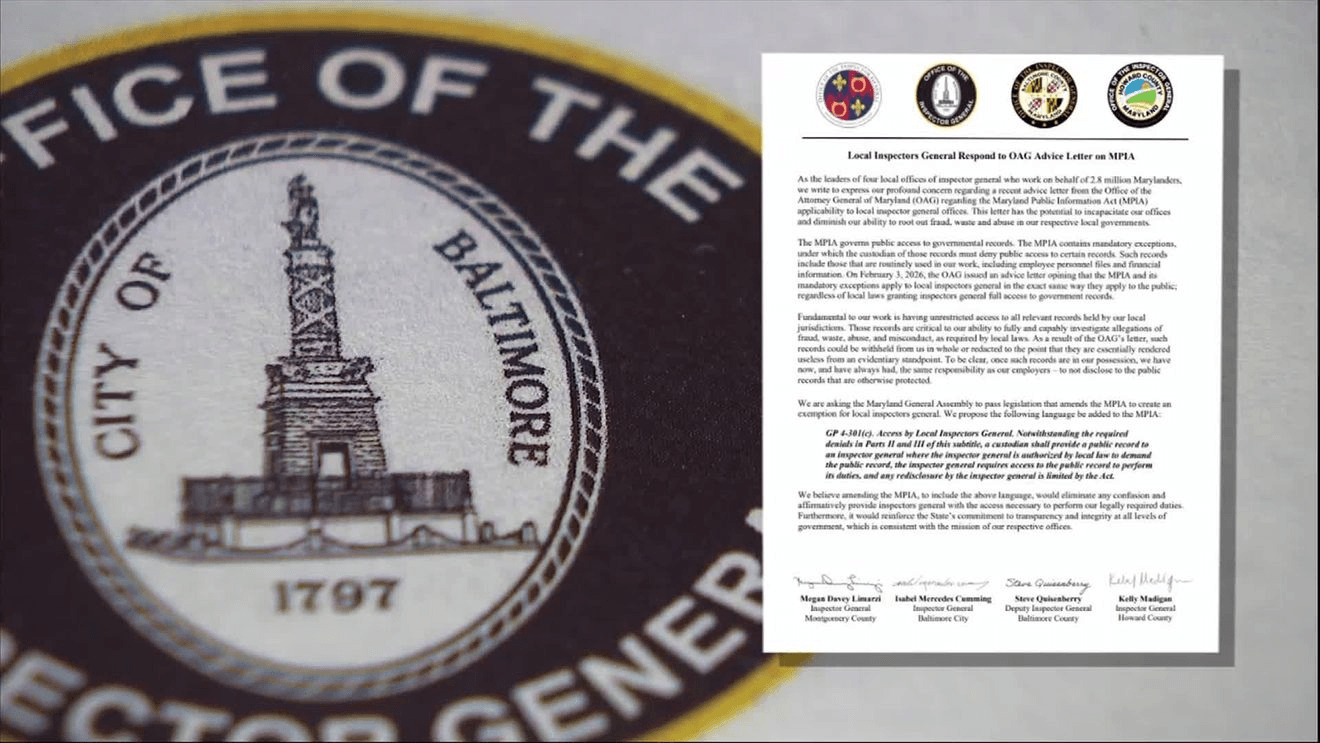
MARYLAND (WBFF) — A new interpretation of Maryland’s public records law from the Office of the Attorney General is drawing sharp pushback from government watchdogs across the state, who warn the guidance could severely limit their ability to investigate waste, fraud and abuse.
In a joint statement, four inspectors general — representing Baltimore City, Baltimore County, Montgomery County and Howard County — said the guidance has the “potential to incapacitate our offices.”
ALSO READ | AG Brown says Baltimore City wrongly interpreted letter used to block IG access to records
The Attorney General’s office recently issued an advice letter interpreting the Maryland Public Information Act (MPIA) to mean that IGs should be treated like any other member of the public when requesting records — even when local laws grant their offices broad access to internal government documents. While not a formal legal opinion, the guidance is already being cited by local governments to restrict what information inspectors general can review.
In Baltimore City, officials have relied on the OAG’s guidance to justify redacting financial records requested by IG Isabel Cumming as part of her investigation into the Mayor’s Office of Neighborhood Safety and Engagement (MONSE). Cumming said the redactions are so extensive that they undermine her office’s ability to do its job.
Montgomery County Inspector General Megan Davey Limarzi said she is facing similar restrictions for the first time in her six-year tenure. She said county attorneys recently informed her office that it could no longer access certain records — including personnel and financial files — that are often critical in fraud and misuse-of-funds investigations.
“If you’re following a investigation where there’s been an allegation of fraud and you need to figure out, where did the money go, how did someone fraudulently obtain some government money, you have to be able to get that bank account information,” Davey Limarzi said.
You can’t tell the whole story if you don’t get every record that’s necessary for the job.”
The IGs argued once records are in their possession, they already abide by strict confidentiality rules. They said limiting their access to records does not protect privacy, it simply weakens government oversight.
“Confidentiality of sources, confidentiality of information, protecting the innocence of people who’ve been wrongly accused is a bedrock of the work that we do,” Davey Limarzi said. “Limiting our access really does come, ultimately, at the expense of our residents. They are the ones who rely on us. They are the ones who trust us, who come to us with their concerns.”
The IGs warned that if the guidance is widely adopted, it could create a chilling effect on oversight across Maryland, effectively allowing agencies under investigation to control what evidence watchdogs are allowed to see.
In the joint statement, they’re now calling on the Maryland General Assembly to amend the Public Information Act to explicitly protect IG access to government records.
“It’s not about one jurisdiction or another,” Davey Limarzi noted. “This is about Maryland as a whole. Are we going to stand up and say we are a state that believes in doing the right thing and holding folks accountable for their actions? And that goes across the board.”

 Local Story