The Savvy Investor
6:00 pm - 7:00 pm

BALTIMORE (WBFF) — On Monday, August 24th, a new school year began in Baltimore City. And for the first time in a decade, a new CEO welcomed the district’s 75,000 students back to class.
Dr. Jermaine Dawson is starting the 2026-2027 school year with more than just a new title. He’s stepping into what he considers a personal mission. Dawson inherited Maryland’s highest funded per pupil, but lowest performing school system – which he hopes to change.
“This is not a job for me, this is really a calling,” Dawson told Project Baltimore outside Hazelwood Elementary/Middle school. “It’s really a ministry for me.”
On Monday, Dawson visited schools across Baltimore, welcoming students back for the first day of class—while beginning his first school year as CEO of Baltimore City Public Schools.

Dawson inherited Maryland’s highest funded per pupil, but lowest performing school system – which he hopes to change (WBFF)
“I’m really dedicated to making sure that all children receive the high-quality education that I received,” said Dawson.
But to get there, his district has a long way to go.
ALSO READ | School choice, academic standards, his contract: Next Baltimore schools CEO talks issues
Dawson took over as City Schools CEO on July 1. He replaced Dr. Sonja Santelises who led the district for 10 years. When Dawson assumed the role, he inherited Maryland’s lowest performing school system.
According to the Maryland State Department of Education, Baltimore City has Maryland’s lowest graduation rate, lowest average SAT score and lowest English proficiency rate. On the first day of school, Project Baltimore asked Dawson how he plans to address student performance.
“Our focus is no longer on growth,” responded Dawson. “Our focus is aiming for proficiency, looking at the state’s goal, looking at the state’s average as our new target, our new North Star.”

According to the Maryland State Department of Education, Baltimore City has Maryland’s lowest graduation rate, lowest average SAT score and lowest English proficiency rate (WBFF)
Dawson told FOX45 News Baltimore City Schools will focus on targeted learning for students who are falling behind by building specific individualized plans.
“Focus in on the individual child and specifically what they need, that will help us to be able to celebrate the learning for all of our young people,” stated Dawson.
At 86.2%, Baltimore City also has the state’s lowest attendance rate. To improve student attendance, Dawson plans to work with the faith-based community to find ways to help solve the attendance problem.
“When a student is absent from school, are we following through to make sure that we communicate with those parents?” Questioned Dawson.
ALSO READ | ‘There’s a Disconnect’: Educator Questions Baltimore County Schools’ Arrest Tracking
At 20.8%, Baltimore City has the state’s highest high school dropout rate. Dawson says when student absences start stacking up, further steps must be taken to keep students enrolled.
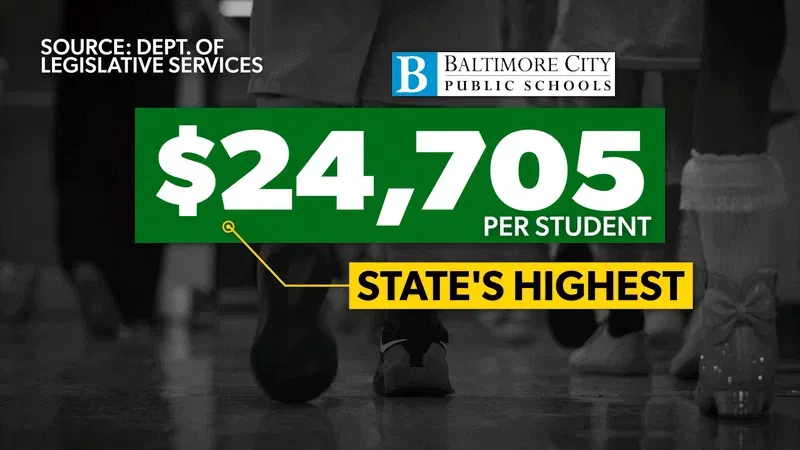
While Baltimore City Schools is the state’s lowest performing district, it’s also the highest funded at $24,705 per student, according to the Maryland Department of Legislature Services (WBFF)
“Working with our social workers and other teams to knock on doors, to talk through and find out what are some of the root causes as to why,” said Dawson.
While Baltimore City Schools is the state’s lowest performing district, it’s also the highest funded at $24,705 per student, according to the Maryland Department of Legislature Services.
“The school system’s budget is now nearly $2 billion. What should taxpayers expect for that nearly $2 billion budget?” Project Baltimore’s Chris Papst asked.
“What they can expect is that we are going to raise high-quality instruction and outcomes for our young people,” Dawson replied. “They can trust that we’re going to be as fiscally sound as we possibly can be with the dollars that we have.”
Follow Project Baltimore’s Chris Papst on X and Facebook. Send news tips to cjpapst@sbgtv.com
 Local Story