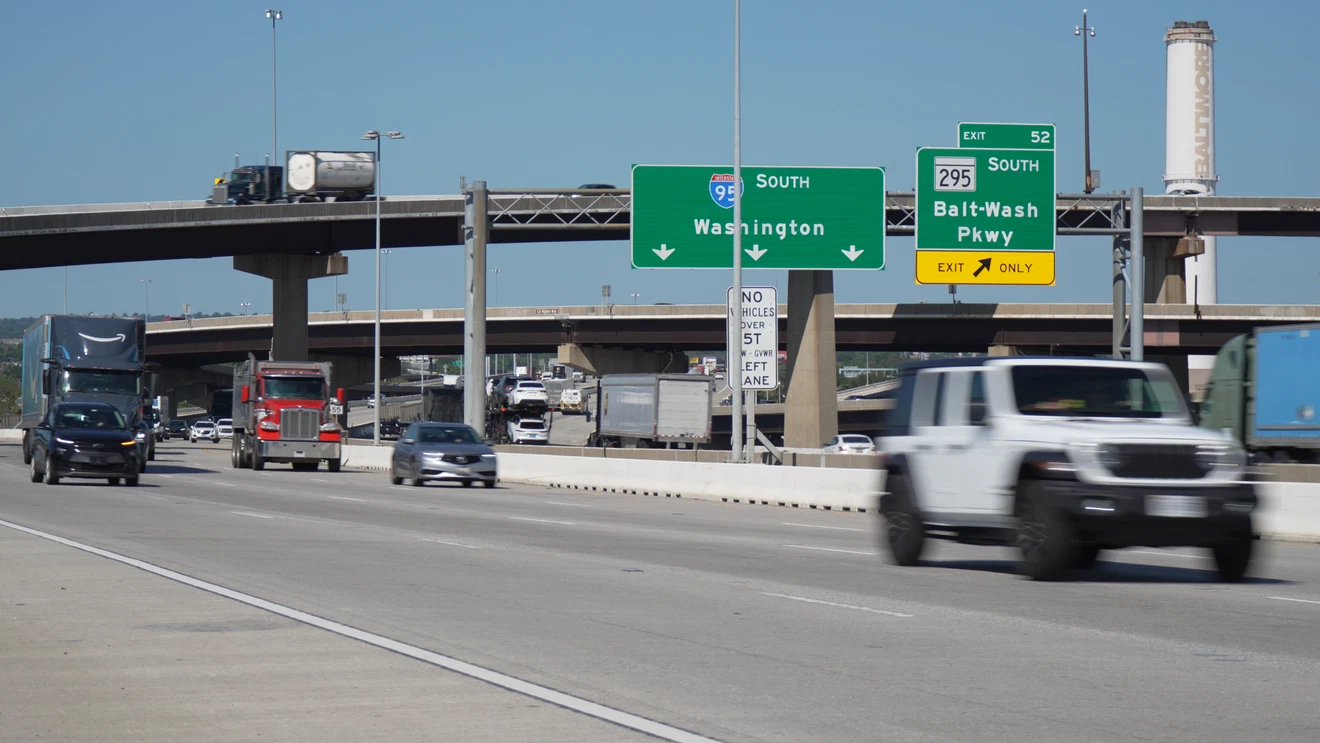
MARYLAND (WBFF) — Maryland projects significantly more of its roads will fall into poor condition in the coming years, but the state has not set aside enough money to keep up with the deterioration.
The state’s own assessments show pavement conditions worsening as Maryland struggles to fund the maintenance needed to preserve its highway system.
The latest transportation plan programs $193.8 million for pavement resurfacing and rehabilitation in fiscal 2027 – less than half the roughly $400 million a year transportation industry leaders say is needed to keep Maryland’s roads in good repair.
A Spotlight on Maryland review also found the amount the state planned to spend on that work has fluctuated sharply. Across six consecutive transportation plans, Maryland’s projected pavement funding for fiscal 2027 has ranged from $99.4 million to $236.9 million – a swing of more than $137 million for the same year.
The funding gap is emerging as Maryland’s own reports forecast worsening conditions.
The state’s 2026 Annual Attainment Report says 10% of Maryland pavement was in poor condition in calendar year 2024. Under current funding projections, the state expects that figure to increase to 13% by 2028.
An earlier state assessment was even more dire.
Maryland’s 2025 Annual Attainment Report projected the percentage of pavement classified as poor could double because of “potential budget shortfalls.”
The newer forecast is less severe, but the direction remains the same. Maryland expects more of its pavement to deteriorate while the amount currently programmed for resurfacing and rehabilitation remains well below what transportation industry leaders say is necessary.
Tim Smith, president of the Maryland Asphalt Association, spent 25 years working for the State Highway Administration and said pavement conditions and transportation decisions have been the focus of his career.
“In 2023, we found that we need $400 million a year to keep roads in a state of repair,” Smith said.
Smith said that figure was based on conditions and budgets at that point in time, but the amount needed can increase when maintenance is deferred.
“Deferring maintenance or delaying maintenance never saves you dollars,” Smith said. “It actually costs you dollars.”
Maryland’s current plan for fiscal 2027 is $194 million for pavement resurfacing and rehabilitation.
That amount is projected to increase to $289 million by fiscal 2032, according to the state’s Consolidated Transportation Program report released Sept. 1.
That is still below the approximately $400 million annual figure cited by Smith, as well as Mike Sakata, president and CEO of Maryland’s Transportation Builders and Materials Association.
“The state resurfaces about 4% of its road network a year – to 17,000 lane miles,” he said. “To keep roads on a cycle that they say is right, their [SHA’s] numbers not ours, it needs to be closer to 8% and that’s roughly $400 million a year.”
That leaves Maryland resurfacing roads at roughly half the rate Sakata says is needed to maintain the system.
Maryland’s projections show roads getting worse
The State Highway Administration uses five factors to determine poor pavement conditions: ride quality, friction, rutting, structural cracking and functional cracking.
The 2026 report says that as pavement conditions deteriorate, restoring roads to a state of good repair will likely cost more because more pavements will require costly reconstruction.
The report says every $1 spent on pavement preservation while pavement is in fair or better condition can result in $6 to $12 in savings on rehabilitation or reconstruction once pavement reaches poor condition.
When Spotlight on Maryland asked about the more severe projection contained in the 2025 Annual Attainment report, which warned poor pavement could double, SHA pointed to its newer 2026 report.
The newer forecast does not project a doubling, but it still projects deterioration.
SHA said it takes the “responsibility of maintaining state roads and bridges seriously” and 79% of its budget is dedicated to system preservation.
Funding swings
Maryland’s plans for pavement funding are not fixed amounts.
The approximately $194 million for fiscal 2027 comes from Maryland’s six-year Consolidated Transportation Program, or CTP. The Maryland Department of Transportation, the agency that oversees SHA, describes the CTP as the state’s six-year capital budget for transportation projects.
Sakata said the CTP should be viewed as a planning document rather than a guarantee of future spending.
“For planning purposes only. You almost have to look at it one to two years out,” Sakata said.
Asked why the public should not look farther ahead, Sakata said: “Dollars change. Fluctuate. Very volatile.”
Spotlight on Maryland reviewed six consecutive CTPs to see how much the state had planned to spend on pavement resurfacing and rehabilitation in fiscal 2027.
The numbers changed substantially:
Fiscal 2022 CTP: $236.9 million
Fiscal 2023 CTP: $236.4 million
Fiscal 2024 CTP: $222.4 million
Fiscal 2025 CTP: $99.4 million
Fiscal 2026 CTP: $195.3 million
Fiscal 2027 CTP: $193.8 million
Six years ago, the state’s plan called for nearly $237 million for resurfacing and rehabilitation in fiscal 2027.
Today, the figure is about $194 million. A decrease of more than $43 million.
The funding did not decline steadily. It dropped to about $99 million in the fiscal 2025 plan before climbing back to nearly $200 million in the subsequent plans.
“When times get tough on a budget perspective or year to year, you see system preservation get squeezed,” Sakata said.
SHA says funding has increased from earlier draft
SHA said the newest CTP actually represents an increase in pavement resurfacing and rehabilitation funding compared with the previous final plan.
The fiscal 2027-2032 draft CTP allocates about $1.5 billion for pavement resurfacing and rehabilitation over six years, including $194 million in fiscal 2027, $240 million in fiscal 2028, $226 million in fiscal 2029, $287 million in fiscal 2030 and $289 million in both fiscal years 2031 and 2032.
SHA said that represents an $85.6 million increase from the fiscal 2026-2031 final CTP.
SHA attributed some of the transportation funding challenges to inflation and rising construction, maintenance and operating costs.
The agency said actions taken by Gov. Wes Moore and the General Assembly during the 2024 and 2025 legislative sessions restored nearly $300 million in roadway resurfacing funds compared with the fiscal 2025-2030 CTP.
SHA also said the cost of hot-mix asphalt has increased nearly 32% since January 2026.
Drivers are a major source of transportation funding
Transportation funding also comes from more than just one source.
More than half, 50.8%, of MDOT’s total funding comes from motorists through vehicle registration fees, title fees and state gas taxes.
But that money supports Maryland’s broader transportation system, including public transit, rather than being dedicated exclusively to road repairs.
“We’re seeing less dollars available for roadways and that’s resulting in less work being done in Maryland,” Smith said.
Spotlight on Maryland is a collaboration between FOX45 News, WJLA in Washington, D.C., and The Baltimore Sun. Have a story tip? Email spotlightonmaryland@sbgtv.com or call 410-467-4670. Investigative reporter Tessa Bentulan can be reached at tbentulan@sbgtv.com.
 Local Story