
BALTIMORE (WBFF) — A group of Maryland landowners is asking the U.S. Supreme Court to review a ruling that allowed a private company to enter their properties for field surveys connected to a proposed transmission line, even as state regulators continue to review the project.
The petition, filed Nov. 4, 2026, by dozens of landowners challenges a Fourth Circuit decision upholding a preliminary injunction that gave PSEG Renewable Transmission LLC access to properties along the Maryland Piedmont Reliability Project, MPRP, route. The landowners argue a federal court should not have allowed the surveys based on the predication that PSEG would likely have eminent domain authority under Maryland law.
The petition concerns access for surveys, not whether the state ultimately approves the MPRP. The Maryland Public Service Commission has not issued a final decision on the project that is proposed to cut through Baltimore, Carroll and Frederick Counties.
ALSO READ |In Depth: BGE, MPRP and policies shaping Maryland’s energy debate
For Joanne Frederick, who owns a 100-acre property in Freeland, Md., the legal dispute is also about a place she says has been part of her family’s story for generations.
“This little stream here has always been my favorite place on the farm since I was a little girl,” Frederick said in an interview at the property. “I would come down here and pick up stones and get my feet wet and get in trouble. But to think that this would go away, it’s heartbreaking. It really is heartbreaking.”
Frederick said her great-grandparents owned the land before it passed to her grandparents, who operated a dairy farm. The family ultimately sold the property to pay for Frederick’s grandmother’s long-term care. But, Frederick bought it back in 2020, hoping to restore the family legacy.
“Then, of course, 2024 was when the whole power line nightmare began,” she said.
ALSO READ | Maryland landowners ask U.S. Supreme Court to intervene in MPRP dispute
PSEG has said the project was selected by PJM Interconnection, the regional grid operator, to help address reliability concerns as electricity demand grows and power plants retire. The company identifies data-center growth as one contributor to rising demand. It says the project would add transmission capacity to the regional grid, where electricity flows across state lines.
Frederick said the line is connected to data-center growth in Northern Virginia, particularly in Loudoun County. She said she is not campaigning against data centers themselves, but questions where they should be built and how they should be powered.
“If we wanted data centers, the question becomes what’s the price we’re willing to pay?” she said. “At a certain point, some rational human has to say, OK, stop. This doesn’t make sense anymore.”
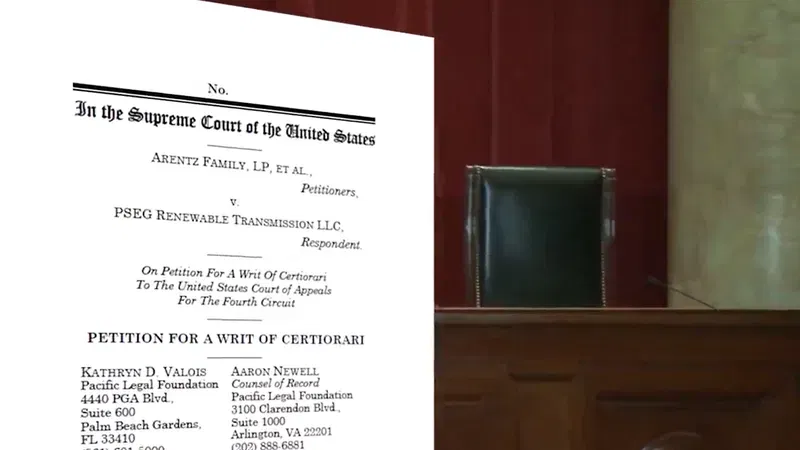
A screenshot of the U.S. Supreme Court petition filed asking the justices to intervene in the issue. (WBFF)
The legal fight began after landowners denied PSEG access to survey their properties. Aaron Newell, an attorney with the Pacific Legal Fund, said Maryland law allows access for surveys by the state or an entity with eminent-domain authority. He said PSEG applied for a state certificate to build the line and sought the power of eminent domain, while agencies reviewing the project said they needed additional surveys.
Newell said PSEG could have asked a state agency to conduct the surveys or sought clarification from the Maryland legislature. Instead, he said, the company went to federal court for an injunction.
ALSO READ | MPRP state approval schedule released, pushing project completion into 2029
A federal judge granted PSEG access to conduct surveys in June 2025. The Fourth Circuit upheld that ruling in August 2026, finding that PSEG had shown it was likely to have authority under Maryland law to enter the properties for surveys. The court’s ruling did not approve construction of the project.
In the Supreme Court petition, the landowners argue the injunction let PSEG exercise a power it had not yet received. They say the issue could extend beyond this project to other cases in which private companies seek access to land before their authority is settled.
“What we’re challenging here is the federal courts’ authority to issue this injunction based on a prediction about Maryland law,” Newell said. “The court hasn’t decided on the merits that PSEG has this power.”
Newell said the case also raises a question about preliminary injunctions, which generally preserve the status quo while a case proceeds. In this case, he said, the status quo was that PSEG had no access to the properties.
“This is a prediction that can’t be undone,” Newell said. “The status quo was no surveys, no access, and the court disrupted the status quo here.”
PSEG declined to comment on the Supreme Court petition, citing potential litigation. The company said field surveys have been largely completed, although a small number remain outstanding.
ALSO READ | In Depth: Bills, transmission lines, and other concerns around energy in Maryland
Frederick said crews have been on her property six or seven times. She said the surveyors have been respectful, but their presence has been upsetting.
“They park and they just walk on,” she said. “It feels like a violation. Not only of your privacy, but of the rule of law and of your safety and security.”

Joanne Frederick, of Baltimore County, continues to fight the Maryland Piedmont Reliability Project, a 67-mile proposed transmission line. She spoke with FOX45’s Mikenzie Frost about the legacy of her property, and why she wants the U.S. Supreme Court to get involved in the fight. (WBFF)
Newell said the injunction also restricts some landowners from hunting without PSEG’s permission. He said hunting helps families manage deer that can damage farms and provides food for some residents. He also said one family that raises sheep and goats is concerned surveyors could spread disease between properties.
On her land, Frederick pointed to a spring that she says feeds Bee Tree Run, the Gunpowder River and, ultimately, the Chesapeake Bay. She said the proposed tower location is near the spring and within a forest buffer she says was established to protect the waterway.
“Just stand here for a moment and imagine this being 150-foot-wide clear-cut instead of this,” Frederick said. “Instead of this ground-fed spring that’s here, that ultimately feeds Bee Tree Run, which ultimately feeds the Gunpowder.”
ALSO READ | Infringing on property rights? Appellate court hears arguments on transmission surveys
The trees are part of her plans to keep the land in the family. Frederick said she makes nocino, an Italian liqueur made from green walnuts, and hopes to build revenue for the property’s future. She described the walnut trees as trees her grandfather planted for the family.
Her grandfather farmed the land and lived there his entire life, Frederick said. She remembers playing in the woods and stream as a child and wants her grandsons to have those memories, too.
Newell said the landowners expect to learn in coming months whether the Supreme Court will take up the case. The court has not decided whether to hear the appeal.
Frederick said the legal fight could affect other landowners facing similar disputes. But when she looks across her property, she said, she still imagines it without the transmission line.
“I don’t look out here and say, ‘Someday there’ll be a power line,’” she said. “I look out here and say, ‘Someday I’m going to remember that we won.’ And that’s what keeps us going. That’s what keeps me going.”
Follow Political Reporter Mikenzie Frost on X and Facebook. Send tips to mbfrost@sbgtv.com.
This post was originally published on Fox 45 by Sinclair Media Group.

 Local Story