Radio Flea Market
7:00 am - 8:00 am
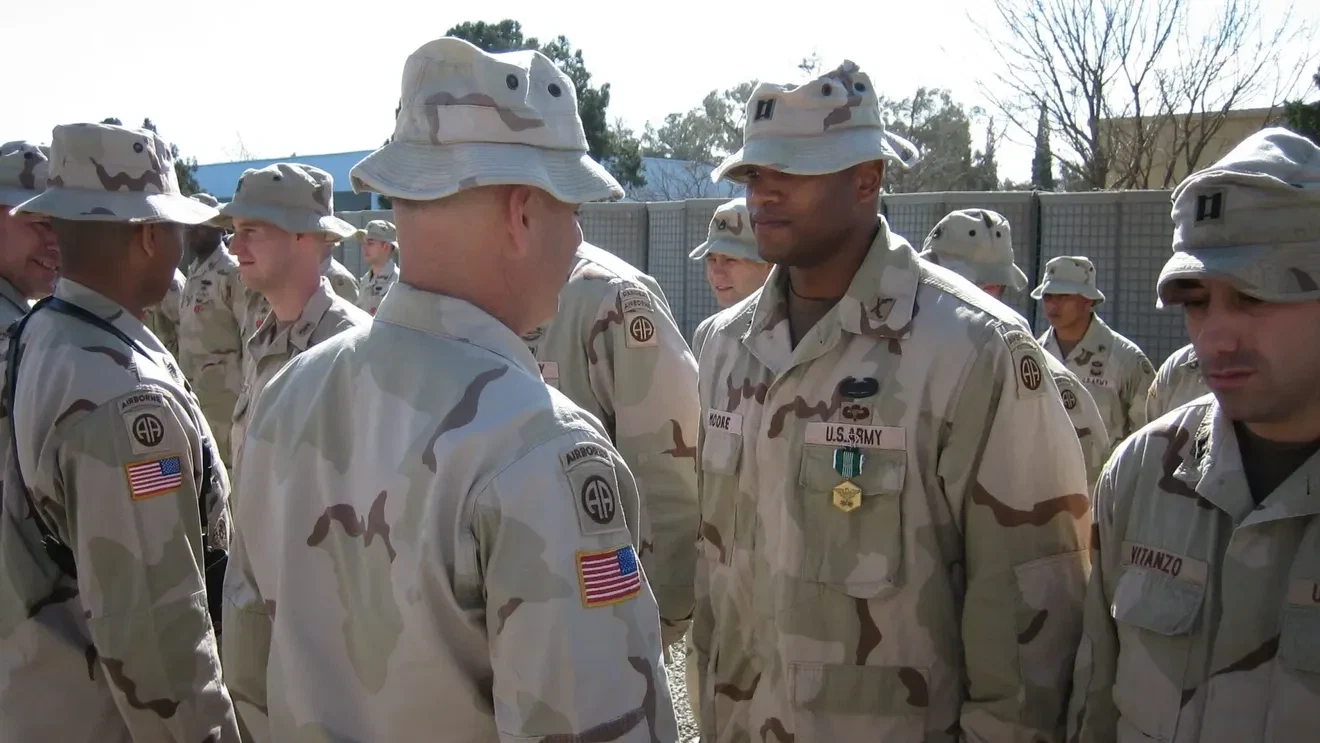
A retired Army general who held final approval authority for Bronze Star medals in Wes Moore’s Afghanistan chain of command says he signed Moore’s 2024 retroactive award recommendation after being assured that Moore’s former brigade commander supported it and would sign next.
That promised endorsement never came.
The Army’s own rules for retroactive awards required the endorsements and signatures of Moore’s full wartime chain of command — a prerequisite that should have prevented the recommendation from moving forward without the brigade commander’s endorsement. The Army approved the Bronze Star anyway.
The missing signature, together with evidence of high-level political help and an award justification contradicted by the facts, raises serious questions about the legitimacy of Moore’s Bronze Star. This includes whether political influence from the White House helped push it through the Army and whether false information was used to influence federal officials.
The key document is the DA Form 638, the Army’s formal recommendation for the award used for Moore’s retroactive Bronze Star in 2024. The Army released it just days after Spotlight sued in federal court in Washington, D.C., seeking records the Army had withheld for nearly a year.
Spotlight first requested the form in October 2025. The Army omitted it from previous document releases even though the form’s own Privacy Act Statement says it’s releasable to the news media under the Freedom of Information Act.
Upon Spotlight’s review of the document, a problem became immediately clear: retired Lt. Gen. Patrick J. Donahue, Moore’s brigade commander in Afghanistan, as a colonel, had never endorsed the reconstructed award recommendation used to secure the medal for Moore nearly two decades later. His name, rank and command position were typed into the form. No recommendation box was checked. His signature was missing.
The general who did sign did so conditionally. Retired Maj. Gen. Jason K. Kamiya, who commanded Combined Joint Task Force 76 during the 2005-2006 deployment and was the wartime approving authority for Bronze Star recommendations from Moore’s brigade, told Spotlight that his participation in the retroactive award process was requested by Lt. Gen. Michael R. Fenzel, Moore’s longtime friend and military mentor.
Fenzel served as a groomsman in Moore’s wedding and recruited him to deploy to Afghanistan to strengthen his resume for a possible political career, according to statements he made to The Baltimore Sun in 2006. According to text messages Spotlight obtained through a public records request, Fenzel was actively coordinating support for Moore’s award with senior Army leaders.

Page two of the recommendation for Wes Moore’s 2024 Bronze Star shows that a key commander, Lt. Gen. Patrick J. Donahue, did not sign. Donahue was the combat leader in 2006 who gave Moore an Army Commendation Medal, not a Bronze Star.

Newly obtained U.S. Army records show the recommendation for Wes Moore’s Bronze Star Award in 2024. (Handout)
Kamiya’s conditions for approval
In two statements emailed to Spotlight, Kamiya described the conditions under which he signed, without Donahue signing before him.
Kamiya said Fenzel approached him in the fall of 2024 seeking support to resubmit what he described as a lost but approved Bronze Star recommendation for one of his officers from their Afghanistan deployment, which wasn’t true. Fenzel confirmed to him that Donahue supported the action. Donahue’s endorsement was critical to Kamiya, who commanded roughly 20,000 U.S. troops, because, as he pointed out in an email to Spotlight, he has never met Moore, nor did he personally know of his service in Afghanistan.
Kamiya said he later received the award paperwork from the Department of the Army. Donahue had not signed it. Kamiya understood from Fenzel that the brigade commander’s signature was missing because of his availability and that it would soon follow, completing the recommendation. Kamiya signed and returned the form.
Kamiya identified three conditions underlying his approval: He had no reason to question the legitimacy of Fenzel’s request; he understood it to be the resubmission of a similar approved recommendation that had been lost; and Donahue’s support had been confirmed, and his signature was forthcoming.
“There would not have been justification to approve the recommendation in the absence of any one of these conditions,” Kamiya wrote.
None of Kamiya’s conditions were met. Donahue never signed, and there’s no evidence that an approved Bronze Star recommendation for Moore was lost in 2006. Therefore, the request was illegitimate.
Donahue’s missing signature matters because Army rules for an award submitted long after the normal deadline require the original chain of command to review and endorse it. In the ordinary sequence, the brigade commander’s recommendation would appear on the form before it reached the wartime approving authority.
Donahue was alive, available and living in northern Virginia in 2024. Yet his endorsement is missing and there’s nothing in the record that explains why, which is required under the Army’s retroactive awards rules when a wartime commander’s support isn’t recorded on the DA Form 638.
Donahue told Spotlight in a November 2025 email that he did not recommend Moore for a Bronze Star in Afghanistan in 2006 but said that he believed Moore performed in a manner that “would have” warranted one.
That retrospective opinion is not the same as an endorsement for Moore in either 2006 or 2024. Under Army awards regulations, retroactive awards cannot be manufactured from a commander’s modern-day recollection; they require proof of a signed recommendation actively initiated within two years of the achievements being recognized. Donahue’s “would have” language appears to confirm the evidence showing he presented Moore with the Army Commendation Medal as his end-of-deployment award, and not the Bronze Star that Moore and Fenzel claim was approved.
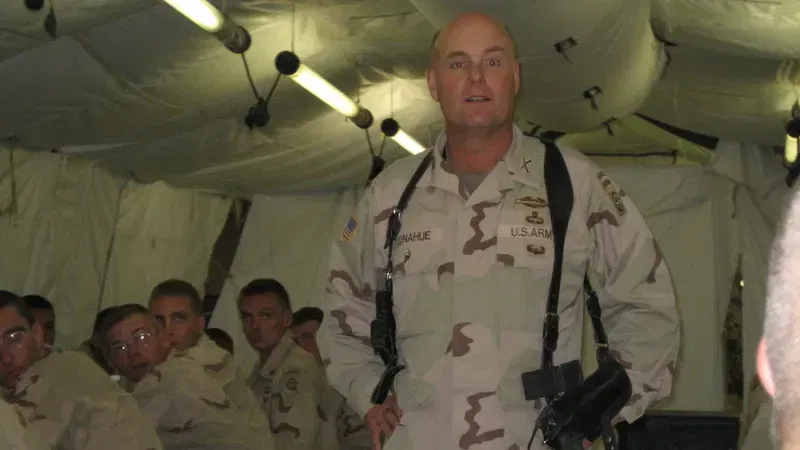
Then-Col. Patrick J. Donahue was the brigade commander who presented Wes Moore with an Army Commendation Medal, or ARCOM, on March 1, 2006. Donahue did not give Moore a Bronze Star, one of Moore’s superior officers said. (James Gottschling/Submitted)
The award Moore received in 2006
The photograph, taken March 1, 2006, shortly before Moore left Afghanistan, shows Donahue presenting him with an Army Commendation Medal, or ARCOM. It was provided to Spotlight by Moore’s immediate supervisor in Afghanistan, retired Lt. Col. James “Jamie” Gottschling.
Gottschling said the ARCOM — not the Bronze Star — was Moore’s intended end-of-tour award. He said it was the appropriate recognition for Moore, a junior officer who served about half of the brigade’s 12-month deployment coordinating information operations while working in an office on Forward Operating Base Salerno.
Moore himself later acknowledged that he did not receive the Bronze Star in Afghanistan. “Towards the end of my deployment, I was disappointed to learn that I hadn’t received the Bronze Star,” he said in an Aug. 29, 2024, press release posted to a state website in response to a New York Times article.
Under Army Human Resources Command rules, Moore’s 2006 Army Commendation Medal should have changed the nature of his 2024 Bronze Star request. If the ARCOM paperwork was missing from his personnel file, the Army first should have determined what happened to that award. Only after resolving the ARCOM’s existence could the Army consider whether Moore had grounds to seek an upgrade to the Bronze Star—which would have required justification for overturning his brigade commander’s original decision to award the lower decoration.
Army officials were intentionally not told of Moore’s ARCOM, as neither Moore nor Fenzel disclosed it, thereby circumventing the Army’s rules on retroactive awards. Instead, the story officials were told to justify the Bronze Star was built on numerous falsehoods.
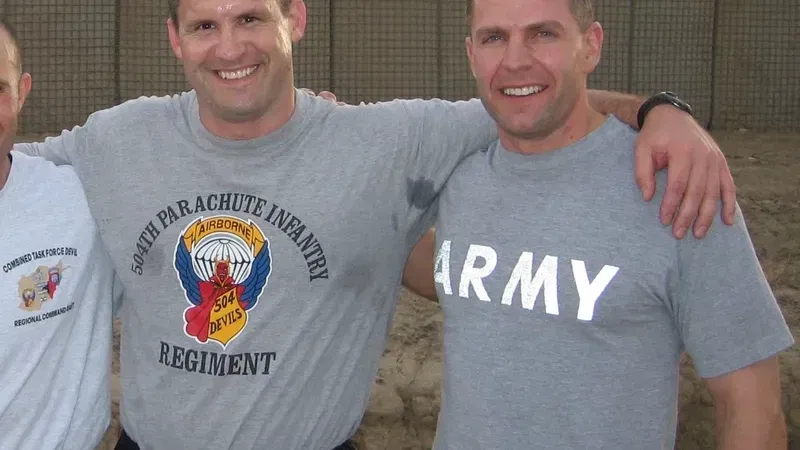
Retired Army Lt. Gen. Michael R. Fenzel, left, and retired Army Lt. Col. James “Jamie” Gottschling, right, are shown after physical training during their deployment to Afghanistan. (Submitted by James Gottschling)
A false narrative spun to federal officials
The story used to obtain Moore’s Bronze Star in 2024 rested on the claim that his Afghanistan chain of command had recommended and approved the medal in 2006, but the paperwork was lost before the award was presented and entered into his records. The evidence contradicts that story.
Moore’s and Fenzel’s coordinated effort followed an August 2024 report in The New York Times revealing that Moore had listed the Bronze Star on his 2006 White House Fellowship application even though he had not received it. Fenzel said he had told Moore to include the medal because it had been approved and would be processed. It was not submitted or approved. Securing the award retroactively would resolve Moore’s political problem going forward, but it could not make the statement on his 2006 federal application accurate when he submitted it.
Moore called the false Bronze Star claim on his résumé an “honest mistake” made on Fenzel’s advice. But an honest mistake is an unintentional error made without trying to mislead or gain an unfair advantage. Moore has acknowledged that he knew before leaving Afghanistan that he had not received the Bronze Star, yet listed the medal on his White House Fellows résumé. It enhanced his military credentials in a highly competitive federal selection process, and there’s no record that Moore rectified the matter with the officials who selected him for the fellowship. The false claim was never corrected and only addressed by Moore when it became public nearly two decades later.
Sen. Laphonza Butler, a California Democrat, repeated Moore’s and Fenzel’s false account in a Nov. 12, 2024 letter to then-Army Secretary Christine Wormuth, requesting the Bronze Star for Moore.
“CPT (R) Moore was recommended and approved for a Bronze Star Medal in May 2006 due to his exemplary service and performance,” Butler wrote. “However, the award was neither processed nor was it filed into his official Army records.”
The “(R)” designation means retired, although Moore did not earn retired officer status, another false claim. More importantly, Butler’s claim that a Bronze Star had been approved in 2006 is unsupported by the facts.
No authenticated 2006 DA Form 638 recommending Moore for the Bronze Star has been produced by the Army, Moore or Fenzel. Neither has a permanent order, approved citation, transmittal record or other historical Army document showing the award was approved and then lost.
The surviving evidence shows Moore receiving the Army Commendation Medal.
Butler’s letter made a second sweeping declaration that, “The leaders of the Combined Joint Task Force and approving authority who witnessed the distinguished service of CPT (R) Moore all agreed that the award was well deserved and, once again, recommended approval.”
That assertion is impossible to reconcile with the available records. The evidence shows that Donahue and Kamiya did not approve a Bronze Star for Moore in 2006. In 2024, Donahue never endorsed or signed the retroactive Bronze Star Medal paperwork, and Kamiya’s signature, as the wartime approving authority, rested on conditions that were not met, including Donahue’s endorsement and signature, which never came.
Butler had no first-hand knowledge of Moore’s Afghanistan service, so someone had to supply the detailed account she presented as fact. The available evidence points to Moore and Fenzel, who were working together to secure the award. Both men have repeatedly refused to answer questions about what information they gave Butler, and they have not responded to multiple opportunities Spotlight has given them to refute its reporting.
Butler has also declined repeated requests to identify her source or explain what her office did to verify the claims. Spotlight went to her Washington, D.C., office seeking to speak with her directly, but she declined to meet.
The political route to activate the award process was unusual. Moore, as Maryland’s governor, did not seek the required congressional sponsorship from a member of Maryland’s delegation, and has not explained why. Instead, according to a person with knowledge of the effort, Moore sought help through then-Vice President Kamala Harris’s office, which connected him with Butler, a close Harris political ally from California.
As Moore worked to gain political support for the medal, Fenzel used his position as a high-ranking general to influence the Army. Fenzel contacted the Army secretary’s office to get the process moving, then sought Kamiya’s endorsement and approval.
Like Sen. Butler, Army officials were told the same false story. Records reviewed by Spotlight also do not show that the Army understood that Kamiya considered Donahue’s support and signature as essential conditions to gain his approval.
Five working days after Butler sent her letter to the Army secretary requesting the Bronze Star for Moore, the Army approved the medal. Fenzel pinned it on Moore a month later during a private ceremony at the governor’s residence in Annapolis.
The extraordinary speed of that decision, during the closing weeks of the Biden-Harris administration, and after assistance from within the vice president’s political orbit, raises a question the Army has not answered: Did political influence help an award recommendation based on falsehoods –– that was also lacking the support of the entire original chain of command –– deviate from the established legal and regulatory retroactive awards process?
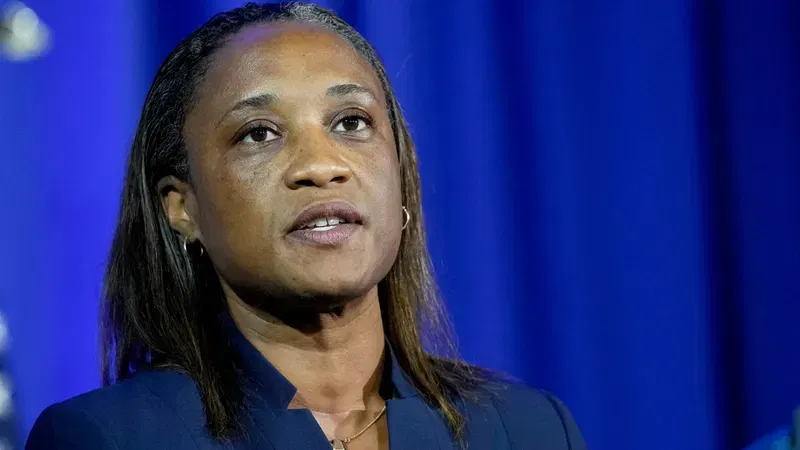
Former U.S. Sen. Laphonza Butler, a California Democrat, urged the Army in November 2024 to award Maryland Gov. Wes Moore a Bronze Star for his service in Afghanistan. (AP FILE)
Conflicting accounts of a supposed 2006 approval
Fenzel has also given two different public accounts of the alleged 2006 approval to help justify Moore’s award.
In 2024, he told The New York Times that in 2006, he had seen Moore’s approved Bronze Star recommendation signed by all of the appropriate officers, but that it was somehow not processed. In a later account for author Rye Barcott’s 2026 book, “Courage Can Save Us,” Fenzel described having personally received a verbal confirmation, in what military jargon is called a “VOCO,” that Moore’s Bronze Star had been approved.
Neither account is true. One depends on the existence of a fully signed DA Form 638 that would be refuted by the ARCOM Moore actually received. The other relies on a verbal assurance, which by itself does not create a lawful military decoration. According to Army regulations, a military decoration is only approved for a soldier when published permanent orders are in hand and a copy is placed in their official military personnel file.
Text messages between Fenzel and Moore obtained by Spotlight through a Maryland Public Information Act request show that when the controversy became public, Fenzel and Moore were actively working together to develop the Army paperwork needed to pursue the retroactive award.
Fenzel asked Moore, “Do you have a copy of the recommendation [for the retroactive Bronze Star]?” indicating that Moore may have provided the narrative achievements for his own award.
Fenzel further asked, “What date did you redeploy from Afghanistan to the U.S.?” showing that Moore also likely provided his own deployment dates for the paperwork.
Fenzel later publicly acknowledged that with this information, the paperwork was created “anew” for the retroactive Bronze Star.
The reconstructed DA Form 638 contained fabrications. It included using an award timeframe 75 days longer than Moore’s documented Afghanistan service –– and incorrectly identifying him as a retired Army officer. Moore’s supervisor, Gottschling, also said the citation credited Moore with work that Gottschling, himself, had performed or was responsible for.
The Army approved the Bronze Star despite those problems and apparently without reconciling it with Moore’s Army Commendation Medal for the same deployment. Army regulations provide that only one decoration may be awarded for the same act, achievement or period of meritorious service.
If a completed and fully approved Bronze Star recommendation existed in 2006, neither the Army nor Moore’s advocates have produced it or explained why the 2024 process required newly reconstructed paperwork containing significant inaccuracies. It also remains unclear whether Army officials determined that the retroactive Bronze Star did not duplicate Moore’s existing ARCOM before approving it — or whether political influence helped the recommendation move forward despite those unresolved issues.
Spotlight’s lawsuit against the Army remains ongoing as it seeks additional records that could shed additional light on whether political influence, fraud or both resulted in Moore receiving the Bronze Star in 2024.

Lt. Gen. Michael Fenzel, United States Security Coordinator of the Israel and Palestinian Authority, right, pins the Bronze Star on Maryland Gov. Wes Moore. MUST CREDIT: Marvin Joseph/The Washington Post
Questions of possible federal misconduct
The evidence appears to raise the question of whether a crime was committed by Moore and Fenzel. Was materially false information knowingly provided to federal officials, or used in any way, to obtain a military decoration for the purposes of eliminating the problem Moore created for himself by lying about it for 18 years?
Title 18 of the U.S. Code, Section 1001 and Article 107 of the Uniform Code of Military Justice both prohibit knowingly and willfully making materially false statements, concealing material facts or using false documents to inappropriately influence federal officials. Federal conspiracy laws can also apply when two or more people agree to defraud the United States and take action to advance that effort.
In 2017, former Army captain Darryl Lee Wright was convicted and sentenced to three years in federal prison for fraudulently manipulating the Army’s retroactive awards process to obtain military decorations he didn’t earn to qualify for VA benefits he wasn’t entitled to. In a press release, the U.S. Attorney who prosecuted the case, Annette L. Hayes, said, “This defendant brazenly lied about his combat history to get more than $600,000 in benefits he did not deserve.”
The chain of events in Moore’s case appears to indicate he and Fenzel, still on active duty at the time, similarly manipulated the Army’s awards process with the alleged benefit to Moore being the protection of his political career, through the elimination of the integrity crisis he created by being untruthful about the Bronze Star for nearly two decades.
Spotlight previously reported that it has obtained a Department of War document indicating that a “law enforcement inquiry” involving Moore’s 2024 Bronze Star is underway. Federal investigators will have to determine if the law was violated to obtain the medal and, if so, whether a federal grand jury should be empaneled to hear the circumstances and consider a possible indictment of Moore and Fenzel.
The officer who knows the most about 2006
Gottschling, the retired lieutenant colonel and Moore’s direct supervisor in Afghanistan, is the leader most familiar with his service while deployed. Last week, Spotlight conducted a second interview with the Ranger-qualified artillery officer, who confirmed he was not consulted in the 2024 retroactive Bronze Star process, but added that he would not have concurred with the decision to present that award to Moore.
In that interview, which will be covered in Spotlight on Maryland’s future reporting, Gottschling will discuss Moore’s service in Afghanistan in greater detail, including his claims of having experienced direct-fire combat and personal tragedies on the battlefield. Gottschling will elaborate on Moore’s statements and explain why he believes Moore has a character problem related to his military service.
Drew Sullins can be reached at dpsullins@sbgtv.com. Spotlight on Maryland is a joint venture by FOX45 News, The Baltimore Sun and WJLA in Washington, D.C. Send story tips to spotlightonmaryland@sbgtv.com or call our hotline at (410) 467-4670. Follow us on X at @SpotlightMDNews, and on Instagram and Facebook at Spotlight on Maryland.
This post was originally published on Fox 45 by Sinclair Media Group.
 Local Story