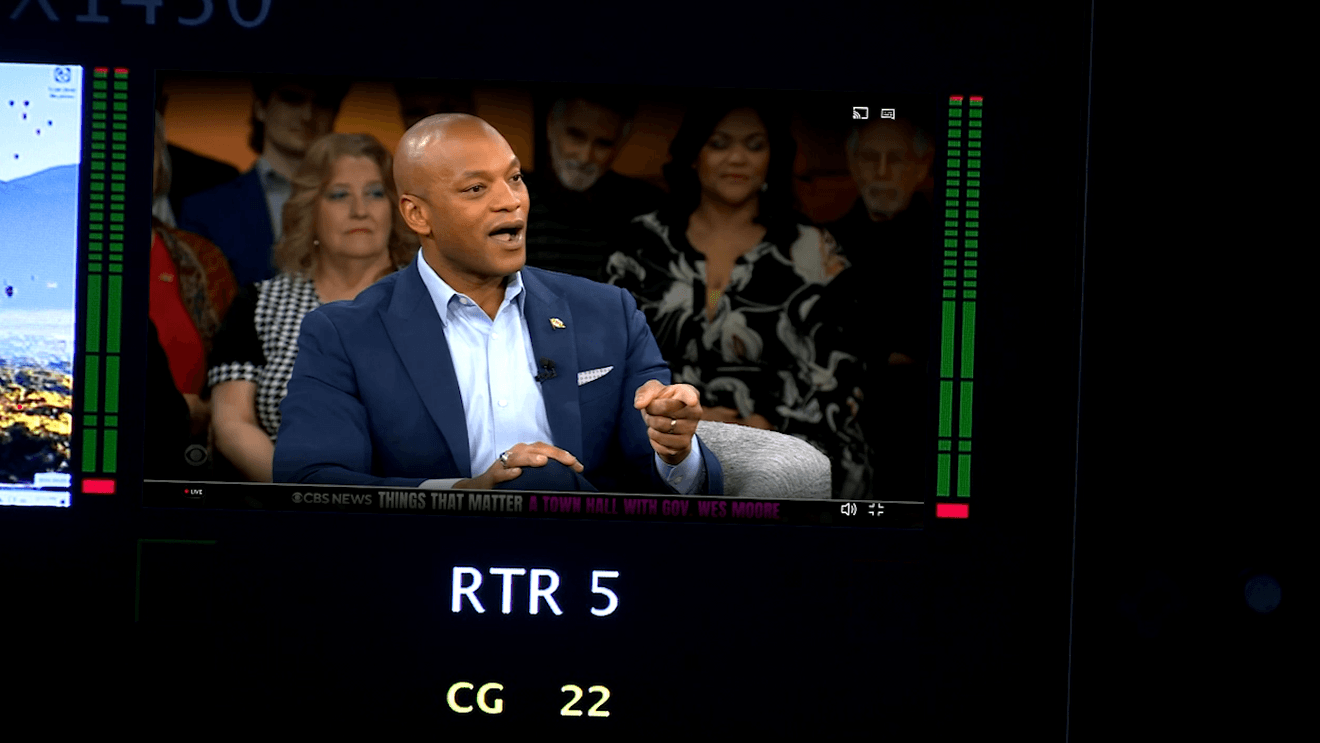
ANNAPOLIS, Md. (WBFF) — Maryland Gov. Wes Moore has maintained for months that he’s not jumping into the 2028 presidential race, but recent activities suggest there’s an inkling of interest as some question whether he would be able to garner enough support to be successful.
Moore, a Democrat in his first term as governor and seeking a second, has been making appearances in key states and on national television that have drawn attention amid speculation about his political ambitions.
He’s scheduled to deliver commencement addresses at Frostburg State University in Maryland, Johnson C. Smith University, a Historically Black College in North Carolina, and his alma mater, Valley Forge Military Academy in Pennsylvania. Notably, the latter two institutions are in presidential swing states.
Over the weekend, Gov. Moore participated in a march across the Edmund Pettus Bridge in Selma, Alabama, commemorating the 61st anniversary of Bloody Sunday. While in Alabama, he delivered a keynote address at the historic Tabernacle Baptist Church and spoke at other events.
“We are watching reckless attempts to claw back the progress that Selma’s Foot Soldier’s bled for. But anyone who thinks we will roll over is gravely mistaken,” Moore said in a statement released by his campaign.
Political analyst John Dedie noted that Moore seems to be balancing his role as Maryland’s governor with a desire to engage in the national political conversation.
“He’s trying to have it both ways,” Dedie said.
Despite his repeated denials of presidential ambitions – at least for 2028 – he remains in the mix of possible candidates for the Democratic nomination. A recent Daily Mail poll of potential Democratic contenders in 2028 had the former Vice President Kamala Harris at the top and California Gov. Gavin Newsom in second. Moore was in last, behind other possible candidates like Pete Buttigieg, U.S. Rep. Alexandria Ocasio-Cortez, Arizona Sen. Mark Kelly, New Jersey Sen. Cory Booker, and Pennsylvania Gov. Josh Shapiro.
“When it comes down to deciding on Wes Moore, he may win the argument of charisma, style, etc.,” Dedie said. “But at the same time, people are still going to want to see the receipts.”
Dedie noted Moore had some wins in his legislative career, especially during his first two years. But fractures started to emerge last year when Gov. Moore vetoed a slew of bills, including a reparations study. In December, the Democrats in control of the General Assembly, voted to override 19 of those vetoes.
“When you had all those overrides, those 19 veto overrides, that was a big message they were sending the governor like, hey, ‘pay attention to me’,” Dedie added.
This year, that divide among some Democrats was on full display as Gov. Moore pushed for Maryland to jump into the mid-cycle redistricting effort. He launched a redistricting commission that included Republican Cumberland Mayor Ray Morriss; the other members were Democrats, and Gov. Moore touted the commission as bipartisan.
In a letter to his caucus, that eventually got leaked, Senate President Bill Ferguson said he did not believe it was a good idea for Maryland to get involved in mid-cycle redistricting, citing legal and political risks; the decision came as other states – including California – got involved and redrew congressional boundaries.
Several meetings were held by the redistricting commission, albeit virtually – much to Ferguson’s dismay – and there were at times a majority of people opposed to the redistricting effort. There were, however, several people who did support Gov. Moore’s effort.
Ultimately, the commission voted to move forward with the plan, drafted a map, and the House of Delegates approved it. The effort remains stalled in the Senate.
“For the umpteenth time, in the Senate, we generally do not bring things to the floor that don’t have the votes to pass,” Senate President Ferguson said to reporters in late February.
While leadership in Annapolis has agreed that tax increases aren’t on the table this year – notably an election year – it’s possible hikes will resurface in 2027. If he wins a second term, which appears likely at this early stage, Gov. Moore and lawmakers will face a structural deficit problem. Imposing more taxes on Marylanders could come with consequences at the ballot box, even beyond the borders of Maryland, according to Dedie.
“You put a tax increase on people in 2027, you’re going to get whacked over the head like a pinata on a debate stage,” Dedie said. “Because other governors, they’re going to be saying, ‘well, we never raised taxes and you did this, this, and this. And Trump did bad stuff to us too; we managed to balance our budgets without balancing on the backs of our people’.”
While there may be some tension among Democrats and Gov. Moore, at least on the Senate side of the State House, Speaker Joseline Pena-Melnyk quashed any idea of tension with her.
“I have an excellent relationship with him; I don’t have any issues with him or the senate president,” she told FOX45 News Tuesday. “I don’t have any issues, he had his bills in the House, he received a hearing. He was treated with a lot of respect. There’s no tension here.”
Follow Political Reporter Mikenzie Frost on X and Facebook. Send tips to mbfrost@sbgtv.com.

 Local Story