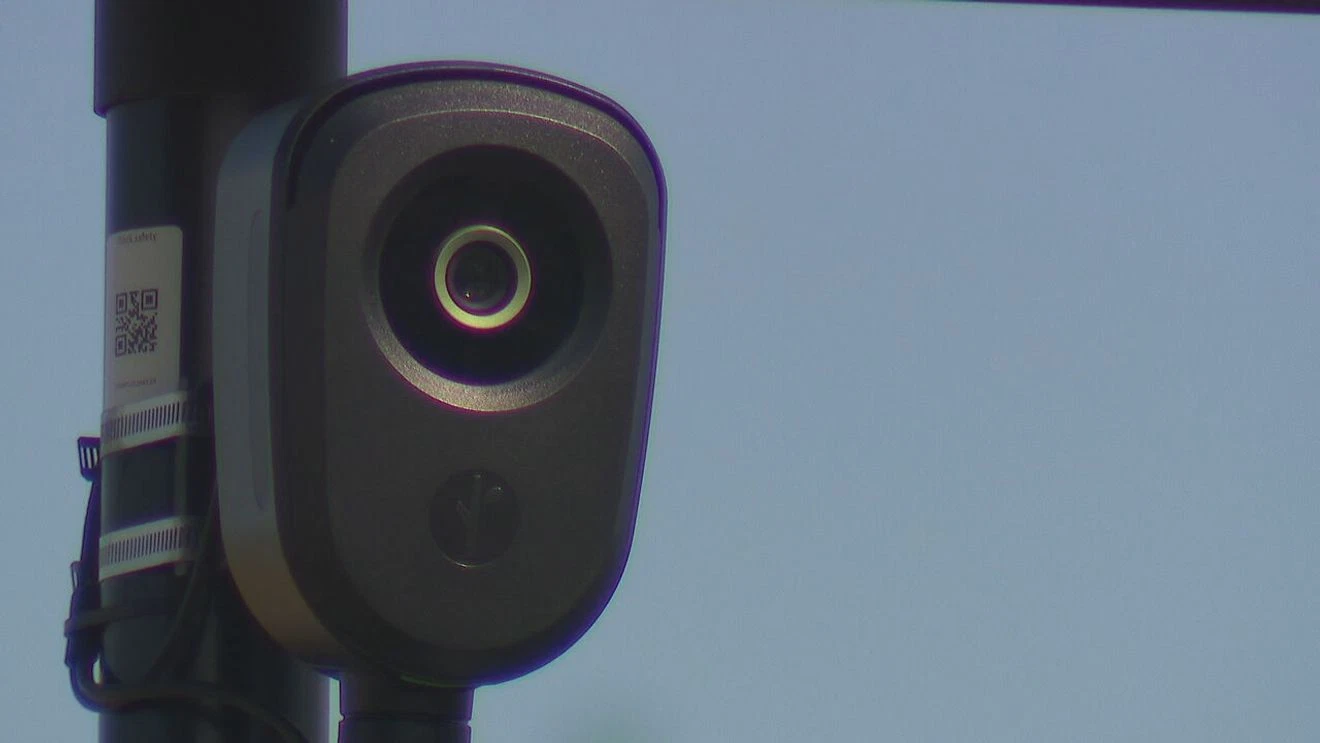
BALTIMORE (WBFF) — You’ve likely driven right past them. Small cameras perched above busy parking lots, potentially, capturing the license plate of every car that passes by. FOX45 News found what appears to be a Flock camera outside of a Home Depot in southeast Baltimore and asked drivers for their take on the controversial technology.
“I didn’t know they were there. They also don’t bother me,” one driver said.
“It’s actually kind of interesting, but at the same time, it’s really weird,” another person said.
ALSO READ | A website can tell you if Flock has searched for your license plate in their database
They’re known as automatic license plate readers, or ALPRs. Unlike a traditional surveillance camera, these can instantly capture information about a passing car, including its license plate, make, model and other identifying characteristics, allowing vehicles to later be searched through a database. Flock Safety cameras are rapidly expanding across the country, marketing the cameras to police departments, businesses and neighborhoods as a tool to help identify stolen vehicles and solve crimes.
“I think it will definitely more helpful as long as it’s used properly,” another driver said.
‘Used properly’ being the key. As Flock’s network grows, so do questions over who can search it, what they’re searching for, and why.
“I don’t like that. I think it’s invasion of privacy. I don’t think it’s going to protect us,” a driver said.
Another said, “I’m in the middle with it because they’re also helping with crime. But at the same time, if you’re not using it for the right things and why have it at all?”
The system has come under fire recently, with several police officers accused of using it to track wives, ex-girlfriends, and for other personal use. While Flock has recently responded by implementing a slew of new security features, some still take issue with the cameras ability to capture everyone, not just suspects.
Amid the growing scrutiny, a nonprofit has now launched HaveIBeenFlocked.com, a website that allows drivers to enter a license plate to determine whether it appears in Flock search logs the organization has obtained. However, it’s important to keep in mind that a plate returning no results does not necessarily mean it has never been searched.
As for how many Flock cameras have made their way Baltimore, it’s hard to say.
The Baltimore Police Department told FOX45 News it does not use Flock cameras and does not have access to Flock’s system.
However, the BPD has been using similar license plate-reading technology for years. City procurement records show BPD uses Leonardo’s ELSAG automated license plate reader technology.
Like Flock, Leonardo’s system allows police to automatically scan license plates and compare them against databases to identify vehicles of interest. The BPD operates both fixed and mobile license plate readers, including equipment that can be mounted on police vehicles.
Department policy implements strict guidelines for how officers can use the system, and Maryland requires annual audits of law enforcement ALPR programs.
Those audits reveal the enormous scale of the data being collected. According to the latest audit, at least 857 license plate readers were operated by law enforcement agencies across the state in 2024. Together, they logged more than one billion plate reads in a single year.
Baltimore accounted for 271,576,177 of them — roughly 27% of every plate read reported statewide.
While the technology can be a valuable tool for police, its widespread use continues to raise questions about where public safety ends and privacy begins.
 Local Story