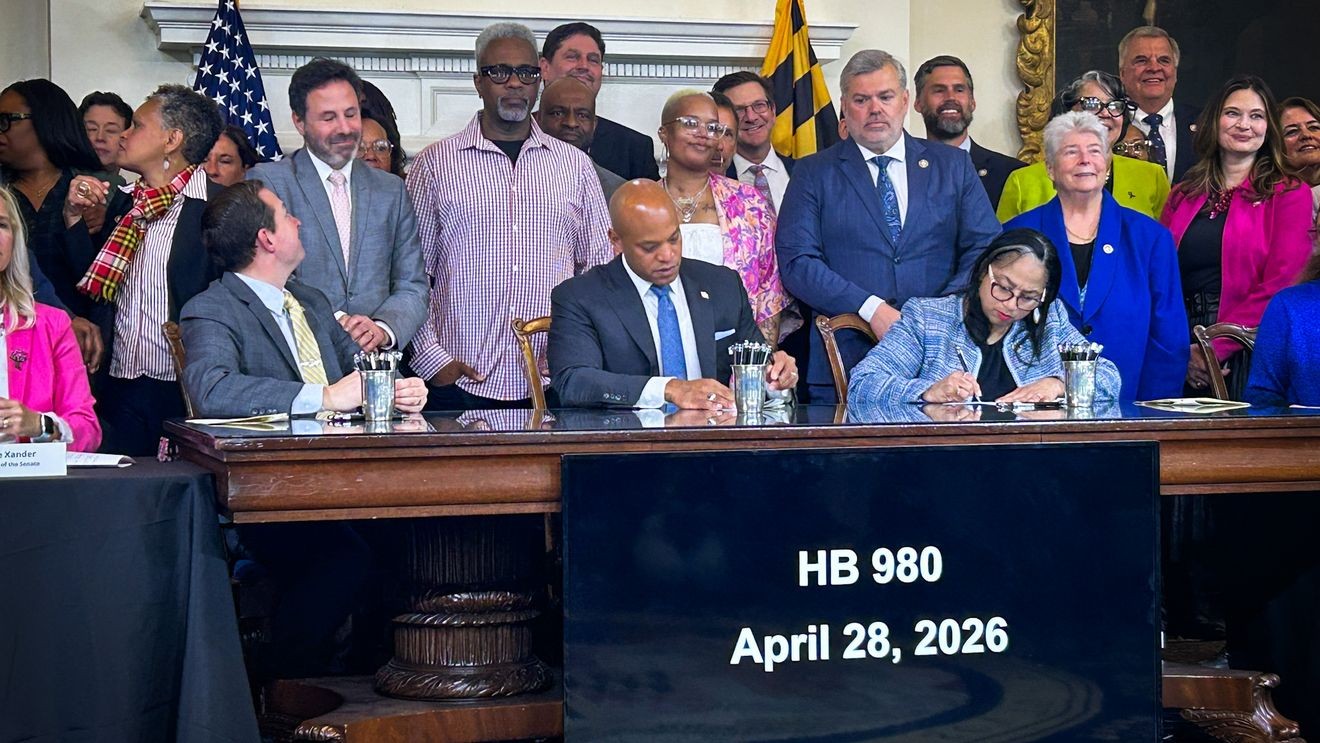
ANNAPOLIS, Md. (WBFF) — With the family of a foster care child who died while under the state’s supervision looking on, Gov. Wes Moore signed several bills aimed at strengthening protections for Maryland’s foster care children into law Tuesday morning.
Kanaiyah’s Law, named after 16-year-old Kanaiyah Ward who took her own life in a Baltimore City hotel in September 2025, creates a state foster care ombudsman and ties funding for guardianship assistance to criminal background checks.
“Every child in our care deserves the same standard of care that any one of us would expect and hope for for our own children,” Gov. Moore said. “Brooke, because of your courage, because of your strength, because of your ability to turn pain into purpose, we are here today.”
The first ceremonial pen used to sign the legislation into law was given to Brooke Ward, Kanaiyah’s mother, who sat in the front row of the bill singing ceremony along with the teen’s grandfather.
The legislation was championed by Del. Mike Griffith, R-Cecil and Harford Counties. Griffith’s legislation originally banned hotel placements, and other unlicensed placement settings. However, that language was removed from the bill and included in a bill sponsored by House Speaker Joseline Pena-Melnyk and Griffith was a co-sponsor. Gov. Moore also signed the unlicensed settings ban legislation into law Tuesday.
“Never again will our foster care kids find themselves in unsupervised settings like hotel rooms or shelters,” Speaker Joseline Pena-Melnyk said.
“This bill gives the state the tool sand oversight to make sure that all children are in the most appropriate setting,” Gov. Moore added.
When lawmakers passed the bill on the final day of the 2026 legislative session, Griffith told FOX45 News that he hopes the legislation signals to the Ward family that their child didn’t die in vain.
“I think it’s important and it’s not to be lost that we got to make sure we acknowledge Kanaiyah Ward, the Ward Family, what they went through and the fact that we’re honoring them,” Griffith said Monday after the Senate passed the bill. “As tragic as her death was, it’s not in vain. We’re going to do some really good work and we’re going to make sure this never happens again.”
Ward had documented struggles with mental health. She was placed in a Baltimore City hotel, and while awaiting another placement, ended up taking her own life in September 2025.
The ombudsman must be an attorney and would be responsible for providing expertise in child welfare, custody and guardianship issues, appeals and due process issues, as well as investigate complaints youth in out-of-home placements, and advocate for out-of-home care foster care children.
“There’s a lot of people who say Republicans can’t get things done in Annapolis,” Griffith said. “We’ve heard a lot of that rhetoric this year. This shows that’s not the case.”
On Oct. 22, DHS announced a major policy shift: the end of hotel placements for foster care children in Maryland with a deadline of November 24 for moving children into “more appropriate” placements.
The agency’s handling of Ward’s case and the broader issue of hotel placements for foster children have drawn criticism and led to calls for reform. Del. Mike Griffith, R-Cecil and Harford Counties, announced plans to introduce legislation in the fall of 2025 named after Ward that called for the end of hotel placements, along with other unlicensed settings, including homeless shelters.
After he announced his intent to introduce Kanaiyah’s Law during the 2026 legislative session, DHS announced the hotel placement ban. Griffith said he believes his legislation pushed the agency to ban the practice.
“It shouldn’t have taken that for DHS and the people within DHS to identify that these practices shouldn’t have been happening,” he said during an interview with FOX45 New In Depth with Mikenzie Frost. “With that being said, when we brought this legislation forward conceptually, the folks within DHS came right to the table and worked with us and we’re very eager to help craft this law and solve these issues.”
It shouldn’t have taken a young girl to take her life. But it did, and we met the moment, Del. Griffith said.
The challenges now rest with the agency itself as DHS is without a permanent leader. Lopez resigned earlier this year, citing health concerns. His departure followed months of Republicans calling on Gov. Moore to replace Lopez as the head of DHS.
“A lot of people within the department know there are a lot of eyes on them. That gives me some optimism that this is the turning point,” Griffith added.
In addition to the legislation passed during the 2026 session, Gov. Moore and his administration approved more than $1 billion to be spent over the next five years to help expand foster care placements around Maryland.
“That’s huge investment, a huge commitment,” Griffith said.
While the state may have a $70 billion budget, the delegate said, and argued he doesn’t agree with all of the spending, putting more funding toward foster care children in Maryland is “our responsibility.”
“If we’re going to make a major investment it should be in something that’s actually the state’s responsibility, which is these kids. And that investment, hopefully, will put the unlicensed sitting conversation to bed, no pun intended, once and for all.”
Features of the new foster care reform laws are set to take effect throughout the fall of 2026 and start of 2027.
Follow Political Reporter Mikenzie Frost on X and Facebook. Send tips to mbfrost@sbgtv.com.

 Local Story