Safe Money and Income with Adam Waskey
4:00 am - 5:00 am

Downtown Baltimore is struggling with storefront vacancies, despite a number of recent taxpayer-funded grants.
Downtown entrepreneurs face many challenges, including having to spend hefty amounts of money on building out abandoned spaces and grappling with a lack of foot traffic, parking difficulties and permitting headaches. Several downtown business owners described recently closing their stores or struggling to open, while others that successfully opened say they’re determined to keep moving forward against significant headwinds.
Last year, Deja Richardson opened Neon Paint Place, where customers don hazmat suits with their friends and throw glow-in-the-dark paint at everything in sight. Richardson said she sees around 200 to 400 customers per month, after moving downtown from her old location, which was much smaller and didn’t allow her to host large groups as she can now on Baltimore Street.
“We get lots of tourists, and they’re looking for amazing, unique things to do, so I wanted to bring that to Baltimore City,” she said to Spotlight on Maryland.
But opening downtown wasn’t easy.
“A lot of the spaces are – they’ve been vacant for years, and most of them are super overpriced. I experienced my own challenge with finding a space myself,” she said. “I’m very blessed and lucky I was able to find this location because it already had, like, everything it needed in here for me.”
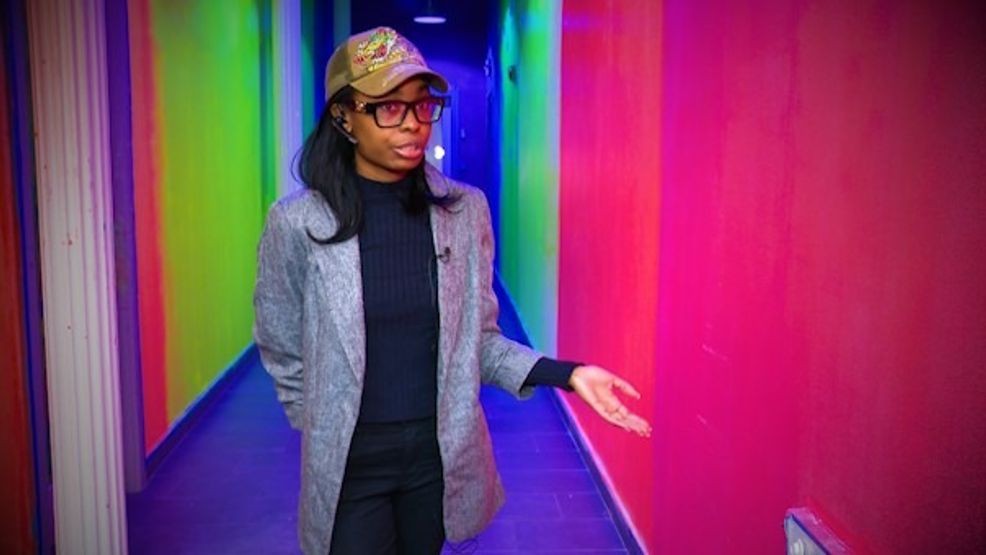
Last year, Deja Richardson opened Neon Paint Place downtown and said she sees around 200 to 400 customers per month.
Richardson said she received help from several public and private grants, including $100,000 from a federally supported program called Black Owned and Operated Storefront Tenancy (BOOST), $90,000 through a state-funded grant called Project Restore and $20,000 through a small business grant from Baltimore Gas and Electric. She used around $20,000 of her own capital to open the shop.
Other BOOST grantees haven’t seen the same success, with some never opening at all and others opening briefly and then closing or moving away, as Spotlight previously reported. It’s part of a broader challenge of filling downtown vacancies acknowledged by City Council Member Zac Blanchard, who represents the area.
“Downtown is everybody’s second most important neighborhood. And if you don’t feel that way, it kind of is a testimony to how big the scale of the challenge in downtown is right now,” Blanchard said. He noted that downtowns are generally where people go for work, restaurants, bars, shows and public transit stops, and that Baltimore’s downtown includes major family event institutions like the Maryland Science Center, National Aquarium and Port Discovery Children’s Museum, with its sports stadiums located nearby.
“There’s substantial public and private investment that is going to have to happen if we’re going to save downtown,” Blanchard added.
Blanchard said there needs to be more funding to increase connectivity downtown. The Downtown Partnership of Baltimore currently has an initiative to revitalize Eutaw Street, outside Lexington Market.
“Go to the Lexington Market during lunch any day, and it’s killing it. Like, it’s doing great. Like, that’s exactly what we want,” he said. “But we need the connective tissues, right? Like, it should be natural that people go to Lexington Market before they go to the O’s game. Like, they’re five blocks away from each other.”
Jimmie Thomas also received significant public and private investment to open Media Rhythm Institute on Howard Street, including from BOOST, the Maryland Arts Council, Baltimore Gas and Electric, the Baltimore Office of Promotion and the Arts, and the Baltimore Children and Youth Fund. The Media Rhythm Institute works with youth and local artists in photography, music and other arts. The money helped him get through a difficult first year when he discovered building leaks and a lack of indoor heat and air conditioning.
Thomas said he’s observed open-air drug markets nearby and said government grants can help businesses like his bring life to parts of the city that look “vacated and forgotten and unloved.”
“We are impacting the community in a positive light,” he said. “When you walked up, did you hear that music playing? That changes the energy in this space. You saw the mural outside? It looks like the people walking outside. It changes the energy in downtown Baltimore. So that’s what our goal is, and our goal is to continue to push forward.”
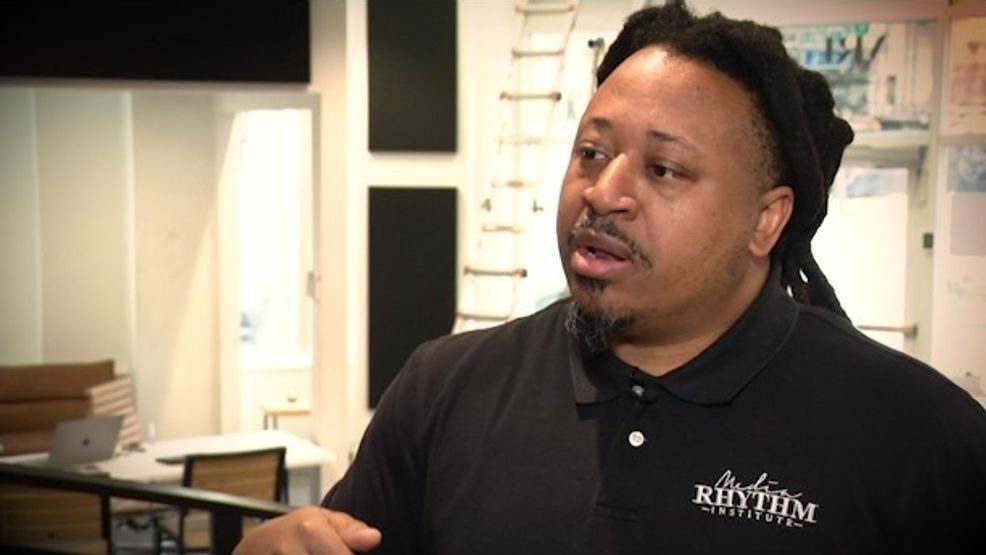
Jimmie Thomas recently opened Media Rhythm Institute downtown and said government grants can help businesses like his bring life to parts of the city that look “vacated and forgotten and unloved.”
Another business owner, Cindy Tawiah, who was selected for a BOOST grant, said she had to turn down the $100,000 in funding because it would have cost three or four times as much to build out the space she’d selected downtown on Lexington Street. Tawiah also said customers at her Baltimore County hair care shop, Diva by Cindy, didn’t want to pay for downtown parking.
The BOOST grants were awarded by the Downtown Partnership of Baltimore, a nonprofit that oversees the city’s central business district.
“Small businesses nationwide are operating in a materially different environment than they were pre-pandemic, with less predictable customer demand driven by shifts in how and where people work,” said DPOB President Shelonda Stokes, in an emailed statement. “Downtown Partnership actively works with City and community partners to help businesses navigate opening and operating in this environment and to address challenges as they arise.”
But the problems with downtown businesses didn’t start during the COVID-19 pandemic, said Mac McComas, senior program manager with the Johns Hopkins 21st Century Cities Initiative.
He said from 2013 to 2019, downtown Baltimore lost 14% of its small businesses as some of the bigger businesses relocated to other parts of the city. Downtown has recovered some since then, but it’s not what it was in the early 2010s.
“There’s this kind of chicken-and-egg issue,” McComas said. “In order for people to move into neighborhoods and want to live there, there has to be kind of a vibrant small business environment. But in order for small businesses to open, they need foot traffic and people living there. And so I think you kind of need to subsidize both.”
One section of downtown that hasn’t improved since COVID is the 400 block of Howard Street. Back in 2021, it was dubbed ‘Healthy Howard Row’ as several business owners started moving in. But during Spotlight’s visit last month, two business owners from that growth phase were the only ones left on the block.
Dwight Campbell said he’s moving his ice cream shop, Cajou Creamery, a few blocks away, where he can get more parking and foot traffic.
Delayna Watkins owns Women’s Wellness Lounge, which provides preventative health, and was packing up her store during Spotlight’s visit to the area. She said she was planning to move one block down the street, combining her business with another shop in hopes of better outcomes.
“Next week, I’m gone,” she said. “I just can’t survive.”
Watkins was awarded a Project Restore grant from the state in 2022, totaling around $15,000, which she said was a huge help. But a decline in business on her block over the past two years became too much to handle.
“The location was perfect, because not only is it community-focused, but we’re also in what we call residential retail, where there are individuals that live above our retail space and location,” she said. “And it’s just been so difficult to really keep the foot traffic, you know, alive.”
Have a news tip? Contact Brooke Conrad at bjconrad@sbgtv.com or 443-578-2126, or contact the Spotlight team at SpotlightOnMaryland@sbgtv.com or 410-467-4670. Spotlight on Maryland is a joint venture by The Baltimore Sun, FOX45 News and WJLA in Washington, D.C.

 Local Story