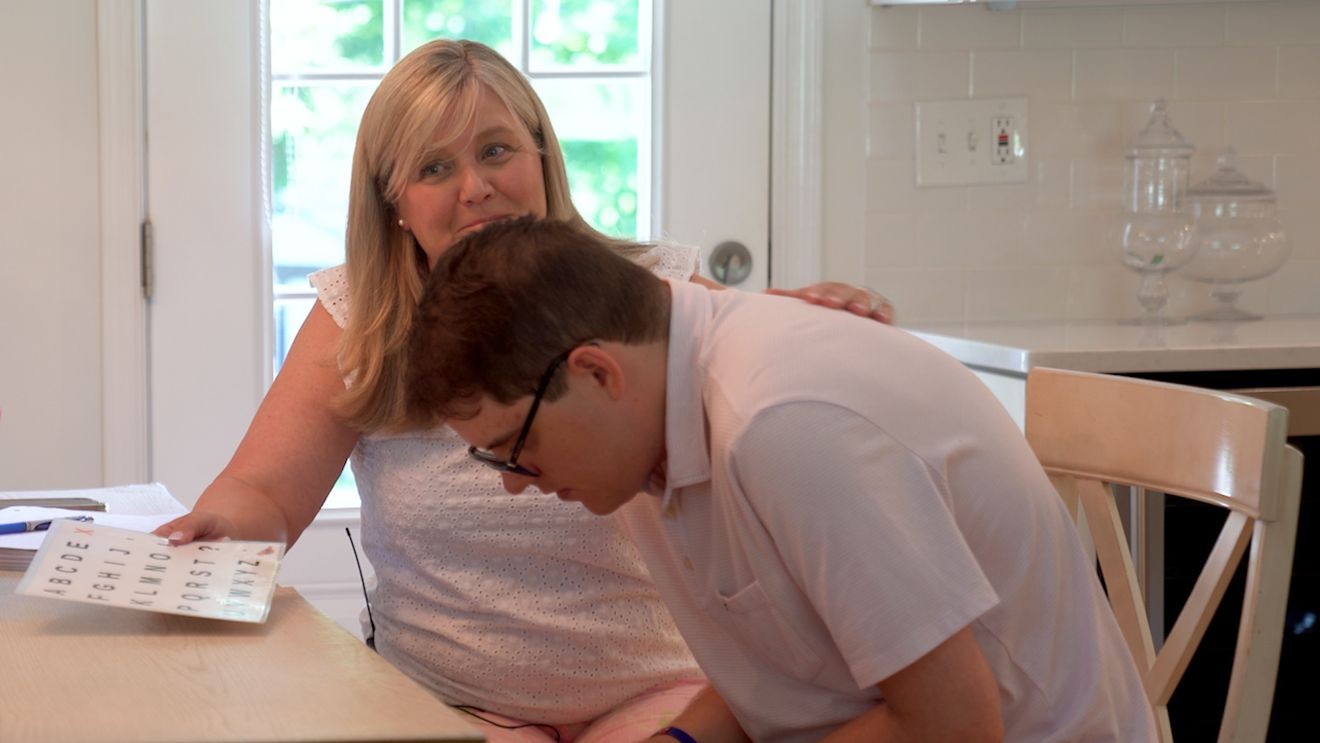
MARYLAND (WBFF) — Connor Feron points to each letter on his spelling board as his mom repeats the letters aloud.
“They jeopardize our health and safety with no accountability or consequences,” he spells in response to a question about state budget cuts for people with disabilities.
Feron, a 30-year-old Lutherville resident, struggles to verbally articulate his thoughts due to autism and other medical conditions, but can communicate them through assisted spelling — a new skill he and his caretakers have been developing over the past two years.
His mom, Tracie Feron, hopes he’ll someday be able to independently type on a keyboard.
Connor is among many who are frustrated by this year’s proposed funding cuts for Marylanders with disabilities. The cuts were scheduled to take effect on July 1, but at 5:31 p.m. the day before, participants were suddenly notified of a delay. The pay cuts are now slated for October.
“I’m frustrated,” said Tracie, a self-employed special education consultant. “I am a professional in this field, and I feel like I’m incredibly knowledgeable — until I’m not … The constant pivoting and the changes are impossible to keep up with.”
‘Catastrophic’ budget cuts
One of Connor’s state-funded staff members left last year due to prior budget cuts, and Tracie is concerned another staff member – the only other person currently trained to help him with his spelling — will leave soon too.
“I’m most fearful about the continuation of lowering the wages and basically hollowing out the self-direction program,” Tracie said.
Self-Directed Services, in which the state pays staff, including family members, to care for Connor at home, led him to the spelling training that helped him find his voice, Tracie said. But last week, she said she received an email notifying her that his self-directed plan may not be approved in the future.
Specifically, Tracie was told that Connor’s request for assistive technology — the category of services under which his spelling training falls — was “not supported.”
In the past, the DDA has reimbursed Connor’s family $6,500 a year for the weekly training in Virginia, Tracie said. She added that the DDA stopped reimbursing earlier this year, forcing Connor’s parents to cut back on the frequency of his training because they’re now paying out of pocket.
“I think it would be catastrophic for Connor,” Tracie said, referring to the changes to his DDA plan, adding that the loss of support means “he loses his voice.”
The DDA did not provide a reason for the discontinued reimbursements when asked but said in an email that “waiver services can only be furnished pursuant to the service plan as approved by the Medicaid agency.”
“When you have retention of quality staff, you have stability,” Tracie added. “When you risk that, you see behaviors increase. You’re going to see hospitalizations increase.”
The rate cuts are also a challenge for community providers, with some already laying off administrative staff in anticipation of the 2 to 4% rate cuts the DDA has proposed for their services.
“In some ways, there’s a relief that’s not being implemented July 1,” said Laura Howell, CEO of the Maryland Association of Community Services. But Howell said that, because of the delay, the state will not realize approximately $22 million in fiscal year 2027, raising concerns that those cuts will have to be implemented elsewhere.
“We know that the state has really significant budget issues, and we would be very concerned if the state were to come back and find other ways to cut funding.”
Asked why the DDA waited until the day before implementation to announce the delay in rate cuts, health department spokesperson Amanda Hils said the DDA implemented a mandatory 30-day public comment period and that department staff had to assess the comments before submitting a waiver amendment to the Centers for Medicare and Medicaid Services.
The DDA said it submitted its waiver amendment to CMS on July 1 — the same day the rate cuts were originally scheduled to take effect.
Asked why it wasn’t submitted sooner, the DDA said, “Our implementation of FY 2027 budget requirements has been adjusted in response to updated federal guidance.”
When Spotlight on Maryland pressed for answers, DDA did not clarify what federal guidance it was referring to.
“Let us be part of the solution. We are not the problem,” Tracie said. “Today there is an opportunity to pause and to do it very respectfully in the name of these individuals, to do no harm, to leave no one behind.”
‘I have a voice after 30 years’
Connor has had a lot of new conversations with friends and family in recent months, generating surprise when he describes old memories or offers advice.
During a recent medical visit, Tracie thought he was experiencing emotional dysregulation when he began spelling a word she’d never heard: “XCOPRI.” The doctor explained that it’s a seizure medication. She was shocked.
“It took two and a half years, but … he’s fully conversational on the board,” she said.
Asked what his favorite word is, Connor said he has many, but he settled on this one: “Hope.”
“I have a voice after 30 years,” he spelled. “That in itself is hope defined.”
His mom smiled.
“Yeah, it is, buddy.”
Have a news tip? Contact Brooke Conrad at bjconrad@sbgtv.com or 443-578-2126, or contact the Spotlight team at SpotlightOnMaryland@sbgtv.com or 410-467-4670. Spotlight on Maryland is a joint venture by The Baltimore Sun, FOX45 News and WJLA in Washington, D.C.
 Local Story