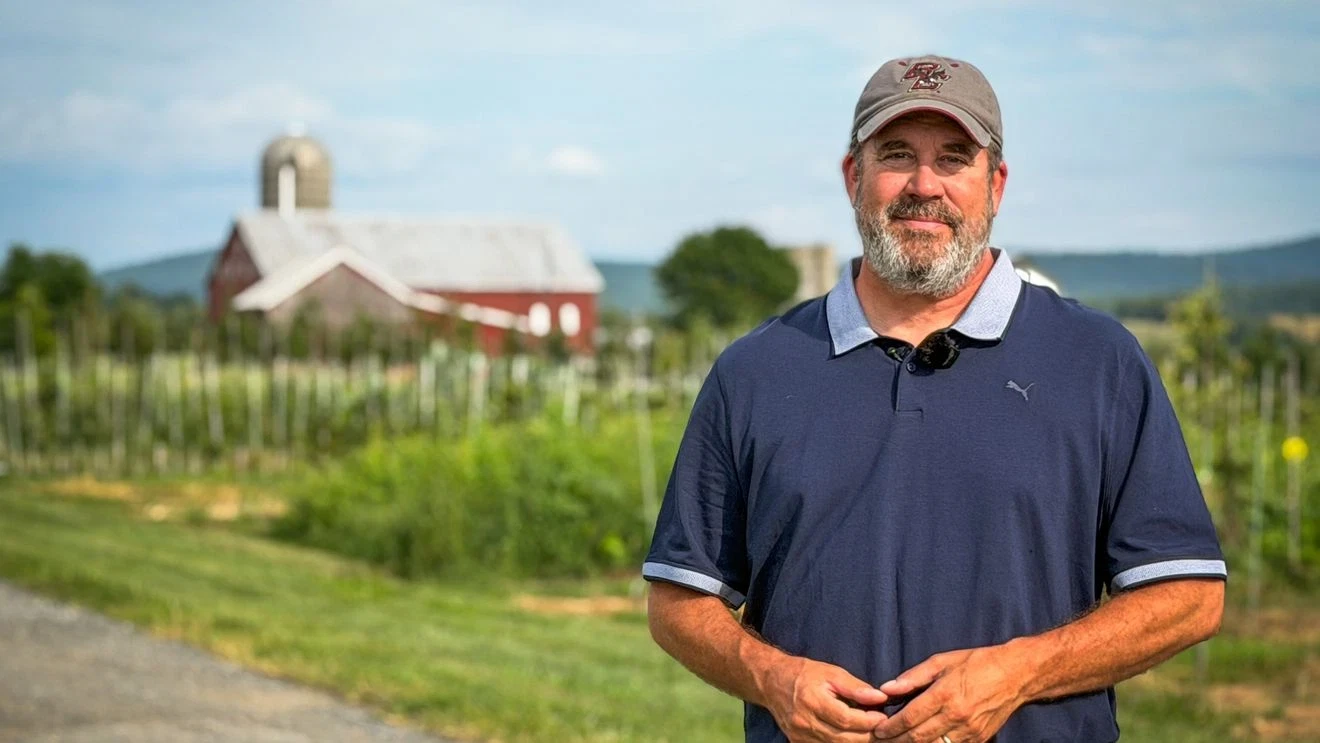
ADAMSTOWN, Md. (WBFF) — On Steve Black’s farm, the data center debate begins far from the servers and algorithms that power artificial intelligence.
It begins with rows of trees, open ground, rolling hills and the land Black has worked for nearly a quarter-century.
“We’ve been farming this ground for about 24 years,” Black said during an interview for FOX45 News In Depth with Mikenzie Frost. “You get an attachment to the land really quickly.”
Black, president of the Sugarloaf Alliance, knows data centers are becoming a bigger part of modern life. They support the phones people carry, the shows they stream and the expanding use of artificial intelligence.

Steve Black spoke with Mikenzie Frost for a FOX45 News In Depth interview about data centers and his concerns about his property. (WBFF)
But as construction moves forward near his Frederick County farm, Black said Maryland needs to decide the rules before the industry expands further.
“We’re going to have data centers in the world. That ship has sailed,” Black said. “But we also need meatpacking plants, and we have rules and regulations about where you can put meatpacking plants. I like my flush toilet. We have rules about sewage treatment plants. We need that same set of rules to come along in advance of the data center industry setting up shop, not after the fact.”
The tension is playing out across Maryland, where local governments are taking different approaches to data centers. Some have imposed pauses to study their effects. Harford County has enacted a ban.
In Frederick County, where some of the state’s most visible construction is already underway, county leaders have paused new development while existing projects continue.
Frederick County’s map shows data center development applications have been accepted on nearly 1,300 acres. County Executive Jessica Fitzwater ordered a pause on new data-center development through the end of the year, but that does not stop construction already authorized. Fitzwater was not available for an interview after FOX45 News requested one for this story.
Frederick County’s regulations require projects to meet noise and vibration standards, minimize light pollution and include screening, landscaping, buffers and setbacks near residential areas. Air quality is also being monitored, along with water limits.
For Black, those safeguards do not erase the uncertainty of living near an industrial-scale project.
“I’m very worried that I’m going to hear the data centers,” he said. “We’re a fair ways away, so maybe I won’t. But I know that every night that we have a low cloud deck, I’m going to be able to read a newspaper out here from all the light pollution. That is guaranteed.”
He bristled at the phrase he said industry supporters sometimes use to describe farmland: “unproductive land.”
“A farm growing food and fiber for people to eat and wear and make part of their lives, that isn’t a nonproductive activity,” Black said. “Once you destroy that land, you have lost that tool and you cannot get it back. You can redevelop an industrial site, but you can never go back to agricultural production.”
His concern echoes the results of new polling from Adam Carlson of Zenith Research. Carlson said 75% of Marylanders surveyed said they were concerned about data centers, including nearly half who said they were very concerned.
The top concern was higher electricity use and utility bills, selected by 39% of respondents. But Carlson said the unease reaches beyond a single issue, including environmental impacts, water use, noise and the potential effect of artificial intelligence on jobs and communities.
“The theme throughout this survey is that data centers are seen as a cost-of-living issue,” Carlson said. “They’re raising utility rates and not giving back to the communities in which they’re operating.”
The concern also crossed party lines, according to Carlson. More than 60% of Democrats, Republicans and independents said they were concerned about data centers’ impact in Maryland.
“When you get a majority of MAGA voters and a majority of Democratic socialists agreeing on something, it’s time to pay attention,” Carlson said.
State Sen. Karen Lewis Young, a Frederick County Democrat, said that bipartisan concern underscores the need for a more complete account of the industry’s benefits and costs.
“We need to much better quantify the job opportunities because most of them are short-term,” Young said.
Young sponsored legislation requiring a statewide analysis of the environmental, energy and economic impacts of data center development. The report was originally expected by Sept. 1, but that deadline won’t be met. Gov. Wes Moore vetoed the original bill as part of a package of studies he said would be too expensive and labor intensive during a period of budget uncertainty.

Sen. Karen Lewis Young spoke with Mikenzie Frost for a FOX45 News In Depth interview. (WBFF)
In his veto message, Moore said the three studies in the package would collectively cost at least $1.28 million and require coordination across numerous agencies and institutions. Lawmakers later overrode the veto, and Young said she now expects the data center report before the next legislative session.
Young said the goal should not be to force the industry out of Maryland.
“We do need to have data centers, and I believe we can find a reasonable compromise,” she said.
Moore said he supports data center development with conditions. Projects must bring or pay for their own energy needs and infrastructure improvements, cannot pollute the air or water, must meet environmental standards, hire local workers and include local jurisdictions in the process, according to the governor.
“Taxpayers cannot pay for it,” Moore said. “You cannot just big foot a local jurisdiction.”
Across Maryland, jurisdictions are deciding how much time they need to study those questions before accepting new projects.
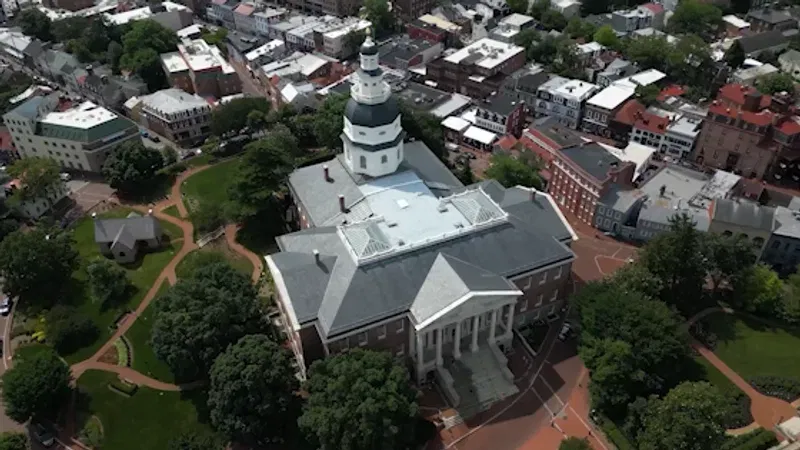
Aerial view of Maryland’s State House in Annapolis.png
Baltimore City passed a one-year pause on new data center development earlier this summer. During that period, city officials are expected to study data centers’ impacts and develop regulatory recommendations. The ordinance took effect July 16.
Howard County also approved a pause while a task force studies issues including sitting, setbacks, screening, water and energy use, noise mitigation, taxes and decommissioning. Its moratorium is set to remain in place until new zoning rules are adopted, the county completes comprehensive rezoning, or no later than November 2027.
Baltimore County’s moratorium, approved in February, is scheduled to run through January. County leaders are considering an extension through June 2027 to allow more time to create regulations and give incoming County Council members a role in shaping the rules. The Planning Board is expected to submit a report and recommendations before Oct. 1.
In Anne Arundel County, data centers are already operating. But pending legislation would remove new data storage centers as an allowed use in certain commercial, industrial, mixed-use and Odenton Town Center districts, while grandfathering certain existing projects. A County Council hearing is scheduled for Sept. 21.
Harford County has gone further than any other Maryland jurisdiction. Its County Council unanimously approved a permanent ban on data centers in June, and County Executive Bob Cassilly signed it into law.
Cassilly said he is not opposed to artificial intelligence itself, but believes Maryland’s energy supply cannot support major data-center demand without putting more pressure on customers.
“It’s not NIMBY. It’s reality,” Cassilly said. “We don’t produce energy.”

Harford County Executive Bob Cassilly spoke with Mikenzie Frost for a FOX45 News In Depth interview about data centers. (WBFF)
The ban ended hopes for a proposed A.I. energy campus at Mountain Branch Golf Course. Owner Bill Vasilakopoulos had argued his project would create its own power, avoid reliance on public water and generate new energy for Maryland’s grid. He had called for strict rules rather than a blanket prohibition.
The competing visions underscore the question Maryland lawmakers, local leaders and communities are now confronting: How quickly should the state build for an A.I.-driven future, and what protections should come first?
Black believes the state’s leaders cannot remain vague while the landscape changes around them.
“I’m afraid in Annapolis, thus far, at least in the governor’s office, we haven’t seen that kind of attention to the community’s concerns,” Black said. “It seems more like we’ve gone from a big proponent to just being quiet on it.”
And, he said, standing in the middle is no longer an option.
“Politicians are figuring out very quickly that they can’t just be mute and stand in the middle,” Black said. “They need to decide where they want to be.”
Follow Political Reporter Mikenzie Frost on X and Facebook. Send tips to mbfrost@sbgtv.com.
 Local Story