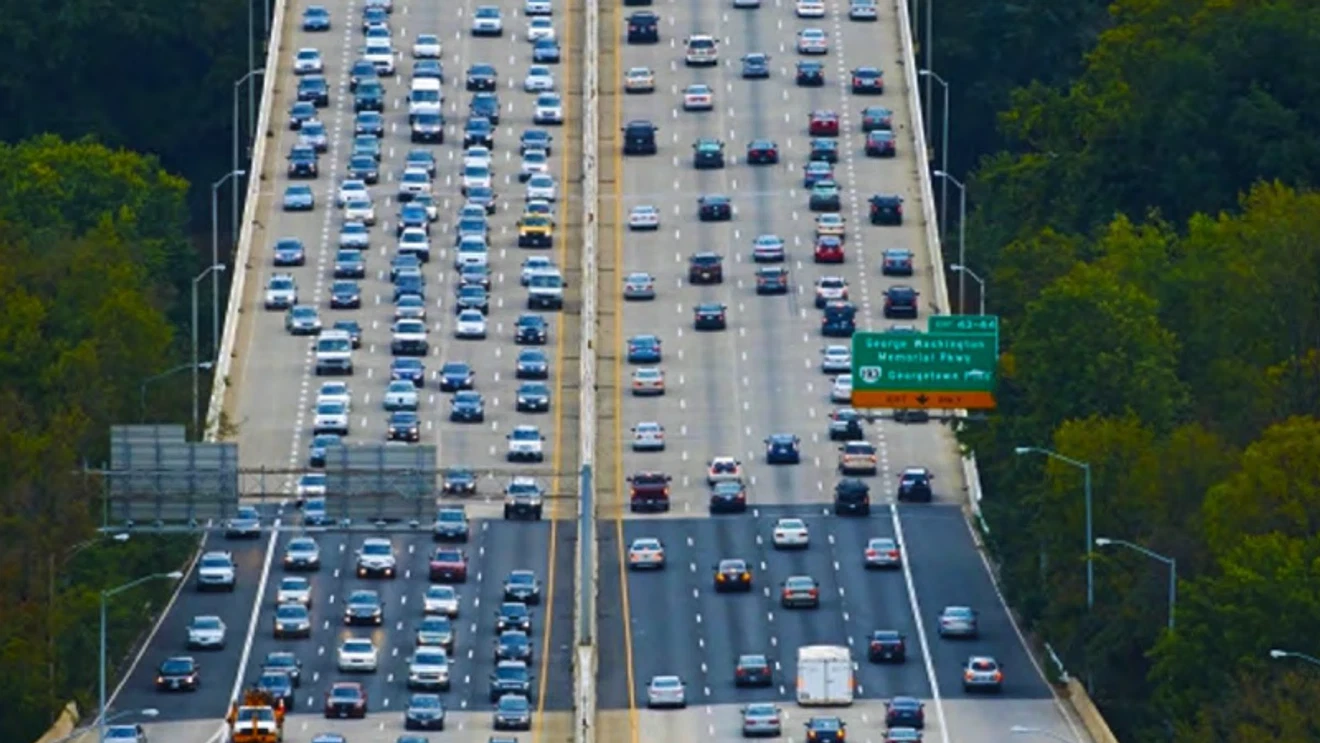
ROCKVILLE, Md. (7News) — Maryland is taking another step toward replacing the aging American Legion Bridge, reopening discussions with private companies about a scaled-back project that could still cost billions of dollars.
The Maryland Department of Transportation released a pre-solicitation information memorandum outlining a plan to gather interest from private-sector companies and explore potential financing and construction options for the American Legion Bridge and I-270 corridor.
The move comes years after an earlier, much larger proposal to widen portions of the Capital Beltway and I-270 stalled under a previous public-private partnership agreement.
The latest proposal focuses on approximately 6.5 miles, stretching from the American Legion Bridge along the Capital Beltway to the I-270 west spur and north along the spur.
More than 230,000 vehicles use the American Legion Bridge daily, making it one of the region’s busiest transportation connections.
The current concept is a narrower version of the original plan first advanced in 2017 under then-Governor Larry Hogan.
That proposal called for adding express toll lanes along portions of I-495 and I-270, including replacing the American Legion Bridge.
The original project was estimated at approximately $7.6 billion and relied heavily on a public-private partnership with Transurban, an Australian-based transportation company.
Under that arrangement, a private consortium would finance, build and operate the toll lanes, collecting revenue from drivers who chose to use them.
The deal fell apart in 2023 after Governor Wes Moore’s administration questioned whether the agreement provided sufficient value to Maryland taxpayers. Environmental litigation also added uncertainty, and Transurban ultimately withdrew from the project.
The new concept would still include managed toll lanes, but the state is examining different ways to finance and deliver the work.
According to the transportation department’s memorandum, the current project would include:
The state is also evaluating whether a public-private partnership would be the best way to deliver the project.
Transportation officials have not selected a financing or construction plan. Public funding remains another possibility.
The state is also seeking federal assistance. Maryland has requested $864 million through the federal Bridge Investment Program to help pay for improvements to eight bridges along I-495, including the American Legion Bridge.
State officials say federal funding could help cover expenses such as acquiring right-of-way, regardless of whether the project ultimately moves forward as a public-private partnership.
The renewed discussions are drawing attention from local officials concerned about how the project could affect commuters and surrounding communities.
Rockville City Councilmember Adam Van Grack says improving the region’s transportation network requires more than expanding highways.
“It’s not just about fixing the pathways and the roads, we’ve got to emphasize public transportation significantly better. We’ve got to make sure we give Metro the support needed, but at the same time we’ve got to do something better with our roadways. And if we are not gonna go the route of a second crossing of the Potomac River, which seems to be the way we are going, we’ve gotta do a better job with the American Legion Bridge.”
The project does not include a second crossing of the Potomac River.
Transportation officials plan to begin meeting with interested private companies in December 2026 and January 2027 to discuss potential approaches.
The state could seek approval to advance a public-private partnership concept in 2027, followed by additional reviews and a competitive process to select a private partner if that approach is ultimately approved.
Under the preliminary timeline, a final agreement could come in 2029.
For now, officials stress that no decision has been made on how the project will be financed or delivered.
For the hundreds of thousands of drivers who depend on the American Legion Bridge and surrounding highways, the latest development marks another step toward a possible replacement — but construction remains years away.
State officials estimate the corridor experiences approximately 12 hours of congestion daily.
Maryland estimates the proposed improvements could reduce injury crashes along the corridor by as much as 28%.
The state currently has approximately $60 million programmed for early work on the project.
This post was originally published on Fox 45 by Sinclair Media Group.
 Local Story