Gov. Wes Moore has made lowering Maryland’s teacher vacancy rate a priority, pointing to targeted investments aimed at strengthening the educator pipeline.
While some of those efforts are showing progress, attempts to recruit former federal workers into classrooms following mass layoffs and firings under the Trump administration are producing limited results.
A Spotlight on Maryland analysis found one of the governor’s initiatives, Feds to Eds, has moved fewer than 1% of Maryland’s roughly 25,000 displaced federal workers into K-12 classrooms. The program is designed to recruit some of those workers, who lost federal jobs, into teaching.
A senior communications strategist for Moore said the Governor is “proud of the meaningful and innovative work this administration has done” to reduce the teacher shortage nearly in half and helping federal workers get back on their feet. “There’s more work to do, and this administration is committed to continuing those efforts.”
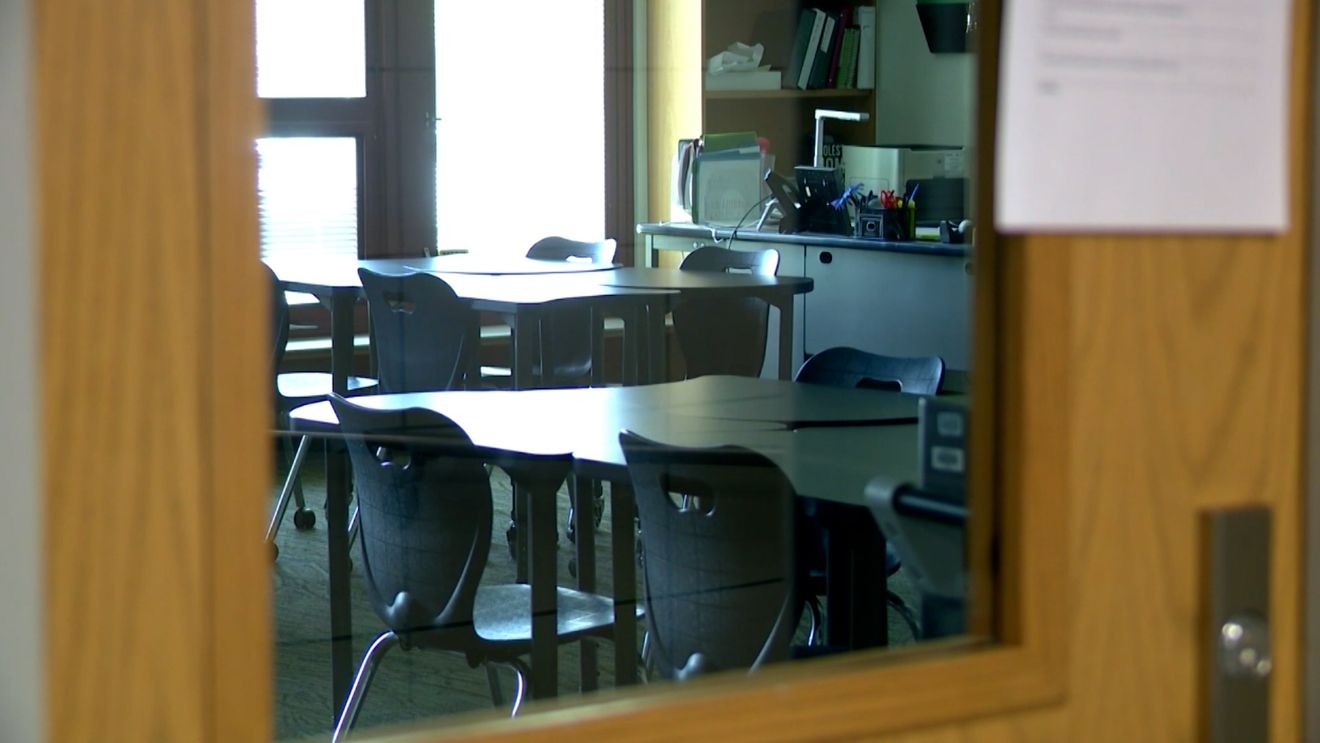
As part of Feds to Eds, the state has invested a total of $1 million across 11 colleges and universities through the Teacher Quality and Diversity Program. It supports accelerated paths to getting a teaching license.
While the initiative is partly marketed to former federal employees, schools explained interest from that group appears limited.
Spotlight on Maryland contacted all 11 participating institutions, including Bowie State University, the Community College of Baltimore County, Goucher College, McDaniel College, Montgomery College, Morgan State University, Notre Dame University of Maryland, Salisbury University, Towson University, the University of Maryland, Baltimore County and the University of Maryland, College Park.
Some schools did not respond to our inquiry for information. Each school was also asked to interview any former federal workers who now work in classrooms. Several said they could not meet Spotlight’s request because it was spring break. At least two schools reported minimal participation from former federal workers.
The Community College of Baltimore County said there has not been “much interest from displaced federal workers.”
Montgomery College, however, reported roughly 18 displaced federal employees from its first cohort. All 18 were offered positions in Montgomery County Public Schools and 16 accepted. The program is starting its second round.
“We view career transitions as opportunities to connect experienced professionals with high-impact fields like education,” Deidre Price said in a statement, senior vice president for academic affairs/college provost. “This work reflects a broader statewide focus on workforce alignment and talent development—ensuring Maryland can respond to economic shifts while strengthening the educator pipeline for school systems.”
Of about 51 total students enrolled at McDaniel College’s teaching program, five of the students came in as former federal workers, according to Tracey Lucas, Assistant Dean of Education.
“I think part of it is the narrative around teaching,” Lucas said when Spotlight asked why more federal workers have not enrolled. “It’s a false narrative because teaching is amazing. It’s a great career. You can make a difference every single day when you enter the classroom.”
She added that concerns about returning to school may also deter potential candidates.
“If they think, ‘Gosh, I already have a master’s degree — you’re telling me I have to go back and take more coursework?’ That’s why we want to make it easy,” Lucas said.
McDaniel is focused on making the transition into teaching practical by pairing coursework with hands-on classroom experience. “They will meet with you virtually and will come visit you in-person at your school,” Lucas mentioned. “If you are not currently working and are a full-time student, we’ll put you out one day a week in a school to give you that experience.”
Every person entering the program, including federal workers, would be assessed on an individual basis. Lucas said they see what degree teaching candidates hold and assess what subjects they are able to teach before mapping out coursework needed to earn a teaching license.
The funding is not limited to former federal workers. It is also available to conditional teachers, those already working in classrooms who hold a bachelor’s degree but not in education, as well as other adults seeking career changes.
“Our program is designed to serve anyone who is eligible and interested in becoming a licensed teacher,” CCBC communications director Hope Davis said in an email. The college is in the middle of recruiting 20 Baltimore County Public Schools conditional teachers after it was granted state permission to operate earlier this month. The first cohort will begin classes on April 13.
Like CCBC, The University of Maryland College of Education was granted funding last year but its program will launch this fall. Roughly 70 people are expected to enroll. Spotlight has asked how many of those enrolled are federal workers. We are still waiting for a response.
Schools said that broader eligibility is helping bring more people into the profession, even if one of the target groups is underrepresented.
“We want to make sure our program is high quality so we can do our very best to produce high-quality teachers that will be standing in Maryland classrooms,” Lucas said.
Still, questions remain about retention among those who do make the transition.
Baltimore County Public Schools said four former federal workers were hired as teachers in August 2025. However, after Spotlight’s phone call with the county this week, the number is currently three.
Spotlight on Maryland is a collaboration between FOX45 News, WJLA in Washington, D.C., and The Baltimore Sun. Have a story tip? Email spotlightonmaryland@sbgtv.com or call 410-467-4670. Investigative reporter Tessa Bentulan can be reached at tbentulan@sbgtv.com.

 Local Story