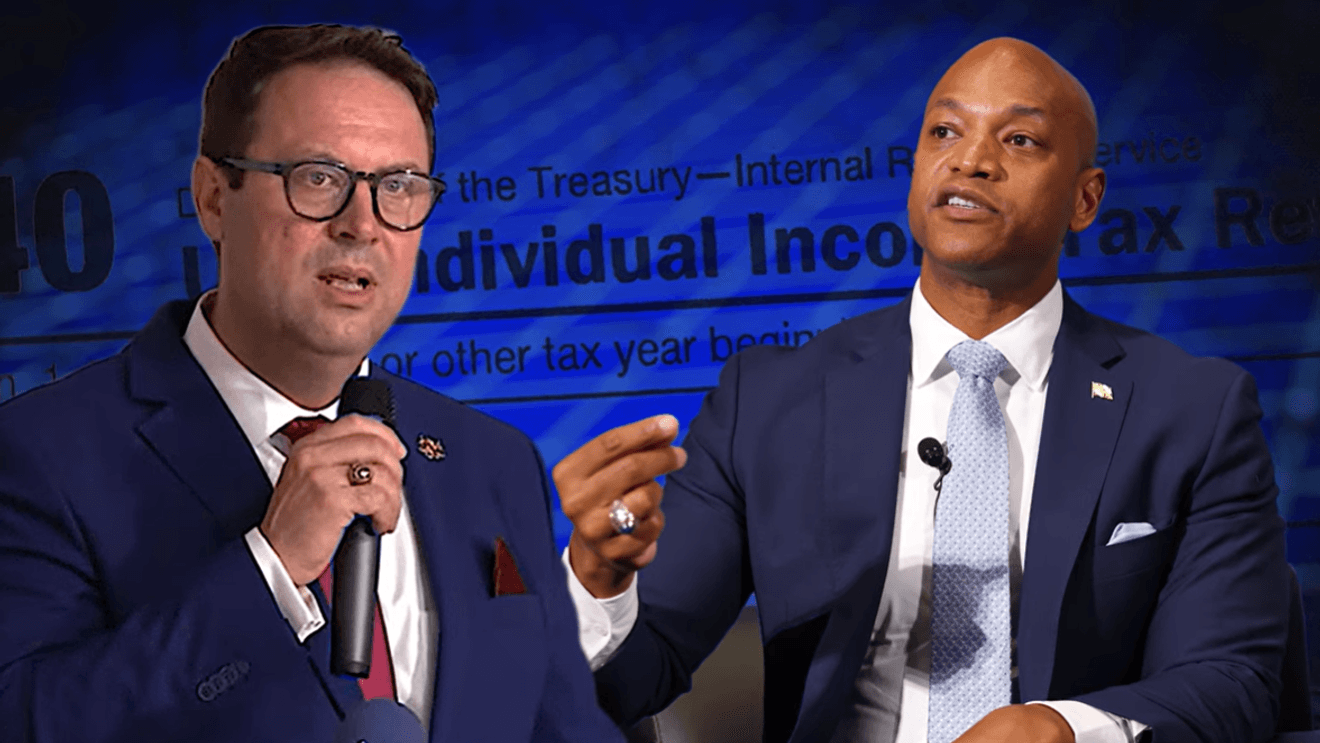
MARYLAND (WBFF) — Maryland’s two major gubernatorial candidates are asking voters for their support this fall while withholding a key piece of their financial history from public view: their personal tax returns.
Gov. Wes Moore, a Democrat who has repeatedly promoted transparency as a cornerstone of his administration, and Republican challenger Dan Cox, who has campaigned on accountability in Annapolis, both declined requests from Spotlight on Maryland to release three years of personal tax returns.
ALSO READ | Congressional tour puts spotlight on Key Bridge costs, timeline and funding
Maryland voters can review financial disclosure forms filed by both candidates that outline assets, investments and sources of income. But political and ethics experts say those disclosures provide only a partial picture of a candidate’s finances.
“The reason voters want that information is that they want to know what else might be motivating their representatives to engage in various behaviors,” said Flavio Hickel, a political science professor at Washington College.
What tax returns reveal
Hickel said tax returns can provide voters with information about how much candidates pay in taxes, their annual income, who they conduct business with and whether potential conflicts of interest may exist.
“Is this problematic for democracy? I think absolutely,” Hickel said of candidates not releasing their tax returns.
Richard Painter, who served as chief White House ethics lawyer during President George W. Bush’s administration from 2005 to 2007, said tax returns contain information unavailable through standard financial disclosures.
“There’s a considerable amount of information on tax returns that is not in public financial disclosures.”
Joanne Antoine, Executive Director of Common Cause Maryland, said releasing tax returns has become a transparency measure that helps build public confidence in candidates.
“I think it is best practice for anyone who is running for office to release their taxes,” Antoine said. “It helps to build public trust overall if you have nothing to hide.”
Why candidates choose not to release them
Neither Moore nor Cox is legally required to release their personal tax returns. But Hickel said candidates often make political calculations before deciding whether to make those records public.
“What is the cost of releasing my tax return?” Hickel said. “Even if he’s done nothing wrong, there may be something in there that can be picked apart and put into an attack ad and used against them. Not releasing becomes a way of avoiding potential vulnerabilities.”
Still, Hickel said withholding tax returns deprives voters of information that could help them evaluate candidates.
Whether it changes votes is another question.
“Democrats generally want disclosure, tax returns, that sort of thing but because Republicans are sort of worse on this issue or have a worse track record since Donald Trump, these Democrats are not going to switch their allegiance on this issue,” Hickel said. “I don’t think this is salient enough for independent voters to be swayed one way or the other.”
What the financial disclosures do show
Moore’s disclosure lists ownership interests in 21 limited liability companies, including three businesses he solely owns – Elevate Speakers LLC, Omari Literary Holdings LLC and Omari Productions LLC. The value of each entity is below $25,000.
The disclosures also list a series of private investment and real estate-related entities. Those include interests in Abbitt Acquisition LLC, Briarwood Member LLC, Broadcom Acquisition LLC, Cityline Acquisition LLC, Multifamily Portfolio 1 LLC, Parking Garage Member LLC, Port Acquisition LLC, Shelter Acquisition LLC and several others. Most of those investments are tied to private real estate and investment partnerships and are valued in ranges anywhere from $250,000 to roughly $10 million.
Moore sold or transferred his entire interest in Colonnade Lakestar Member LLC for at least $100,000 in December 2025. He sold or transferred his ownership interest in Zeal Capital Management back to the company for between $5,000 and $9,999 in November.
As for Cox’s disclosure, he listed two properties that he owns with his wife, Valerie. One of them is the couple’s principal home purchased in 2004 after acquiring the land for less than $25,000. The disclosure states the home is financed through Shellpoint and also identifies it as generating income for the household, though it does not explain the source of that income.
The second is a rental property in Secretary, MD which the couple purchased in 2006 for between $200,000 and $249,999. The filing states the property generates income for the household and carries a mortgage held by Atlantic Union.
Beyond his real estate holdings, Cox reported investment portfolio consists of 10 publicly traded stocks that he owns jointly with his wife, Valerie. According to the disclosure, the couple acquired all of the securities through ETrade and did not report selling any shares during the reporting period. The investments include shares of Nvidia Corp, Tesla, MARA Holdings, Inc., Hycroft Mining Holding Corp., Jet.AI Inc, the Invesco QQQ Trust, Royal Gold Inc., Vistra Corp, Williams Companies and Wheaton Precious Metals. Cox reported under 100 shares for each of the stocks, with the exception of Jet.AI Inc, and most purchases were valued at less than $5,000. However, Cox reported investing between $5,000 and $9,999 in shares of Royal Gold and Tesla.
Cox also disclosed sole ownership of The Cox Law Center LLC, his Emmitsburg based law practice, which he valued between $300,000 and $349,999. The filing states the business does not conduct business with the State of Maryland.
Neither disclosure, however, reveals the candidates’ total annual income or how much they paid in federal or state income taxes.
Campaign promises of transparency
The issue may be particularly sensitive for Moore, who has repeatedly pledged to increase transparency in government.
In his first Substack post dated July 10, 2025, Moore wrote that Marylanders “deserve transparency and accessibility” and called those values “pillars of my administration.”
The governor has also faced questions about his military and educational records, subjects Spotlight on Maryland has previously reported.
In a statement to Spotlight on Maryland, the Moore administration said the governor has “gone further than any Maryland governor in history to ensure transparency by placing his financial holdings in a blind trust and passing historic legislation requiring all future Maryland governors to do so as well.”
Cox, meanwhile, has made government accountability a central theme of his campaign for governor.
During his victory speech in June, minutes after winning the Republican nomination, Cox criticized Moore’s leadership as governor, “What have we received in exchange? A Maryland that is too expensive, too dangerous and too unaccountable to the taxpayer. It’s time for common sense governance and to restore and renew our beautiful state.”
Cox did not respond to multiple requests for comment from Spotlight on Maryland.
Still, both candidates are asking voters to trust them without opening their tax returns to public scrutiny.
This is the second time Moore and Cox have declined to release their tax returns.
In 2022, The Baltimore Sun requested five years of personal tax returns from both candidates during their first race for governor. Neither released them.
A changing political norm
For decades, releasing tax returns became standard practice for presidents and presidential candidates.
Painter said every president and major-party presidential nominee since Richard Nixon had publicly disclosed tax returns, even though Nixon’s were first leaked from within the IRS.
That precedent changed when Donald Trump refused to release his tax returns while running and serving as president.
Painter believes Trump’s decision changed expectations for politicians across both parties.
“President Trump didn’t release his tax returns, and he got away with it, politically. It appears the voters didn’t care,” Painter said. “The message was sent that a politician could get away with not releasing their tax returns and not taking seriously their own financial conflicts of interest. Voters are increasingly alienated from government.”
Moore, who is viewed as a potential 2028 Democratic presidential candidate, has previously criticized Trump for profiting while in office.
“They’re seeing a president who has now profited by billions of dollars,” Moore said on a July 3 broadcast of MSNOW.
Painter said transparency is most meaningful when elected officials hold themselves to the same standard they expect of political opponents.
“We can’t have a situation where we hold only members of the other political party accountable. We need to all play by the same rules, the same standards.”
Spotlight on Maryland is a collaboration between FOX45 News, WJLA in Washington, D.C., and The Baltimore Sun. Have a story tip? Email spotlightonmaryland@sbgtv.com
 Local Story