HUNT VALLEY, Md. (WBFF) — Maryland taxpayers have invested billions of dollars into public education over the last several years. But a new report from the Annie E. Casey Foundation shows the state’s national education ranking has fallen. Now, one state education leader says the report is misleading.
“It is not a comprehensive look at our education system. It’s a dipstick,” explained Dr. Joshua Michael, the President of the Maryland State Board of Education. “I was surprised to see us go down.”
The Baltimore-based Annie E. Casey Foundation, every year, releases the Kids Count Data Book. The study ranks states in various categories based on child well-being, including education by comparing pre-school attendance, math and reading proficiency, and high school graduation rates.
ALSO READ | Maryland’s national school ranking falls despite billions in new funding, per report
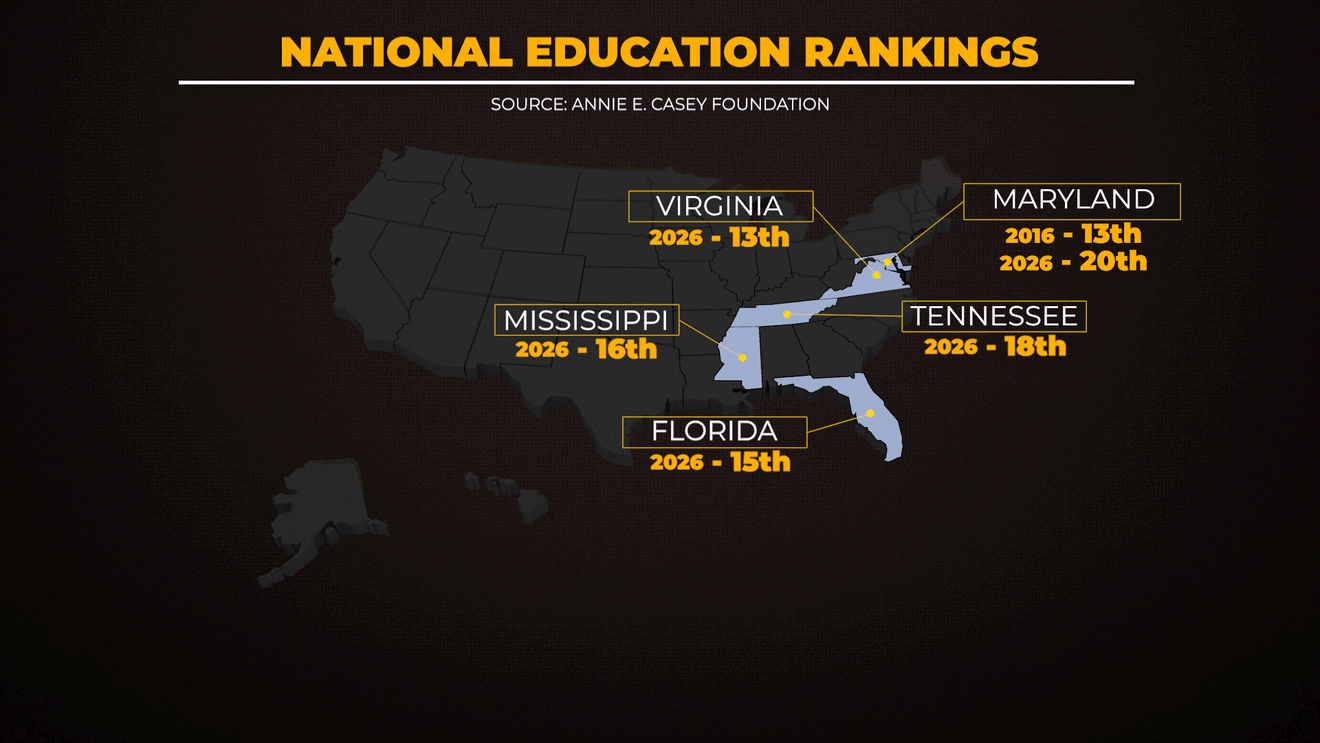
In 2016, according to the Kids Count Data Book, Maryland was ranked 13th in the country for education. Ten years later, in 2026, Maryland had fallen seven spots to 20th.
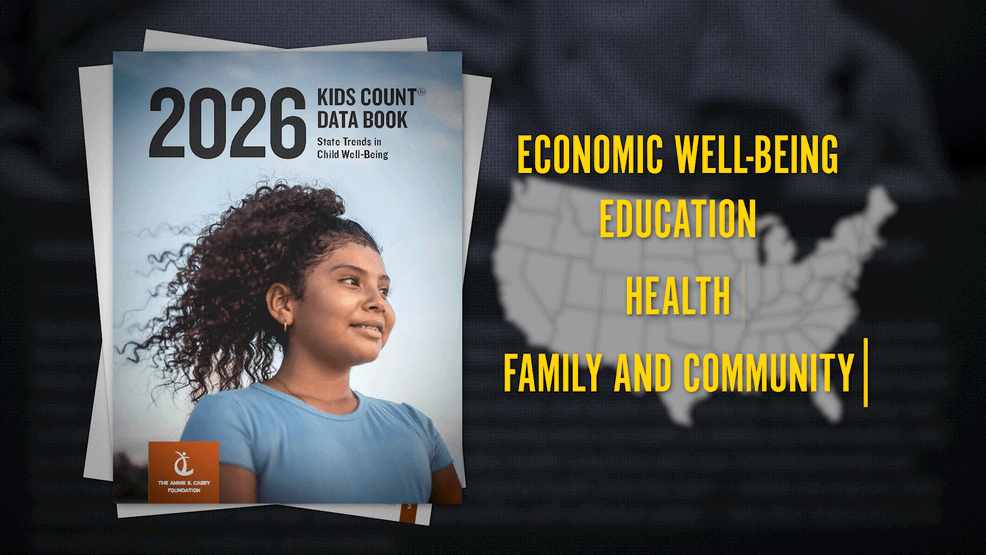
The Annie E. Casey Foundation, every year, releases the Kids Count Data Book which ranks states in various categories based on child well-being, including education (WBFF)
“It’s not designed to analyze the quality of our schools,” Michael said.
“Your argument to taxpayers and residents would be, don’t think too much into the Annie E, Casey Foundation report?” Questioned Project Baltimore’s Chris Papst.
“It’s designed to look more broadly at child well-being,” replied Michael.
Dr. Michael tells FOX45 News, of the data points in the study, Maryland only declined in preschool attendance. And the data used by Annie E. Casey lags two years. Since 2024, Michael argues, Maryland has seen increases in math and reading proficiencies, which he expects will help increase Maryland’s future national standing.
“I anticipate that we’re going to see increases in the coming years,” stated Michael.
Maryland, according to the Kids Count Data Book, now ranks behind Florida, Tennessee, Virginia and Mississippi. All four states spend less money on education than Maryland.
In 2021, Maryland passed the Blueprint for Maryland’s Future – the largest education funding increase in state history. According to the U.S. Census, in 2024, the most recent year federal data is available, Maryland public schools spent $20,208 per student. Mississippi spent $12,324, Florida spent $12,693, and Tennessee spent $12,882. Virginia spent $17,104 per student.
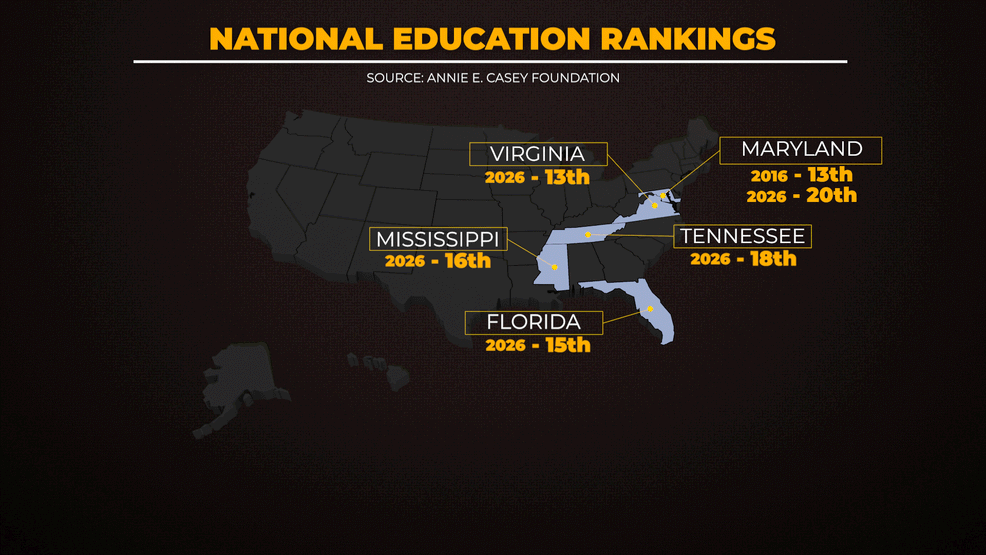
Maryland, according to the Kids Count Data Book, now ranks behind Florida, Tennessee, Virginia and Mississippi (WBFF)
Project Baltimore emailed Governor Wes Moore, Senate President Bill Ferguson and every member of the state House and Senate regarding the Kids Count Data Book – asking, “Should taxpayers be concerned that Maryland has not improved in national education rankings despite taxpayers investing billions of additional dollars into public schools?”
Senate President Ferguson did not respond.
ALSO READ | New Baltimore County school report shows declining enrollment due to state exodus, in part
Governor Moore’s office did reply, but did not mention the Kids Count Data Book. Moore’s office stated, “Maryland students are gaining ground faster than nearly every other state.” Moore’s office highlighted the 2025 Education Scorecard, a report that found out of 35 states, Maryland students rank 3rd nationally for growth in reading. And out of 38 states, Maryland students rank 5th for growth in math.
Out of 141 Delegates and Senators, six replied to our email. Democrat Senator Ron Watson of Prince George’s County blamed Maryland’s decline in Kids Count Data Book on how, “The state has not yet produced broad-based gains for Black and Latino students.”
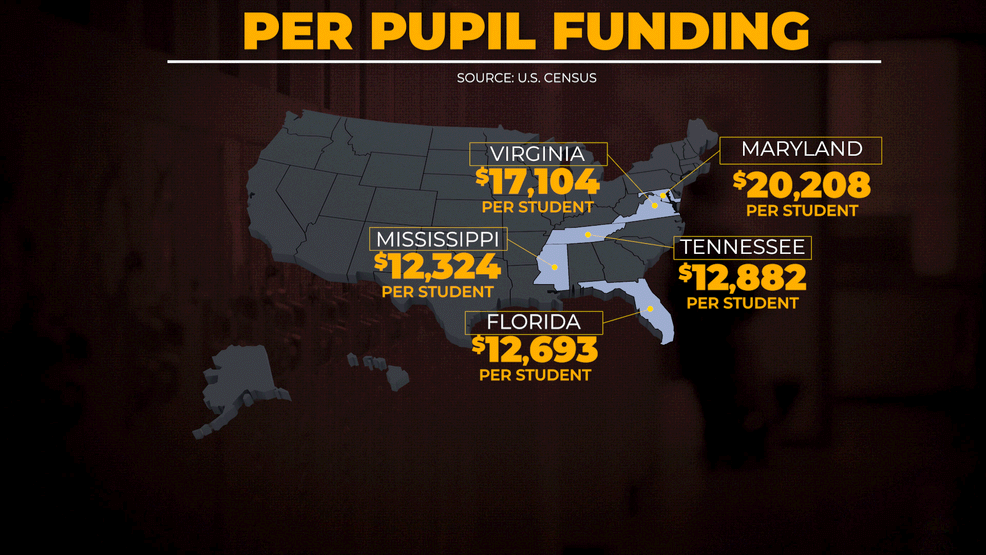
All four states spend less money on education than Maryland (WBFF)
Republican Christoper Tomlinson from Carroll and Frederick Counties replied, “It’s time to state the obvious: The Blueprint for Maryland’s Future has been a colossal waste of taxpayer money.”
Michael disagrees – saying the additional investments from the Blueprint are improving schools, despite the ranking from the Kids Count Data Book.
“Am I happy with where we are? Absolutely not,” remarked Michael. “We are making the progress that I expect to see. And I’m encouraged about the trajectory that we’re at.”
Below are the full responses we received from each of the six delegates.
Christopher Tomlinson – Republican, District 5, Carroll County & Frederick County:
“Hello Chris,
Please see my response below.
It’s time to state the obvious: The Blueprint for America’s Future has been a colossal waste of taxpayer money. A boat is often described as “a hole in the water into which you pour money.” Well, Blueprint has been worse — it is a vacuum on State Circle in Annapolis sucking huge piles of money into a dark void, and with precious little to show for it.
Maryland Democrats’ attitude toward Blueprint can fairly (if cynically) be described as “The Blueprint is admittedly unrealistic and incredibly expensive, but let’s nevertheless make it our top priority, ferociously resist changes, raise taxes however high is necessary to maximize funding for all the included progressive wish-list programs, and bully and threaten the public and local jurisdictions into swallowing it whole – so we can point to it and say ‘Look! We did something!’ And if it fails, we’ll just claim it was underfunded!”
I obviously see it differently. The Blueprint was poorly conceived, overly ambitious, and ill-fitting and unhelpful for many local Maryland jurisdictions. Even school systems like the one in my own Carroll County, which have shown for years their ability to provide excellent education at a reasonable price, were forced – under threat of a loss of state funding – to abandon course and get on the downbound Blueprint train. And yet Democrats protect Blueprint like it’s their baby – which of course it is. And they continue to laud its goals, as if goals were an acceptable substitute for results – which of course they are not.
I believe the key is not to try to preserve the Blueprint as some sort of holy icon of idealistic bureaucratic planning, praised by education bureaucrats, worn proudly as a crown by its designers, and aggressively defended in all its excesses by those who conceived and created it. Rather, the goal should be to find and encourage flexible, feasible solutions that actually work to improve educational outcomes in Maryland’s various local jurisdictions.
I don’t care whether Blueprint is preserved or abandoned in name, but it’s well past time to make the necessary changes to actually fix what ails Maryland schools, and those changes are clear: More local autonomy, including budget, personnel, and timeline flexibility for local jurisdictions; more tools, flexibility, and support for teachers to make and enforce rules and mete out real, effective discipline when necessary; a refocus on educational basics like phonics; an end to grade inflation and social promotion; a direct link between teacher performance and compensation; a retreat from extreme levels of “inclusion” (previously known as “mainstreaming”); more focus on student and teacher merit and less on DEI and CRT; and (I’m getting dreamy here) real school choice. At the very least, we must take the obviously necessary steps of relaxing timelines and rigid personnel allocation formulas and giving local jurisdictions more flexibility in implementation.
As for classroom specifics, Maryland hired Dr. Carey Wright, author of the “Mississippi Miracle,” in which Mississippi went from its perennial ranking at or near dead last in the United States in educational outcomes to a respectable middle-of-the-pack ranking in just a few years. Dr. Wright used tried and true techniques and policies – such as refocusing on phonics in reading, strict student, teacher, and school accountability, an end to social promotion, targeted teacher training, and yes, expanded early childhood education. Let’s focus on those reforms and stop resisting the uncomfortable elements (such as third-grade retention for students not reading at grade level). She wasn’t hired as a figurehead – let’s let her do her thing to bring about a “Maryland MIracle.”
Education is important. But the Blueprint– an education bureaucrat’s wish-list-turned-state-mandate — is not. Outcomes are important, but blue ribbon commissions and their trophy plans are not. Children are important, but bureaucrats’ egos and resume enhancements are not. So yes – let’s turn off the vacuum on State Circle. Let’s stop worrying about “saving the Blueprint,” and start focusing on effective educational strategies that are proven to work.”
William Wivell – Republican, District 2A, Frederick & Washington Counties
“Of course, Marylanders should be concerned. The state spends $10-$12 billion a year on Pre-K through 12 education and can’t even achieve passing rates in science and math greater than 26% on standardized test scores. Maryland needs to implement school choice, education, savings accounts, and other programs that have proven successful in other states to improve outcomes and student performance.”
Robert (Bob) Long – Republican, District 6, Baltimore County
“It is becoming increasingly clear that the Blueprint for Maryland’s Future is not achieving the results that were promised.
Former Governor Larry Hogan vetoed the Blueprint because he believed the costs were unsustainable for Maryland taxpayers. Despite those concerns, the Maryland General Assembly overrode his veto and moved forward with the program.
At the time,I had raised concerns that the COVID-19 pandemic would have a significant and lasting impact on student learning and educational outcomes. Unfortunately, those concerns were not adequately addressed as the Blueprint was implemented.
We were assured that benchmarks and accountability measures would be in place to evaluate the Blueprint’s progress. However, the results we are seeing today raise serious questions about the program is not meeting its goals and whether taxpayer dollars are being spent effectively.
It is obvious that changes need to be made to the Blueprint for Maryland’s Future—not only because of the growing financial burden on taxpayers, but also because of its failure to produce the educational improvements that were promised.
I did not vote for the Blueprint, and in 2020 I warned that the effects of COVID-19 on student learning would make achieving its goals far more difficult. The results we are seeing today confirm that those concerns deserved greater evaluations.”
Ron Watson – Democrat, District 23, Prince George’s County
“Thanks Chris,
The first thing to understand is that the KIDS COUNT Education ranking is not based on one test score. Maryland’s education rank is calculated from four indicators:
Preschool enrollment (ages 3–4)
Fourth graders not proficient in reading
Eighth graders not proficient in math
High school students not graduating on time
So when Maryland moved from 13th (2016) to 20th (2021), improved to 18th (2025), and fell back to 20th (2026), the change reflects the combined performance of these indicators.
Maryland’s education ranking has not meaningfully improved because the state has not yet produced broad-based gains for Black and Latino students. In 2024, only 19% of Black fourth graders and 17% of Latino fourth graders were proficient in reading, compared with 52% of White students and 64% of Asian students. In eighth-grade math, only 10% of Black students and 12% of Latino students were proficient, compared with 39% of White students and 57% of Asian students. The Blueprint’s promise was equity; the current data show that Maryland has not yet delivered that promise at scale.
The important caveat to this, and I state this as a former School Board member, is that any initiative implemented for educational improvement typically takes 6 years to see real results.
The real question to ask is: if our students are taught in the same schools with the same curriculum and the same certified teachers, why are some students graduating with 4.0 GPAs and going off to college, and other students underperforming given the significant investment in education? The answer is what takes place outside of the classroom and the infrastructure and support that happen at home. The family structure and dynamic is vital to educational outcomes, and once we realize that money alone is inadequate and focus on the family, we will see the change we desire.”
Jesse Pippy – Republican, District 4, Frederick County
“Chris,
These findings further confirm that the Blueprint has not delivered the results that were promised to Marylanders. More concerning is the multi-billion dollar cost of this program may actually bankrupt our state.”
Aaron Kaufman – Democrat, District 18, Montgomery County
“Good afternoon, Chris,
Thank you for reaching out.
At this time, our office does not have a comment regarding the Annie E. Casey Foundation’s 2026 Kids Count Data Book findings. We appreciate the opportunity to review your inquiry and welcome future requests for comment.
Please continue to keep us in mind for upcoming stories.”
Follow Project Baltimore’s Chris Papst on X and Facebook. Send news tips to cjpapst@sbgtv.com
 Local Story