MARYLAND (WBFF) — Maryland taxpayers, in recent years, have increased school funding by billions of dollars. But a FOX45 News investigation found students are falling short of the academic goals set by the state.
Project Baltimore examined the numbers, the money, and what some lawmakers said should happen next to the Blueprint for Maryland’s Future.
Maryland Governor Wes Moore and Maryland State Superintendent of School Dr. Carey Wright both agree, the failure of Maryland students to meet academic goals set by the State Department of Education is not a concern.
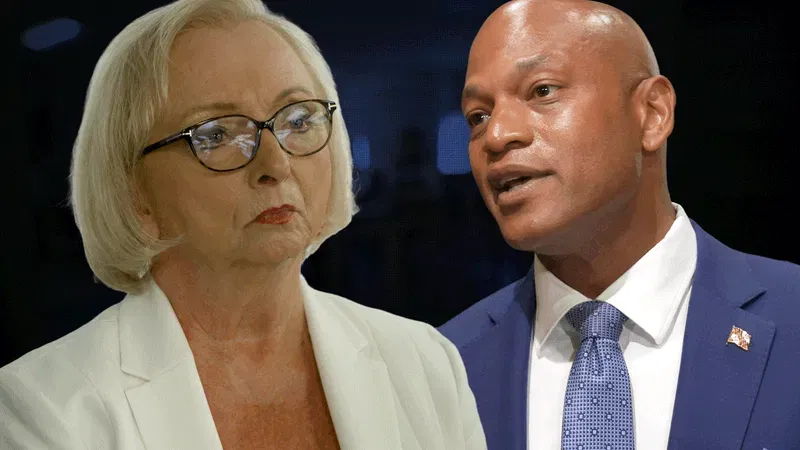
Maryland Governor Wes Moore and Maryland State Superintendent of School Dr. Carey Wright both agree: The failure of Maryland students to meet academic goals set by the State Department of Education is not a concern (WBFF)
“Well, no. Because I think you want to set high goals and high standards,” said Moore. “I think part of the problem we had before is we had low expectations and we had no intention of actually even being able to push towards.”
“I’m not the least bit concerned about that,” stated Wright. “My concern is, are we making incremental progress? And the answer to that question is yes, we are.”
But what about Maryland lawmakers, are they concerned?
To find out, Project Baltimore emailed the state legislature asking: “Do you believe the failure to meet the state’s 2026 academic goals warrants legislative hearings, or a special session, to examine the academic and economic impact of the Blueprint for Maryland’s Future?” And, “If hearings or special sessions are not warranted, what steps do you believe should be taken to address the significant gap between Maryland’s stated academic goals and actual student performance?”
We’ll get to their replies later. But first, here are the numbers.
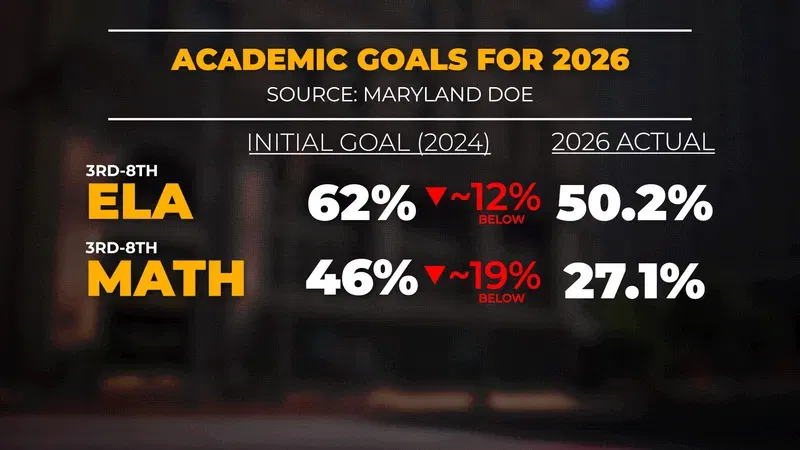
Overall, in ELA, the state fell short of its initial goal by 12 percentage points. In math, the state fell short of the initial goal by 19 percentage points (WBFF)
In 2024, the Maryland State Board of Education set academic goals it wanted students to reach by 2026. For third through eighth grade English Language Arts, the state set a goal of 62% proficiency. For math, the goal was 46% proficiency.
One year later, in 2025, the state revised the 2026 goals down to 57% in ELA and 37% in math.
When the 2026 results were released in July, Mayland students did not come close to meeting any of the goals. In ELA, 50.2% of students tested proficient, which was 12 percentage points below the goal. In math, 27.1% of students tested proficient – 19 percentage points below the goal.
This is happening as taxpayers have increased school funding by nearly $1.5 billion annually, largely due to the Blueprint for Maryland’s Future which passed in 2021.
Which brings us back to the legislature which passed the Blueprint more than five years ago. Out of the 188 legislators Project Baltimore emailed, 12 provided written responses.
Delegate Ryan Nawrocki from Baltimore County wrote, “These results absolutely warrant legislative hearings.”
Delegate Chris Tomlinson from Frederick and Carroll Counties added, “Maryland families and taxpayers deserve to see meaningful results after investing billions of dollars in public education.”
Senator Ron Watson from Prince George’s County stated, “We must strategically assess the benefits vs costs of the Blueprint.”
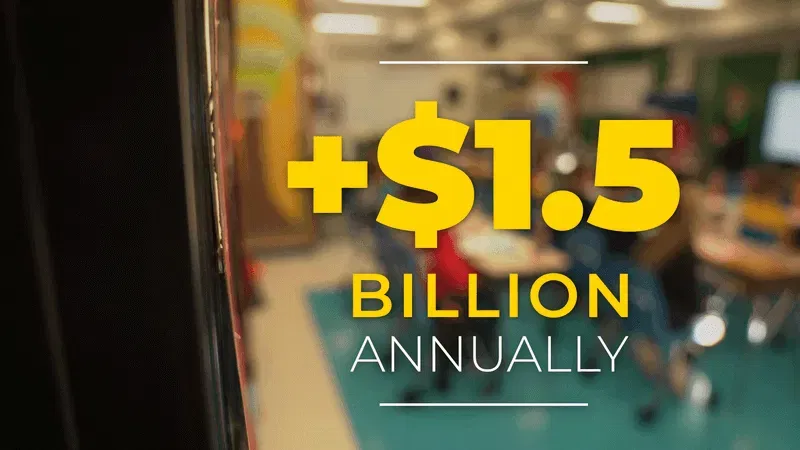
Taxpayers have increased school funding by nearly $1.5 billion annually, largely due to the Blueprint for Maryland’s Future which passed in 2021 (WBFF)
LaToya Nkongolo from Anne Arundel County wrote, “The answer cannot simply be to spend more money. Taxpayers must demand results for the money we are already spending.”
Senator Jason Gallion from Cecil and Hartford Counties emailed, “Governor Moore cannot continue celebrating “incremental progress” while taxpayers spend billions.”
Below are the full responses from legislators who wrote Project Baltimore back:
“Hey, Chris:
Thanks for reaching out to us regarding this incredibly important issue.
These results absolutely warrant legislative hearings. When only 27.1% of Maryland students are proficient in math and barely half are proficient in English, state leaders should not dismiss the failure to meet their own goals as acceptable “incremental progress.”
Maryland is spending unprecedented amounts under the Blueprint while the state faces multibillion-dollar structural deficits, yet students are still being left behind. Taxpayers and families deserve a full accounting of where the money is going, which programs are producing results, and which are failing. At a minimum, the General Assembly must hold comprehensive hearings when it reconvenes and be prepared to fundamentally reform the Blueprint rather than continue pouring money into a system that is not delivering.
We must also expand school choice and give parents greater freedom to choose the educational path that works best for their children. Maryland families cannot afford more excuses, and Maryland students cannot afford another year of missing critical academic milestones.
Thanks so much for allowing me to add to the discussion. Feel free to reach back out at any time.
Have a great evening.
Office of Delegate Ryan Nawrocki, District 7A”
“Hello Chris,
I apologize for the very late reply. Here is the response from Delegate Tomlinson on your two questions.
“Maryland families and taxpayers deserve to see meaningful results after investing billions of dollars in public education. Republicans, including myself, have been talking about the problems surrounding Blueprint for years and how there is no realistic way to implement it. More importantly, we’ve been asking if we’ll ever see any positive outcomes or proof that this Blueprint boondoggle is actually working. I will argue that the recent Statewide test results provide all of the evidence you need to see that Blueprint is not turning out to be the miracle drug the Democrats claimed it would be.
I am naively optimistic that the MD General Assembly will finally make changes to Blueprint during the 2027 legislative session. Every jurisdiction has complained about the cost and has been forced to cut beloved programs or lay off staff in an attempt to become compliant with Blueprint. Even the Democrats are having trouble defending Blueprint at this point and the recent test results do not make the situation any better.
My daughter will be starting preschool in one month and will be entering the public school system in a few short years so I care deeply about the future of public education in our state. I will continue to fight to make sure that my daughter and every other Maryland child receives the best education without wasting taxpayer dollars.
Our focus must remain on, making sure every Maryland student has the skills they need to succeed in the real world. Maryland taxpayers are making an unprecedented investment in public education, and they deserve accountability for those dollars.
Best.
Alyssa Young
Chief of Staff to Delegate Chris Tomlinson”
“We must strategically assess the benefits vs costs of the Blueprint. Starting in the 2027 – 2028 school year, the new statewide policy under which third-grade students who do not demonstrate sufficient reading proficiency can be retained rather than automatically promoted to fourth grade. Although this is important, what we have seen in Mississippi is that mandatory retention by itself did not produce statistically significant improvements. Maryland, like Mississippi, needs a more holistic approach, making retention part of a comprehensive system that incorporates teacher training, literacy coaches, diagnostic assessments, and intervention, with emphasis on the Science of Reading (i.e., phonics).
Math proficiency should be given the same level of rigor with the third-grade assessment providing validation of early interventions, and not the first checkpoint.
Micheline Bowman
Chief of Staff to the Senator Ron L. Watson”
“Maryland needs legislative hearings—and we need them now.
We need to examine the true cost of the Blueprint, the financial burden it is placing on taxpayers and families, and whether we are getting the results we were promised.
If we’re spending billions more, why are we still seeing low test scores, declining enrollment, and disappointing graduation rates?
More spending without measurable results is not accountability.
Our children deserve better, and Maryland taxpayers deserve answers.
Stop the blank checks. Start demanding results.
Delegate Bob Long
6th District, Baltimore County”
“I believe he was just interviewed by you about –
but answer to first question is yes there should be regular hearings on the progress of the Blueprint, it’s something that ought to be happening every interim in the General Assembly.
Justin Ready Senator”
“Good afternoon, Chris.
Please see the following response from Delegate April Miller to your question. Please let me know if you have any further questions for her.
The persistent failure to meet the state’s 2026 academic benchmarks and the $2-4 billion dollar structural deficit Maryland’s Blueprint for Education creates, makes one thing crystal clear: legislative oversight is urgently needed. Yet the Special Session called this summer only focused on partisan power plays. We were not permitted to submit any additional legislation. So instead of addressing the Blueprint’s stalled outcomes, looming fiscal cliff and delivering the structural adjustments local school systems and taxpayers desperately need, the General Assembly focused exclusively on a constitutional amendment to protect partisan congressional map drawing. That measure was drafted so egregiously that two separate circuit courts struck down its language before the Supreme Court of Maryland had to step in and rewrite it for the ballot.
Let’s be honest about the mechanics of the Blueprint for Maryland’s Future: there is zero true academic accountability built into this multibillion-dollar program other than its statutory checkpoints.
The original design, enacted in 2021, established 2026 as a crucial evaluation moment. It was designed to assess whether billions of tax dollars were actually moving the needle on student achievement and pre-K expansion, providing a mechanism to hold districts accountable and adjust planned formula funding before local costs spiraled out of control.
Instead of facing the music, the legislature kicked the can down the road until after the election.
The only adjustments the General Assembly majority has managed to make over the last few years are adding more administrative positions, pouring more money into top-down bureaucracy, and shifting an ever-growing share of the financial burden directly onto local county governments and taxpayers. Delaying the AIB’s findings until mid-January creates an impossible legislative hurdle, leaving lawmakers with virtually no time to thoroughly vet the data, solicit public and school system input, and pass meaningful adjustments before session deadlines run out.
The work needed to fix this law should have been happening all along during this interim. This past session, I introduced House Bill 1396, which would have established a Bipartisan Blueprint Commission. My bill would have given the Maryland General Assembly the dedicated platform needed to begin the critical work on necessary operational, fiscal, and academic adjustments, well before the statutory clock expires.
Over the past four years, I have worked directly with elected local board of education members across Maryland to craft sensible, proactive solutions where the Blueprint is actively failing. I have introduced multiple legislative fixes based on direct recommendations from the Public School Superintendents’ Association of Maryland (PSSAM) to relieve our local systems of rigid operational mandates.
Instead of taking proactive action, state officials are now moving the goalposts: replacing the MCAP assessment system with MSTAR to reset the testing baseline and wipe the performance scoreboard clean. NAEP trends, postsecondary remedial placement rates, and national readiness measures will have to be used to truly determine the value of the billions more spent on education.
The General Assembly cannot afford to wait until county and state budgets face massive shortfalls in FY 2027 while state reading and math scores remain low, with even NAEP scores significantly lower than they were in 2009. I would support dedicated hearings immediately to hold state education leadership accountable, provide statutory relief to local school boards and to protect taxpayers from an impending fiscal cliff.
-Delegate April Miller, District 4
Best regards,
Kerry Gillespie
Chief of Staff
Delegate April Fleming Miller”
“Kevin Anderson was only an interim delegate for District 38A after the sudden passing of Charles Otto, and therefore not up to speed on many issues. A new delegate will be elected in November. That person will take on all issues of concern going forward.
Thank you.
H. Kevin H. Anderson Delegate”
“Hi Chris,
Thank you for reaching out with this request, but Delegate Roberson does not have a statement to give at the moment.
Best,
Jailon Henry
Chief of Staff
Delegate Kent Roberson
Maryland Legislative District 25″
“Good afternoon, Chris,
Unfortunately, Senator Jackson is not currently available for this. We appreciate you reaching out!
Rachel M. Keatts
Community Director
Senator Carl Jackson
Maryland State
Legislative District 8″
“I would support legislative hearings focused on results, accountability, and return on investment when it comes to public education. I don’t believe a special session should be the first response unless the hearings warrant that immediate legislative action is necessary. We should first examine where the money is going, which programs are actually improving academic achievement, where implementation is failing, and why some schools and districts are outperforming others.
The answer cannot simply be to spend more money. Taxpayers must demand results for the money we are already spending.
—
LaToya Nkongolo, District 31 State Delegate”
“Please see the following response from Senator Gallion:
“Yes. Maryland’s failure to meet its own academic goals warrants serious legislative oversight. Governor Moore cannot continue celebrating “incremental progress” while taxpayers spend billions on the Blueprint and students fall short of the benchmarks they were promised.
We need accountability, not excuses and certainly not simply more spending. It is especially disappointing that, while Maryland struggles to meet these goals, the Moore Administration chose not to participate in the federal school-choice opportunity provided through the One Big Beautiful Bill. Parents deserve more options, and taxpayers deserve measurable results for the enormous investment they are already making.
Jason Gallion Senator”
“Good morning, Christopher,
Thank you for reaching out to Senator Simonaire. Unfortunately, the Senator is not available at this time and unable to participate.
Sincerely,
Verna Leber
Legislative Aide”
“Maryland needs legislative hearings—and we need them now.
We need to examine the true cost of the Blueprint, the financial burden it is placing on taxpayers and families, and whether we are getting the results we were promised.
If we’re spending billions more, why are we still seeing low test scores, declining enrollment, and disappointing graduation rates?
More spending without measurable results is not accountability.
Our children deserve better, and Maryland taxpayers deserve answers.
Stop the blank checks. Start demanding results.
Delegate Bob Long
6th District, Baltimore County”
“Good afternoon,
Here is Delegate Buckel’s comment:
“I definitely believe that the Blueprint has unfortunately, but not unexpectedly, failed to produce meaningful academic progress for our students and families. It’s without question that we need legislative revisions to the existing program and much tighter limits on increased spending when these basic achievement targets are consistently unmet, whether those legislative actions take place in some format this year or, more likely, in the 2027 Session.”
Please let me know if you need anything else.
Best,
Tori
Victoria Laird
Chief of Staff
Delegate Jason Buckel”
Follow Project Baltimore’s Chris Papst on X and Facebook. Send news tips to cjpapst@sbgtv.com
 Local Story