COLLEGE PARK, Md. (7News) — A team of University of Maryland (UMD) researchers says it may be on the verge of solving one of the world’s biggest environmental challenges: finding a biodegradable alternative to plastic that is affordable, effective and ready for mass production.
After roughly three years of research, engineers at the University of Maryland’s College Park campus have developed a biodegradable food-packaging material they believe could begin appearing in commercial products by the end of the year.
The breakthrough combines artificial intelligence, robotics and naturally occurring materials found in shellfish.
And unlike many environmentally friendly alternatives that struggle to match plastic’s performance, researchers say their material may actually outperform conventional plastic packaging in some applications.
“We have found that material,” said Dr. Abhishek Sose, a biomolecular engineer on the project. “We aim to see that material soon in the market.”
The stakes are high.
Traditional plastics can remain in the environment for hundreds of years after being discarded. As they degrade, they break apart into microscopic particles known as microplastics that have become nearly impossible to avoid.
SEE ALSO | Over 200 jobs could be cut in Maryland university system as schools face funding deficits
For Sose, the growing environmental and health concerns surrounding microplastics helped inspire the research.
“Plastic has been a design problem,” Sose said. “It is made for a few minutes of use, like straws and packaging, but it persists in the environment for 500 to 600 years.”
Over time, those materials enter soil, waterways and eventually the food chain.

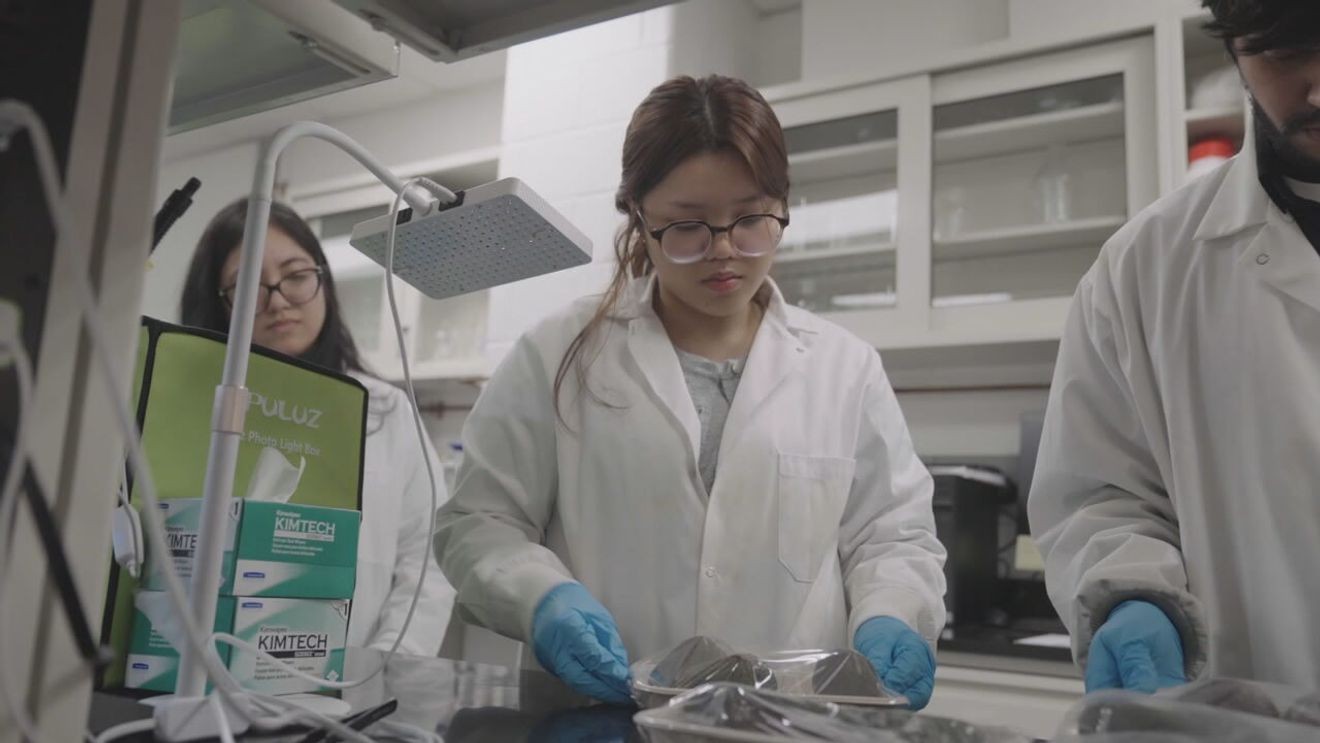
MAY 29, 2026 – A team of University of Maryland researchers says it may be on the verge of solving one of the world’s biggest environmental challenges: finding a biodegradable alternative to plastic that is affordable, effective and ready for mass production. (University of Maryland)
“They enter into the soil, animals eat it, and when we eat the animals or the plants, those are contaminated with microplastics,” Sose said. “It’s not just affecting the environment, but also human health.”
The researchers’ goal was ambitious: create a material that works like plastic, costs less than existing alternatives and naturally breaks down after use.
“If we put it in the garbage bin, within 20 to 30 days it can just degrade away into the soil,” Sose said.
One of the biggest challenges wasn’t finding biodegradable ingredients. It was determining the right recipe. Researchers experimented with materials such as cellulose and chitosan, a natural compound derived from shrimp and crab shells.
SEE ALSO | Study finds that 62 placentas tested had microplastics in them
The problem was that millions of potential combinations existed.
“There are plenty of different biodegradable materials,” Sose said. “The problem that we have is we don’t know the exact ratio that we need to mix each of these input materials.”
Traditionally, scientists would rely on years of trial and error testing.
“If you want to try millions of different samples, it would take several years to do that,” Sose said.
Instead, the Maryland team turned to machine learning and artificial intelligence.
“We use machine learning and AI to narrow down the search space and accelerate the design of these materials,” he said.
Dr. Po-Yen Chen, who leads the research effort, said robotics and AI have dramatically compressed the development timeline.

MAY 29, 2026 – A team of University of Maryland researchers says it may be on the verge of solving one of the world’s biggest environmental challenges: finding a biodegradable alternative to plastic that is affordable, effective and ready for mass production. (University of Maryland)
“Conventionally, bringing a new technology toward mass production can take two to three years because you need to test different formulations back and forth,” Chen said. “We reduced that timeline from years to about three months.”
Developing a true plastic replacement requires more than simply creating something biodegradable.
Food packaging must resist water. It must resist oils and grease. It must be strong enough to survive shipping and handling.
Improving one property often weakens another.
“When you’re tuning your formulation for one performance, sometimes you’re losing the other performance,” Chen said. “For example, if I want to enhance oil resistance, I’m decreasing my water resistance. So it is a trade-off.”
Researchers say AI allowed them to optimize multiple performance goals simultaneously.
“For this kind of packaging, there are multiple performance targets,” Chen said. “It needs to be oil-resistant. It needs to be water-resistant. It needs to be mechanically robust.”
The team says its technology helped identify formulations that meet those requirements far faster than traditional methods. The researchers say they have already demonstrated encouraging results.

MAY 29, 2026 – A team of University of Maryland researchers says it may be on the verge of solving one of the world’s biggest environmental challenges: finding a biodegradable alternative to plastic that is affordable, effective and ready for mass production. (University of Maryland)
In testing, produce wrapped in the biodegradable material remained fresh approximately twice as long as produce wrapped in conventional plastic cling film.
At the same time, the material naturally decomposed within three to four weeks when placed in soil.
Sose believes the technology could offer consumers something that is not only environmentally friendly but potentially better than the plastics currently lining grocery store shelves.
“It will be much cheaper as well as better for the environment,” he said. “We are making that product further better so that we can directly use them and remove the use of polyethylene plastics.”
The University of Maryland team is already working with industry partners to scale up production.
Chen said the researchers have partnered with a company that produces chitosan from shellfish waste and are now manufacturing large sheets of coated packaging material for commercial testing.
The team can currently produce sheets measuring about one meter by one meter and is working toward continuous industrial-scale manufacturing.
SEE ALSO | Gov. Moore invests in new federal defense contractor facility in Maryland, LufCo
The remaining challenges involve scaling production, further refining performance and ensuring the material remains cost competitive.
“It’s really hard to compete with plastic because plastic is so cheap,” Chen said.
Still, growing environmental regulations and industry demand for biodegradable packaging are helping create a market opportunity.
“I think by the end of the year, we should be able to see the product on some channels already, especially in produce packaging,” Chen said.
The Maryland team’s work comes as scientists continue to learn more about microplastics and their prevalence in everyday life.
Recent studies highlighted by ABC News found microplastics in human brain tissue, placentas, food supplies and drinking water. Researchers have also found higher concentrations in people with dementia, liver disease and preterm infants, although scientists caution that more research is needed to determine whether the particles directly contribute to those conditions.
For Chen, the urgency became personal during a scuba diving trip to the Pacific island nation of Palau several years ago. While underwater, he watched a sea turtle attempting to eat a floating plastic bag.
“I heard that before from the news,” Chen said. “But when I really saw it, it was shocking.”
The experience helped shape the direction of his research program at the University of Maryland. Three years later, that effort may soon result in a product designed to reduce the amount of plastic entering the environment in the first place.
The only thing still missing? A name — Despite the technological breakthrough, the researchers admit they have not yet settled on a branding for their invention.
“To be honest, we haven’t set up a name yet,” Chen said.
The science may be nearly finished. The marketing department’s work, however, is just beginning.

 Local Story