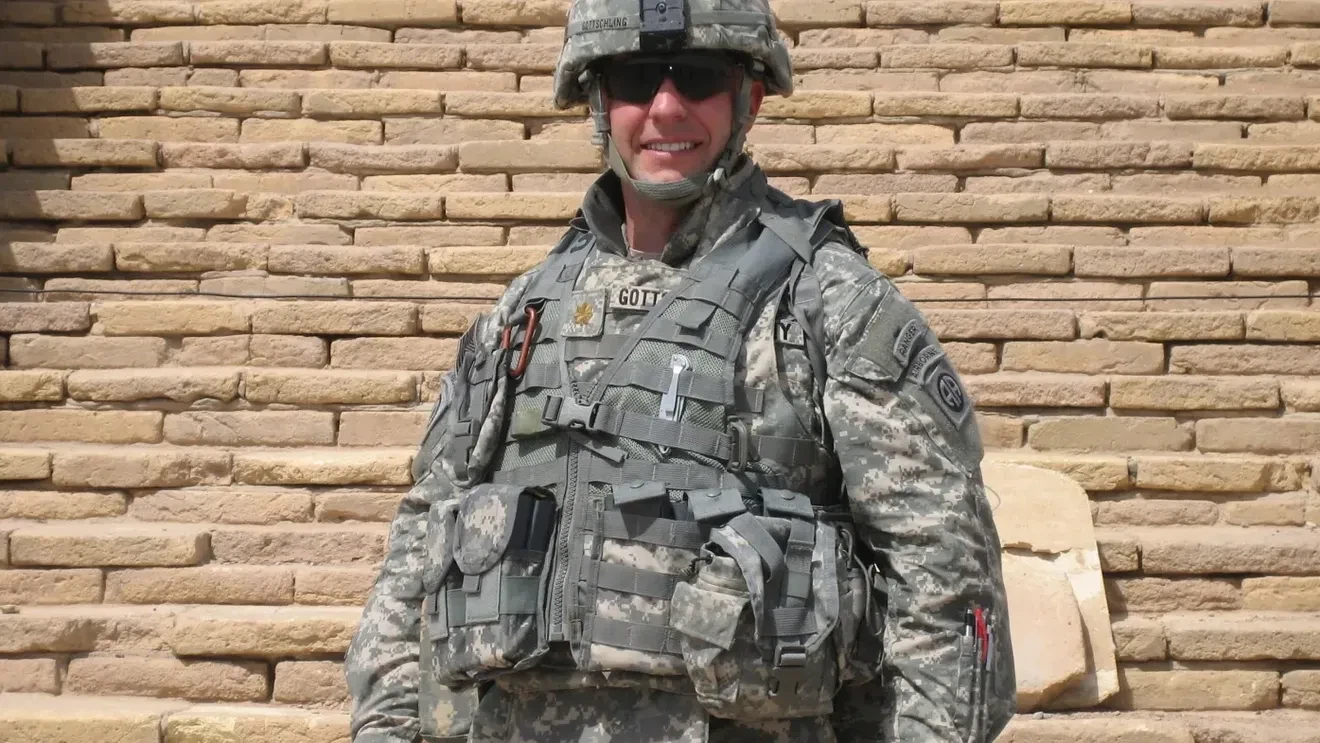
The Army officer who directly supervised Maryland Gov. Wes Moore in Afghanistan is challenging the governor’s accounts of his military service, disputing claims that Moore led soldiers in combat and questioning whether he deserved the Bronze Star he received nearly two decades later.
Retired Army Lt. Col. James “Jamie” Gottschling, who oversaw Moore during his 2005–06 deployment, told Spotlight on Maryland that Moore performed well as a staff officer but has since embellished his service in ways that raise serious questions about his honesty and integrity.
Moore’s office did not respond to Spotlight’s offer to sit down with the governor and give him an opportunity to dispute his former supervisor’s statements or any of Spotlight’s reporting to date.
Gottschling served 20 years in the Army, including 12 years in airborne and special operations assignments. A Ranger-qualified officer who deployed to Afghanistan and Iraq, he served with the 82nd Airborne Division, 173rd Airborne Brigade and U.S. Army Special Operations Command.
[embedded content]
Few officers had a more direct view of Moore’s responsibilities in Afghanistan. Gottschling supervised his work, helped write his performance evaluation and says he would have refused to support the Bronze Star awarded to Moore in 2024.
The following interview has been edited for length and clarity.
Drew Sullins: Wes Moore, who worked directly for you in Afghanistan, often says he was a paratrooper in the 82nd Airborne Division, but our reporting has repeatedly challenged that narrative that he really wasn’t a paratrooper; he was an attached Army reservist. As someone who spent a sizable portion of his own military career in airborne units, how would you respond to Wes Moore when he says those kinds of things?
Jamie Gottschling: I mean, the truthful part of that is that he served with the 82nd Airborne Division in Afghanistan, but not as a paratrooper. He wasn’t assigned to a parachutist position and didn’t earn jump pay, so therefore, he’s not a paratrooper.
Drew Sullins: When talking of being a “paratrooper,” Moore also often says that he “led soldiers in combat,” indicating that he participated in firefights while in Afghanistan. Are you aware of any actual combat experience Moore might have?
Jamie Gottschling: No, we were staff officers, brigade-level staff officers on FOB (Forward Operating Base) Salerno, which was a very big, protected base. I like to say that we’re combat veterans, but we’re not veterans of combat. You know, veterans of combat; that’s a different class of individual. You know, people that lead people in direct action who receive fire and actually fire their weapons at a hostile enemy, and that’s just not the role that we were in at that time.
Drew Sullins: What would you say to Moore directly in response to those claims?
Jamie Gottschling: Be honest. I mean, his service in Afghanistan was good. He was a valued member of the brigade staff. He was very helpful to all the operations that we did. I’m very appreciative of his effort and his sacrifice to go over to Afghanistan when he didn’t need to do that. But it’s disingenuous to say that you led paratroopers in combat, or that you did what would be direct action activities in a combat zone. So, I just say be truthful.
Drew Sullins: To your knowledge, did Moore ever fire his weapon in Afghanistan?
Jamie Gottschling: Not to my knowledge.
Drew Sullins: Describe for us what a typical day might look like for Moore in Afghanistan.
Jamie Gottschling: We’re at FOB Salerno in the Brigade Tactical Operations Center; we’re analyzing situation reports. We’re getting information from our tactical units that are in the field, the provincial reconstruction teams, the [infantry] maneuver battalions. Really, you know, down to the company level, because we were spread out But we would be getting that information and analyzing it and seeing where we could make headway into winning the hearts and minds of the Afghan people. That was our primary role. And as a brigade combat team, it’s kind of tough because you’re a bunch of steely-eyed killers over there, and then they want you to assist in humanitarian operations and deworming animals and all these things that that isn’t really your mission in a wartime environment, but we had to adapt to that mission.
Drew Sullins: So, in no way was Moore responsible for any kind of direct or indirect fire combat activity?
Jamie Gottschling: No. His job was information operations, which is tying together the civil military and public affairs stuff. He did a really good job trying to train the Afghans how to kind of sell their own story. When he would come along, some mayors or other Afghan officials, he would kind of tell them, “Hey, this is what you need to do in response to this. If there’s a flash flood, people are hurt or killed, you need to go to the hospital, visit, get out there and give some comfort to your constituents.” So, he was doing a lot of that, training them on public affairs for their own affairs.
Drew Sullins: In Moore’s 2015 book, “The Work,” he elaborately describes participating in his first firefight in Afghanistan and then spoke of soldiers he led as if he was commanding them. He said, he “knew everything about them: Which ones were having financial troubles or marital issues. Which ones were motivated by carrots, which were motivated by sticks. Which ones were making the military a career, etc.” He also said he made himself available to them even when he was “exhausted and weary” because that was essential to lead them effectively. Did Moore, even as a staff officer, actually lead any troops?
Jamie Gottschling: You know how staff officers are. You don’t really lead staff officers. You coordinate with staff officers. That sounds like the role of what a platoon leader or company commander would be. I mean, if he was in a military police company [Moore’s assigned branch of the Army], that’s what he would have been doing. But that’s not what his role was.
Drew Sullins: So, he didn’t have any troops assigned to him? He didn’t write any evaluation reports on soldiers?
Jamie Gottschling: No.

Retired Lt. Col. James “Jamie” Gottschling was Wes Moore’s immediate supervisor in Afghanistan. He said the Army Commendation Medal — not the Bronze Star — was Moore’s end-of-tour award. (Steve Pierce/Spotlight on Maryland)
Drew Sullins: Speaking of evaluations, Moore often uses his officer evaluation report (OER) from Afghanistan to cite his skill and ability, and he likes to use that “top 1% officer in Operation Enduring Freedom” line as an example. You wrote part of that report as his rater. Was he as good as he sounded?
Jamie Gottschling: If you read your evaluations and you think it’s really close to that, you’ve got an issue, because there’s nothing humble about that because they are inflated. I wouldn’t read my own and say that that was really who I was. There’s a lot of embellishment, but that’s how the system was. You’re trying to take care of your soldiers. You’re not trying to be deceitful about it, but you want to elevate what they did and their accomplishments, so that they can get the next job or the next promotion. I was very transparent about that evaluation. He did everything that he was called to do. There were never any issues with his performance over there. I think he can be very proud of that. It’s just really the embellishment of the story after that that’s the issue.
Drew Sullins: Moore claims he was close friends with First Sgt. Tobias “Toby” Meister and helped select the route his team took on the day he was killed in Afghanistan (Dec. 28, 2005). He also claims he envisioned Meister’s body in his grandfather’s casket, even though his grandfather’s funeral occurred 11 days before Meister’s death. Our reporting indicates the Asadabad PRT commander, Meister’s commander, who I’ve spoken with, that neither he nor Meister knew who Moore was. What do you make of these claims, particularly Moore’s trying to gain sympathy and political capital from the death of a fallen soldier and what would you say to him about them? Do people have a right to be angry over these claims?
Jamie Gottschling: Absolutely. You know, for people that serve shoulder to shoulder and have experienced those things –– and those things are valid –– I think that when somebody comes in and just kind of superimposes themselves into that situation, it’s just disingenuous and should be called out. I mean, truth is the truth, and we need to hold on to the truth.
Drew Sullins: Would you be willing to go so far as to say that this story about Toby Meister is a lie?
Jamie Gottschling: Yeah, it’s a lie.
Drew Sullins: For nearly two decades, Moore has claimed that he was approved for the Bronze Star in 2006, but the paperwork was lost, a claim used to justify his retroactive award in 2024. You provided photographic evidence that Moore actually received an Army Commendation Medal, which you said was his intended award, in part, because he served only about half the deployment. You also cited Maj. Britton London, a more senior officer, who arrived midway through the deployment like Moore did and also received an ARCOM. Can you explain how end-of-tour awards were determined and processed in your brigade, particularly during the final weeks before redeployment?
Jamie Gottschling: Yeah, it’s very chaotic. You’re trying to get another unit to come in, take over your responsibility. At the same time, you’re trying to get your soldiers situated so that they can redeploySo, there’s a lot of cutting and pasting [of awards recommendations], and I’m not sure that that’s how it was in our brigade, but certain people get certain awards. If you’re junior enlisted, you’re getting not even an Army Commendation Medal. You’re getting an Army Achievement Medal. Then you, and then it goes by rank. I was awarded a Bronze Star. Did I deserve a Bronze Star? I don’t know. I mean, it’s really a wartime award for people that are in a combat area. So, I really don’t know all the particulars about that. But a junior officer who wasn’t part of the original unit that came over and only served half of the deployment, I would say, doesn’t warrant a Bronze Star.
Drew Sullins: So, as Wes Moore’s Afghanistan supervisor, you’re completely comfortable that he received the Army Commendation Medal?
Jamie Gottschling: Absolutely. I mean, most of the people I worked with in my section were awarded the Army Commendation Medal.
Drew Sullins: Could there have been anything, in your view, that Moore could have done to have earned a Bronze Star for meritorious participation?
Jamie Gottschling: No.
Drew Sullins: Speaking of the Bronze Star, Moore’s retroactive 2024 award has a lot of errors in it, and you had stated to us earlier that, in the citation, he was taking credit for things that you did. Do you have any idea why it was written the way it was?
Jamie Gottschling: There was a lot of detail in that. A lot of things that probably were erroneous. The length of the service was wrong. It talked about a lot of the responsibilities, as you indicated, that were my responsibilities as the senior fire support officer in that area of operations. That was my job was doing all that, and then it was delegated to people that worked for me. He was just one of those people. So, I do think that it’s kind of peculiar how that was written and some of the things, some of the language that was used in it.
Drew Sullins: What if I told you we have strong indications that Moore may have written his own recommendation for the retroactive award. Would that surprise you?
Jamie Gottschling: No, not really. A lot of times, military awards are written just like an officer evaluation report because your senior officers don’t know all the ins and outs of what you did, so they ask for a lot of input from you. But when you’re talking about specific deployment dates, times, and things like that, that’s a problem. And I did also notice on the Bronze Star, the 638 (DA Form 638) that it indicated that Wes Moore was a captain retired. You know, he didn’t retire from the military, and to put that in there is another error in that system.
Drew Sullins: Are you surprised they didn’t contact you for the retroactive award? You were the officer most familiar with what Wes did in Afghanistan in 2005-06.
Jamie Gottschling: Sure.
Drew Sullins: Would you have participated had they contacted you?
Jamie Gottschling: Absolutely not.
Drew Sullins: So, you didn’t think that Wes Moore deserved a Bronze Star Medal, so you wouldn’t have participated?
Jamie Gottschling: Right. And I know that he got an award for that service? Right now, the problem is that he has two awards for the same time, and that doesn’t, that shouldn’t exist in the military. He originally got an ARCOM. If he was going to get a Bronze Star, that should have been an upgraded award, which goes through a different process than to create an award like this Bronze Star presented in 2024 out of thin air.
Drew Sullins: What do you think this entire episode says about Wes Moore’s character?
Jamie Gottschling: I think it calls his character into question. My biggest issue with Wes Moore is that he’s in a leadership position. It happens to be political, and his character is an issue. His integrity is an issue. His truth-telling is an issue, and that’s my problem. You know, I wouldn’t have any problem with him talking about his service, talking about how he sacrificed. I was very appreciative of it, but it’s the rest of the story, or the after-story, that’s the problem. That’s where the chink is in the armor.
Candy Woodall: What’s your biggest problem with the way he’s described his service in Afghanistan?
Jamie Gottschling: The biggest problem I have with it is because it’s all about self-promotion to get the next jobThen from there he had to embellish the application for the White House Fellowship. Then he gets that. Then it’s whether that sets him up for a post-career after that. You know, but it’s all about setting the conditions for the next big thing. But that’s a problem.
Candy Woodall: Wes Moore frequently says in debates and interviews that the Army doesn’t question his integrity, the 82nd Airborne Division doesn’t question his integrity. Do you?
Jamie Gottschling: I do.
Candy Woodall: Why is that?
Jamie Gottschling: As a former Army guy, paratrooper, it’s offensive when somebody makes claims that are unique to certain service or individuals, and that’s a problem for me. You know, I served in airborne units for 12 years of my 20 years and jumped out of planes in the middle of the night in foreign countries –– not in a combat zone or anything –– but you know, those are real experiences. That’s what paratroopers do: jump with a full combat load and land hard and not know where you are and all those kinds of things, and he has no idea what that’s about. So, for him to say that he leads paratroopers or that he is a paratrooper is again, it’s disingenuous.
Drew Sullins: During the recent election campaign, Wes Moore would not commit to serving the full four-year term as Maryland’s governor, if reelected, which many are saying is a strong indicator that he will mount a 2028 presidential bid. What are your thoughts of Wes Moore serving as the commander-in-chief of the Armed Forces?
Jamie Gottschling: Unqualified. I think his past resume has demonstrated that he’s unqualified to serve in those positions. I know that doesn’t really say a whole lot because there’s a lot of people in those positions now that don’t deserve being in there, their resume doesn’t. But that’s what elected officials are. They’re not running on a resume. They’re running on popularity. It’s not competence. It’s just their ability to get votes. That’s the scary thing, because you get somebody in that position that you can’t trust. I have a problem with that.
Drew Sullins can be reached at dpsullins@sbgtv.com. Spotlight on Maryland is a joint venture by FOX45 News, The Baltimore Sun and WJLA in Washington, D.C. Send story tips to spotlightonmaryland@sbgtv.com or call our hotline at (410) 467-4670. Follow us on X at @SpotlightMDNews, and on Instagram and Facebook at Spotlight on Maryland.
This post was originally published on Fox 45 by Sinclair Media Group.
 Local Story