The Savvy Investor
10:00 am - 11:00 am
Retired Army Lt. Col. James A. Patton remembers the moment he called a halt to Wes Moore’s second run through a live-fire convoy range in Afghanistan.
Patton was watching as Moore moved from one target to the next.
Before Moore could get his pistol out of its holster, Patton said, a round fired into the ground.
It was then that Patton said he fully realized that Moore was “a military neophyte.”
Maryland Gov. Wes Moore describes the incident in his 2015 book “The Work: Searching for a Life That Matters,” including what he says Patton told him afterward.
The two men agree that Moore fired the round by accident. They differ on why Moore was on the range, what he was doing when the pistol went off and what Patton said to him afterward.
In an interview with Spotlight on Maryland, Patton also challenged two claims Moore made on his 2006 White House Fellows résumé. One concerned Moore’s role in establishing a university partnership. The other concerned his authority over brigade personnel, including the psychological operations teams Patton led.
Patton, of Amarillo, Texas, served 36 years in the Army Reserve and National Guard, including deployments to combat zones. Now a semiretired chemical engineer, he spent more than a decade as an enlisted soldier in combat units and reached the rank of sergeant first class before receiving a direct commission, initially as an infantry officer before reclassifying into psychological operations.
During the 2005-’06 deployment, Patton and Moore were Army reservists attached to the 1st Brigade, 82nd Airborne Division. Patton was a captain and the brigade’s psychological operations officer. Moore was a lieutenant assigned to information operations. Both reported to then-Maj. James A. “Jamie” Gottschling.
Patton recalled that at their first meeting, Moore made a point of mentioning his personal relationship with Lt. Col. Michael R. Fenzel, the brigade’s deputy commander.
“Wes Moore was the kind of guy that five minutes after you met him the first time, you knew everything that he had ever done, because he would make it a point to humble brag for you, either to create instant credibility with you or, you know, impress,” Patton said. “Like after meeting him for just a few minutes, I knew he was a Johns Hopkins graduate, a Rhodes scholar and — his words, not mine — close friends with Mike Fenzel,” the brigade deputy commander.
Moore’s office did not respond to an interview request for this story. The governor has not sat down for an interview with Spotlight on Maryland to answer questions about his military record and has not refuted any of Spotlight’s reporting to date with evidence.
‘Everything was fabricated’
Moore identifies Patton by name in his account of the negligent pistol discharge at Forward Operating Base Salerno (FOB Salerno). Moore writes, “ during target practice with members of my civil affairs team, I accidentally let off a round trying to reholster my weapon, coming inches from shooting myself in the foot.”
Moore describes what happened next. “Captain Patton pulled me aside and, through a huge smile, said, ‘After the stuff we’ve seen out here, it would be pretty ironic to have to give you a Purple Heart for shooting yourself.’”
Patton disputed that account.
“The only thing I saw that he got correct in the book was one, he did have a negligent discharge, and it was his own fault and two, he got my name spelled right, and I am from Texas. Other than that, everything was fabricated.”
Patton specifically denied making the remark Moore attributed to him. “He tells this ridiculous Purple Heart story everyone knows you can’t get a Purple Heart for a self-inflicted wound.”
According to Patton, Moore was on the range because he was expected to accompany his psychological operations team on selected missions outside the base. Before taking him along, Patton wanted to see how he handled his weapons and whether he could follow the team’s procedures under fire.
“In order for him to do that, he had to become familiar with and trained on my team’s TTPs [tactics, techniques and procedures]. You don’t want somebody going out with you that when you react to an ambush one way, they go the other. That just gets people killed,” Patton said.
Staff Sgt. Brad Milton, the team’s noncommissioned officer in charge, trained Moore. The drills called for soldiers to engage targets with a rifle and a pistol, as they would if their convoy came under fire. Some tasks took place inside a Humvee and others outside it.
Patton described Moore’s first run as “alarmingly comical,” and said the team gave him more training before a second attempt. This time, Patton accompanied him on the range.
“He engaged two targets standing with his M4 [rifle] and then moved towards what would have been cover to fire at a target through an opening with his pistol,” Patton said. “As he drew his pistol, it discharged into the ground. After charging the pistol at the beginning of the run, he failed to safe the weapon” — meaning he had not activated the pistol’s safety.
Patton ended the exercise.
“I had him clear both weapons and said, ‘You’re done. I’m not going through this again because you’re clearly not comfortable and not safe.’ He was very nervous around weapons with live ammunition,” Patton said. “I told him at the time, you’re not going with us. You’re going to have to find another way off of the FOB.”
Soon afterward, Patton said, Fenzel summoned him to his office.
“Colonel Fenzel called me in and spent about 30 minutes ripping me apart for having done something I was told by the commander, [Col. Patrick Donahue], to do,” Patton said.
Patton attributed the reprimand to Fenzel’s relationship with Moore.
“He [Moore] was clearly attached to the staff as a pet project of Fenzel’s –– both are Johns Hopkins graduates –– and that seemed to be the reason Moore was there to begin with I knew they were close friends,” Patton said. “At the time, I thought he took issue with what I was doing, but in retrospect, I think he did not appreciate me embarrassing his pet project.”

Lt. Gen. Michael Fenzel, United States Security Coordinator of the Israel and Palestinian Authority, right, pins the Bronze Star on Maryland Gov. Wes Moore. MUST CREDIT: Marvin Joseph/The Washington Post
‘Someone who’s never been shot at’
In the introduction to his 2015 book, “The Work,” Moore describes coming under fire.
“As a soldier, you never forget the first time you get shot at. A sudden, stunning commotion engulfs you — the sound of shells buzzing past your ears, a flurry of divots leaping out of the earth around your feet — but then everything slows down as your training kicks in. Find Cover. Scan for the position of your men. Return fire,” Moore wrote in the book.
Moore also describes his reaction: “We’re all going to die one day –– everyone knows that. As soldiers, we practice owning that truth, living with it, and, when the bullets fly, confronting it with calm professionalism when I heard those first bullets, for a moment I felt my body flood with fear and tried not to let the fear control me.”
“My initial thought, having read that, was that this is someone who’s never been shot at,” Patton said.
What stood out to Patton was the detail with which Moore described the firefight and how little he said about where it happened or who was with him.
“If he remembers in such distinct detail all the happenings, why can’t he recall where it was at? Who was he traveling with? He was an inexperienced lieutenant with no assigned soldiers. Why don’t those soldiers come forward and attest to any of this?” Patton said.
Patton also questioned why Moore didn’t receive recognition for the encounter he described: “If indeed Moore was in a firefight, why did he not get an award for it like the Combat Action Badge [CAB] or a Bronze Star if he led soldiers and soon after the fact?”
Moore did receive a Combat Action Badge, but as Spotlight previously reported, it was for an indirect-fire incident at Forward Operating Base Salerno on Dec. 9, 2005. No one was injured in that event.
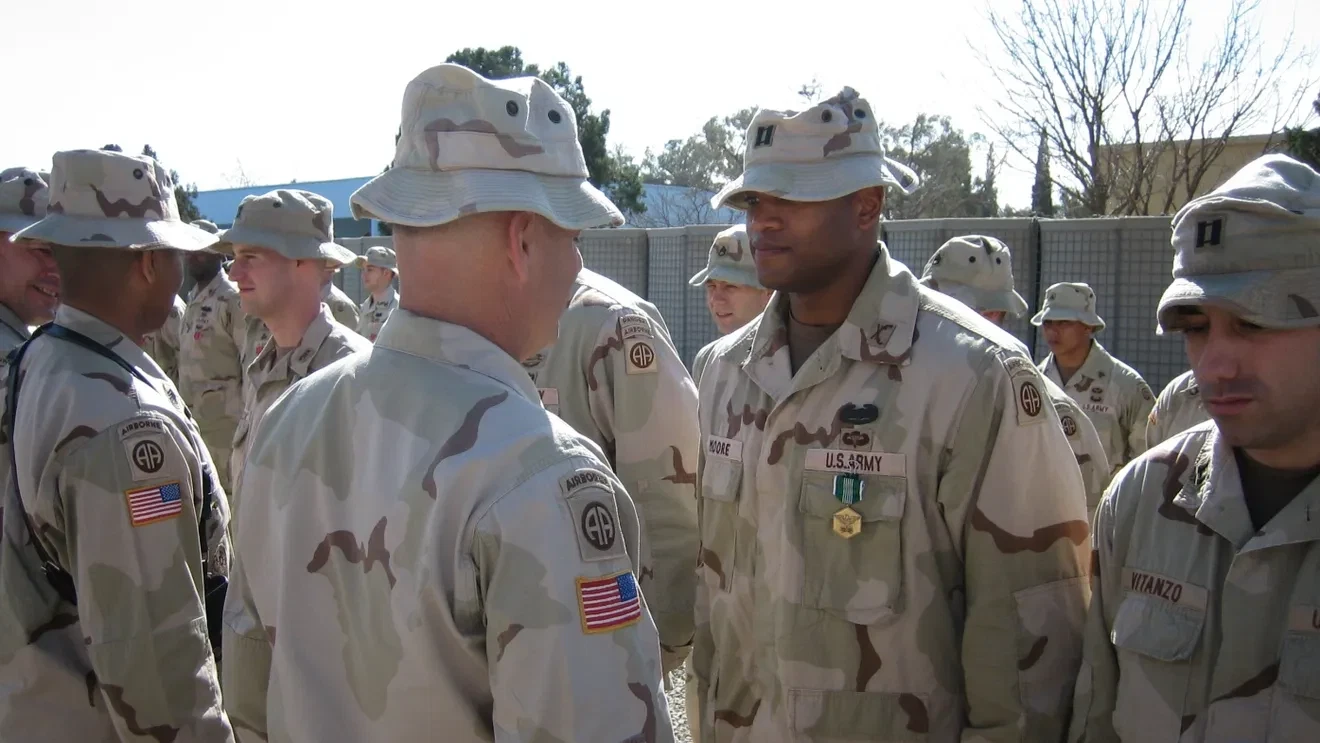
And the only medal Moore received during his time in Afghanistan was his end-of-tour award, an Army Commendation Medal, according to his supervisor, Gottschling, and as confirmed by photos of the awards ceremony from March 1, 2006.

Retired Lt. Col. James “Jamie” Gottschling was Wes Moore’s immediate supervisor in Afghanistan. He said the Army Commendation Medal — not the Bronze Star — was Moore’s end-of-tour award. (Steve Pierce/Spotlight on Maryland)
A university partnership?
It’s well known that Moore lied and listed the Bronze Star Medal on his 2006 White House Fellows résumé. On that same résumé, Moore disingenuously described his role in establishing a university partnership.
“As a paratrooper, I initiated first-ever university educational partnership between an American and Afghan university,” Moore’s 2006 application said.
It is yet another false claim made by Moore that cannot be backed up by his military colleagues.
Patton recalled that Moore accompanied his team to Khost University. In Patton’s account, a State Department official from the U.S. Agency for International Development (USAID) requested the visit in support of USAID’s Afghanistan Higher Education Project. Patton’s team provided the military escort, and Moore was there for the meeting.
“I’m very dubious as to the veracity of that claim [by Moore] because the whole point of us taking troops to Khost University was prompted by a request from a representative of the Department of State [and USAID] who was on Salerno at the time Our whole point in going to the university was to take them from Salerno to there, and while we were there, to engage students and/or faculty with my tactical psyops guys. Moore did sit there and participate but [establishing that partnership] wasn’t really in his list of taskings,” Patton said.
Retired Army Col. John W. Harney served as the senior civil affairs staff officer for Combined Joint Task Force 76, the brigade’s higher headquarters. He described how such projects typically began and where the military fit in.
“There were volumes of folks through the State Department and USAID who would show up and say, we would like to do this and then military assets, which is where the civil affairs –– the military side of the house comes in –– would be utilized to assist them in their ventures,” Harney said.
Harney questioned whether a lieutenant with Moore’s experience would have coordinated a university partnership.
“The fact that he would be, at that level, involved in synchronizing it and making it happen, that university partnership, no way. Someone that junior in grade[rank]? I don’t think so,” Harney said.
Who supervised the brigade’s teams?
Moore’s White House résumé also said he “Oversaw a staff of 25 people, to include 11 Afghans, and was responsible for Brigade Assets such as Psychological Operations, Electronic Warfare, and Civil Affairs,” a description Patton challenged based on his own position in the brigade.
Patton led four psychological operations teams in eastern Afghanistan. He said he reported to Gottschling, as Moore did. In Patton’s view, Moore’s description of his responsibilities placed the lieutenant above him.
“In what clown world does it make any credible sense for an inexperienced Military Police lieutenant to be in charge of a branch-qualified and experienced O-3 [a captain] like me?” Patton said.
Gottschling, who retired as a lieutenant colonel, previously told Spotlight that Moore served exclusively as an information operations officer and had no troops assigned to him during his six months in Afghanistan.
Saying he oversaw 25 people appears to be another debunked claim from Moore’s résumé.
‘Attached at the hip’
Patton recalled seeing Moore and Marine Lt. Anthony Del Signore, the brigade’s public affairs officer, together at Salerno. He said the two also traveled outside the base to meet with local Afghan leaders.
“When you saw Moore, you saw Del Signore and vice versa. They were pretty much attached at the hip,” Patton said.
Del Signore has described coming under fire with Moore. Patton questioned whether that account corroborated the kinds of combat engagements Moore described in his book and elsewhere.
“[Moore] can’t seem to find a credible source of confirmation. And what I mean by that was, yeah, we took harassing fire from a mountainside. That’s a far cry different from a direct fire ambush,” Patton said.
After reading this month’s report in the Washington Free Beacon on Del Signore and his troubles leading to his untimely departure from the FBI, his relocation to Thailand to be with a Russian cam girl and his financial difficulties, Patton questioned why Moore’s public relations team would turn to Del Signore to back up Moore’s story and what his motivations for cooperating might be.
“Del Signore and his motivations, I have my own opinions on what those might be for supporting Moore. But am I surprised they dug him out of the woodwork? No,” Patton said.
End-of-tour awards
By the end of the deployment in 2006, Patton had 21 years of enlisted and commissioned service. He was a senior captain responsible for four psyops teams across eastern Afghanistan. Spotlight asked what award he received at the end of his tour.
Patton said, “I received an Army Commendation Medal (ARCOM).”
Moore also received an ARCOM, and despite photographic evidence and statements from his direct supervisor, Gottschling, that it was his intended award, Moore has failed to publicly acknowledge that he received it.
And in 2024, in pursuing a retroactive Bronze Star Medal, Moore and his mentor, Fenzel, misled retired Maj. Gen. Jason K. Kamiya and Army officials by not disclosing that ARCOM, in what Spotlight has reported, may have been a criminal manipulation of the military awards system.
That Moore had previously received an ARCOM for that period of service should have been mentioned in the award recommendation form, a DA Form 638, and it was omitted, which surreptitiously changed the nature of Moore’s award request.
As previously reported, Spotlight is in possession of a document issued by the Department of War Inspector General stating, “documents that may be responsive to your request are compiled for a law enforcement inquiry, and release, at this time, could reasonably be expected to interfere with the inquiry.”
Spotlight does not have an update as to the status of this inquiry.
Drew Sullins can be reached at dpsullins@sbgtv.com. Spotlight on Maryland is a joint venture by FOX45 News, The Baltimore Sun and WJLA in Washington, D.C. Send story tips to spotlightonmaryland@sbgtv.com or call our hotline at (410) 467-4670. Follow us on X at @SpotlightMDNews, and on Instagram and Facebook at Spotlight on Maryland.
Editor’s note: In a statement emailed Saturday to Spotlight on Maryland, Gov. Wes Moore’s spokesman Ammar Moussa said: “These recurring attacks on Governor Moore are about politics, not facts—and Marylanders rejected these lies when they re-elected him by more than 30 points. Governor Moore is deeply proud of his service, and we have nothing to hide because the U.S. Army’s signed records speak for themselves: he earned the Combat Action Badge, led information operations across five battalions and eight Provincial Reconstruction Teams, and was called a ‘top 1% officer’. Fellow soldiers who served alongside him have also spoken out to confirm his combat record. Governor Moore remains focused on delivering for Maryland families, not shameful, politically motivated attempts to smear his service 20 years after he returned home from war.”
Spotlight on Maryland will have more coverage soon on the statement from the governor’s office.
This post was originally published on Fox 45 by Sinclair Media Group.

 Local Story