(TNND) — NASA will have to wait at least a month to launch humans to their deepest point in space in over 50 years.
The launch of Artemis II will be pushed from a possible February window to March at the earliest after a “wet dress rehearsal,” a prelaunch test to fuel the rocket, was terminated because of a liquid hydrogen leak early Tuesday.
“You want to make sure that you can do all of the things that it takes to get humans safely to and from space without any major operational or infrastructural hiccups,” said Kenny Evans, a fellow in science, technology and innovation policy at Rice University. “And so, it’s very important that they do these wet tests, that they do all the flight rightness checks.”
Evans said working with hydrogen fuel is tricky, but Tuesday’s issue isn’t anything out of the ordinary for NASA.
And delaying the rocket’s launch by a month or two isn’t a concern in the grand scheme, he said.
“There’s lots of I’s and lots of T’s, and they all need to be dotted and crossed,” Evans said.
Artemis II will be a crewed flight around the moon. The lunar flyby, when it happens, will take the four astronauts 10 days to complete.
“They’re going past the lunar far side,” said Margaret Landis, an assistant professor at Arizona State University’s School of Earth and Space Exploration. “So, that’s, from a science perspective, something that’s really cool about Artemis II, is that a human has not seen the lunar far side since the 1970s.”
Once Artemis II happens, humans will be the farthest they’ve been from Earth since the Apollo 17 mission in 1972.

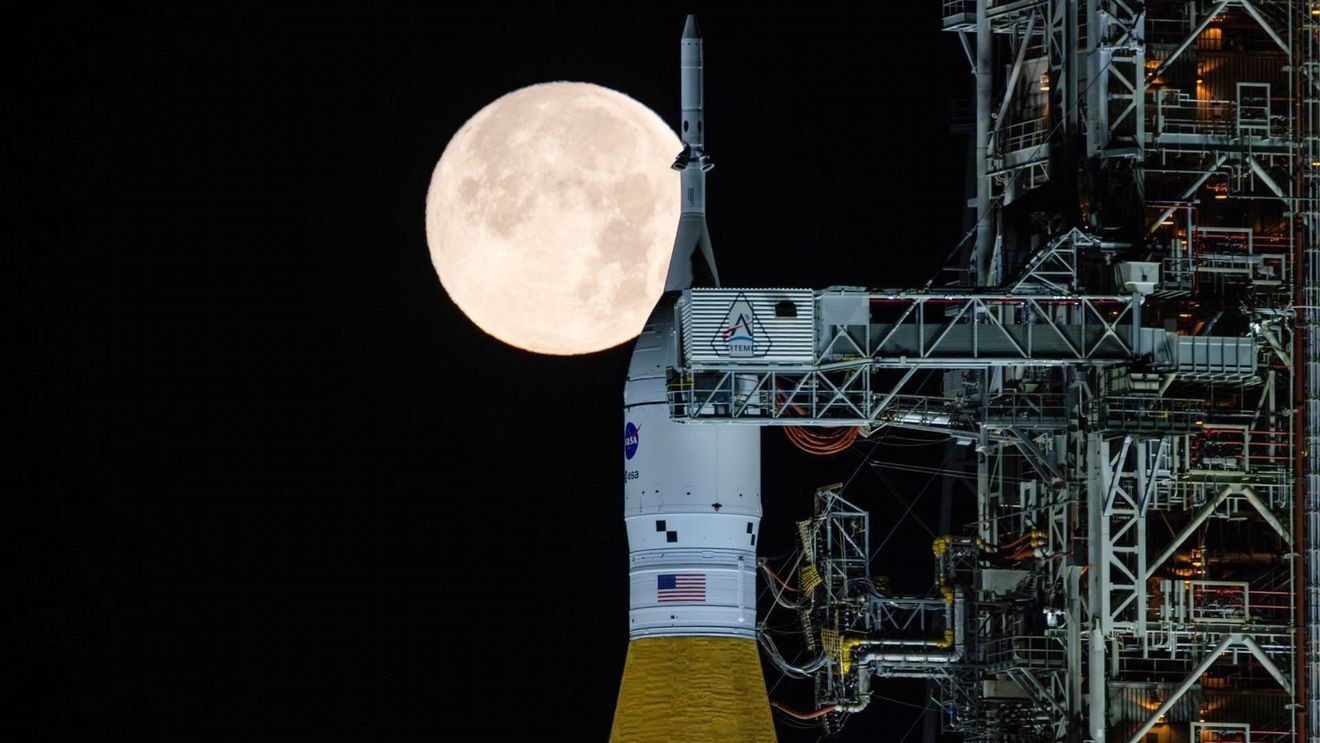
The NASA Artemis II SLS (Space Launch System) rocket with the Orion spacecraft is seen at Launch Complex 39B at the Kennedy Space Center, Sunday, Feb. 1, 2026, in Cape Canaveral, Fla. (AP Photo/John Raoux)
Artemis II builds on 2022’s Artemis I uncrewed lunar flight test.
And it will serve as a vital stepping stone to the Artemis III mission, planned for 2028.
NASA plans for humans to touch down on the moon’s surface during Artemis III, during which they’ll explore the lunar South Pole region.
“This is really meant to be a live test of the entire system before landing on the moon,” Landis said. “It’s very much test like you fly, and then testing more and more complex versions of that system until you do what you intended to. Part of the caution is that human spaceflight is challenging, and there is a life rather than just property on the line. So, we take that really seriously.”
The moon basically rotates at the same rate that it orbits the Earth, so that we really only see about half the moon, Landis said.
The upcoming Artemis missions will offer a new generation of explorers and scientists the opportunity to study rarely seen parts of the moon. And Landis said the missions might inspire the next generation of explorers and scientists to go even further.
NASA said the Artemis missions could eventually take humans to Mars, but that’s a far more challenging task than the moon missions, which are extremely challenging in their own right.
Landis said a round trip to Mars would take a couple of years, compared to 10 days or a month for the Artemis II and Artemis III moon missions.
“Being in space for 18 months to 24 months, then being in microgravity, and then coming back is a very different beast,” she said.

 National Headline