(TNND) — New car sales began the year on a weaker note as ongoing affordability concerns continue to throttle demand, according to a new Bank of America Institute report.
However, January car sales might’ve come in stronger if not for the big winter storm towards the end of the month.
Bank of America data on consumer vehicle loan applications suggests sales might’ve hit or even exceeded last January’s total if not for the weather disrupting car shoppers.
“But all that being said, when you look back at car sales since the pandemic, barring a few months, they’ve generally been weaker,” Bank of America Institute Senior Economist David Tinsley said.
And he said affordability is a key part of the drop in automotive sales volume.
New car prices are up around 22% compared to 2019 levels, while used car prices have jumped around 30%.
Meanwhile, it costs more to both finance a car purchase and insure a new vehicle.
“The affordability concerns are everywhere, but they’re also particularly acute in vehicles,” Tinsley said.
January saw about 15.4 million vehicle sales, down from 16.4 million in December and down from around 16 million the January before.
For comparison, Bureau of Economic Analysis data shows about 17.5 million vehicles were sold in an average month over the three years preceding the pandemic.
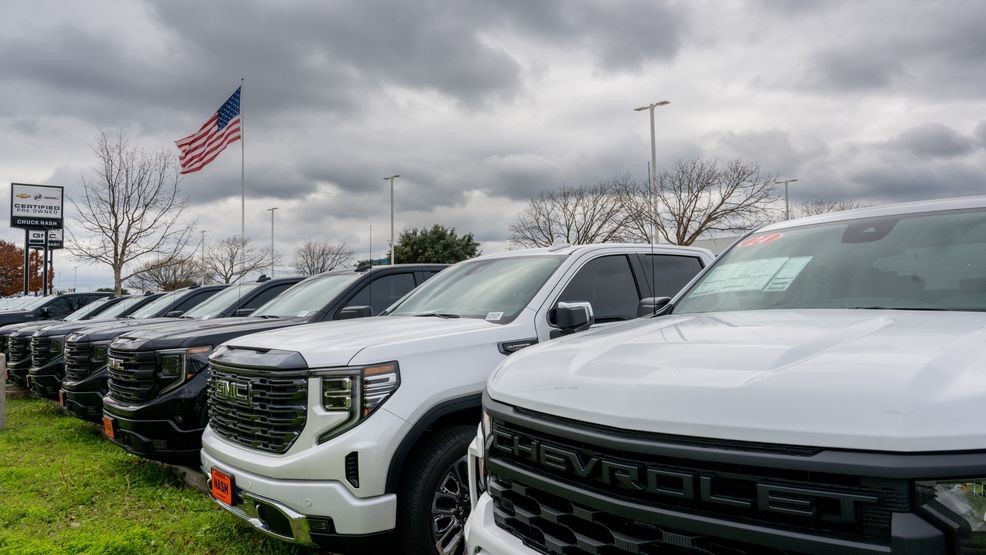
FILE – Vehicles are seen for sale at a dealership Jan. 3, 2024, in San Marcos, Texas. (Photo by Brandon Bell/Getty Images)
The Bank of America Institute found that affordability pressures are especially impacting younger car buyers.
The average auto loan payment from Bank of America customer accounts has risen most for younger millennials, those in their early or mid-30s.
That generation’s average auto loan payment is up nearly 60% from 2019.
Tinsley said those folks are forming households and are possibly more dependent on financing car purchases as they grow their families.
Kelley Blue Book reported that last month set the record for January new vehicle prices, coming in around $50,000.
The best-selling vehicle segment was the compact SUV.
But KBB said strong sales of full-size pickups and large, luxury SUVs keep pulling the average vehicle price higher.
And the U.S. market no longer has a new vehicle with an average sticker price below $20,000.
Tinsley said the so-called K-shaped economy is probably boosting the higher-end of the vehicle market.
The K-shaped economy is one in which lower-income people are disproportionately hurt by inflation while high-income households fare better.
“Essentially, this is a tough environment for many people, but not everybody,” he said. “And some higher-income households are continuing to spend pretty well.”
Typical car prices are hitting new highs not only because of inflation, but the vehicle mix is shifting to more expensive models.
Tinsley said expected higher tax returns could boost car buying, though he said the affordability concerns are likely to keep volume below prepandemic levels.
And he said affordability concerns are taking a bite out of electric vehicle sales.
Bank of America auto loan origination data appears to show demand for hybrids replacing some of the demand for new EVs.
Lower gas prices, coupled with the expiration of the $7,500 EV tax credit, also appear to be hurting demand for EVs, though the used EV market has fared better.

 National Headline