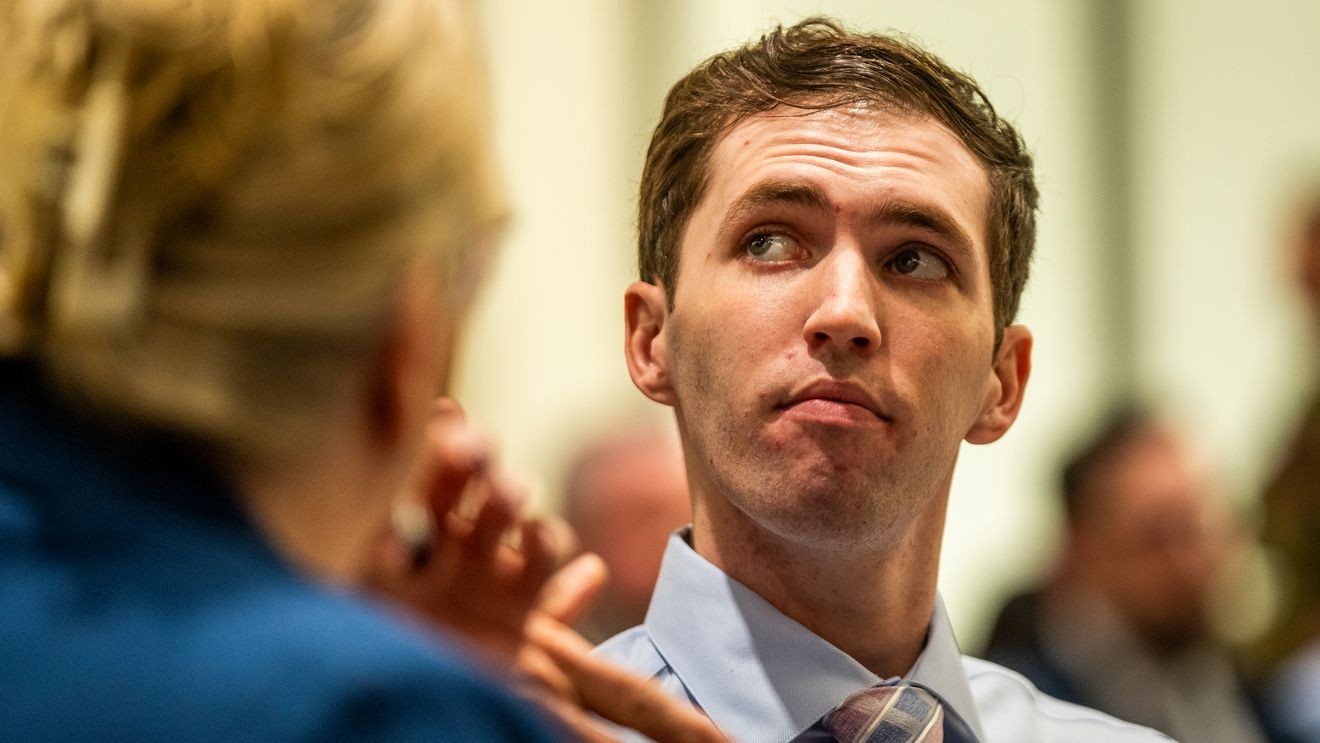
PROVO, Utah (KUTV) — Tyler Robinson, the man accused of shooting and killing Charlie Kirk, is expected back in court Friday for a state judge to weigh on whether or not certain documents and proceedings will allow media access and be open to the public.
What the judge decides will set the stage for the evidentiary hearing scheduled for April 17.
A motion filed by his attorneys, in part, states, “Mr. Robinson seeks to take evidence in a closed setting regarding the unfairly prejudicial and misleading media coverage and the improper statements of government officials in order to avoid republicizing the same.”
Robinson’s attorneys argue this request is based, “upon the realistic likelihood of prejudice to Mr. Robinson’s right to a fair trial.”
In this motion of theirs, Robinson’s team cites a 1984 Utah Supreme Court case – Kearns-Tribune Corp. v. Lewis – as a reference to why media and cameras should be excluded from the hearing.
Skye Lazaro, a Salt Lake City-based criminal defense attorney not associated with the Robinson case, sat down with KUTV to go over why this 1984 case is referenced and how it applies to Robinson.
“What this case did is analyze the historical view the United States Supreme Court has taken on the press’s First Amendment right to cover trials,” said Lazaro. “What this case does is differentiate between a trial and, as here, a preliminary hearing.”
Kearns-Tribune Corp. v. Lewis – otherwise known as Utah 1984 – is a Utah Supreme Court case that goes over the circumstances in which a judge can exclude the public and media from preliminary hearings, but explains how trial courts must hold a hearing and make known their specific findings before a judge issues any restrictions on the press.
Lazaro explained how, with a case like Robinson’s, attorneys want as little information about the case to come out before a jury is seated and trial has begun. That, she said, is because information shared during a preliminary hearing does not follow the same “rules” as a trial.
“The rules of preliminary hearings are far different than the rules at trial. The rules of evidence are different. Hearsay can be admitted,” said Lazaro, “So, because the rules are so different at a preliminary hearing juncture vs. the trial juncture, a defendant would want to limit the public’s access to things that may or may not be admissible down the road.”
With Robinson’s case being such a high-profile topic and receiving local, national, and international coverage, Lazaro said protecting a client’s right to a fair trial is one of the main objectives of his attorneys. But according to the 1984 case, it is up to his team to prove there is a “clear and present danger” that could jeopardize Robinson’s right to a fair trial and that there are no less restrictive alternatives available.
So, while the media and public have both a federal and state constitutional right to have access to information, Robinson has a right to a fair trial, and it is up to the judge to determine whether or not the right to a fair trial outweighs, or is at risk, if the right to information remains intact.
“As a defense attorney, your duty is to your client, and so you do everything you can to protect information getting out there that may sway a jury or information that may not be admissible in trial that goes to your defendant’s character, things along those lines,” said Lazaro.
_____

 National Headline