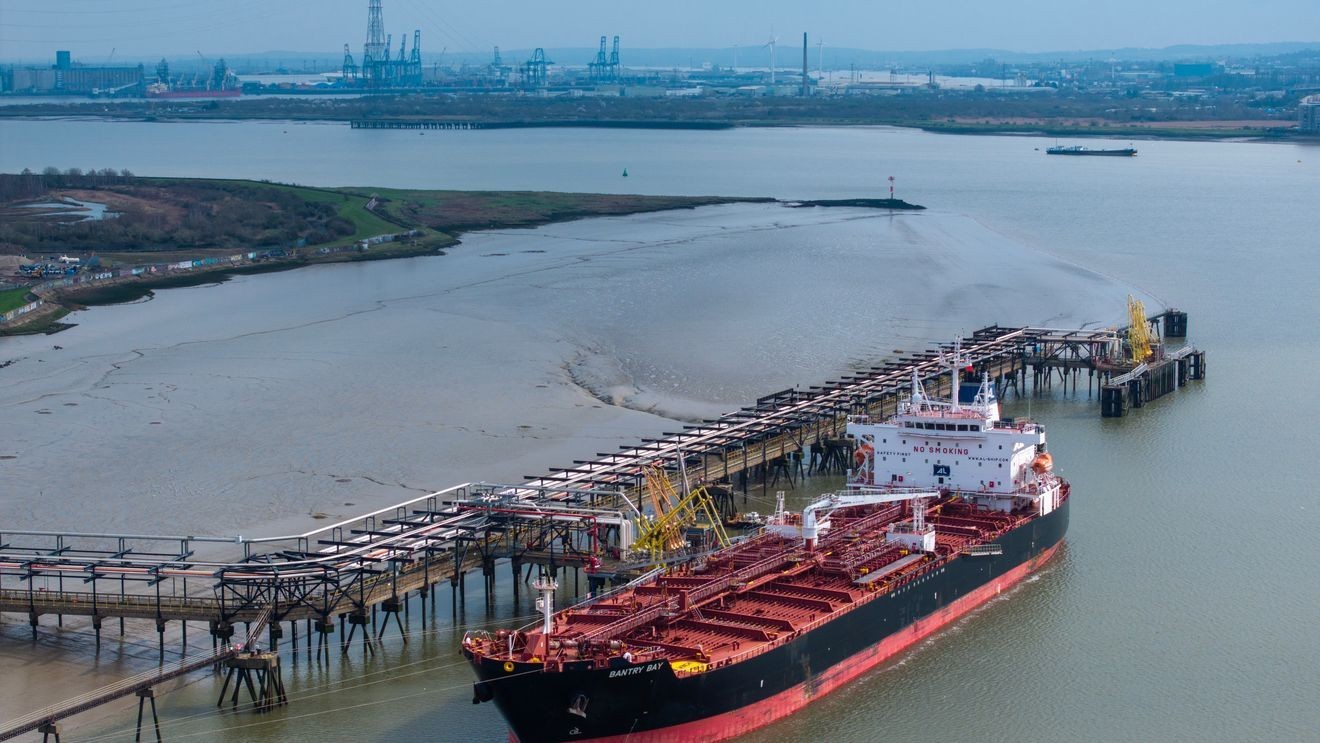
WASHINGTON (TNND) — The Trump administration says the U.S. could soon begin escorting oil tankers through the Strait of Hormuz, a move aimed at reopening one of the most critical oil routes in the world.
But these convoys would be supported by far more than just ships and would likely include additional air and sea military support. (TNND)
Right now, that route is effectively stalled. Data from the U.S. Energy Information Administration shows roughly 20% of the world’s petroleum liquids pass through the Strait of Hormuz, making it one of the most important chokepoints in global energy markets.
Amid escalating attacks and threats tied to Iran, many tankers have stopped transiting the waterway, disrupting supply and sending prices sharply higher, with global oil benchmarks rising significantly in recent weeks, according to market reporting
So what would it actually look like for the U.S. military to step in, and why are some experts warning it may not be enough?
First, the U.S. isn’t just escorting ships, it’s preparing for a fight
Experts say this would not be a simple operation. According to analysis from CBS News, citing military analyst Aaron MacLean, a former Marine Corps officer and national security expert, any escort mission would begin with what he describes as “preparing the battlefield.” That means reducing Iran’s ability to attack ships before any convoy operation begins.
The focus is on degrading:
U.S. Central Command says it has conducted strikes on thousands of Iranian-linked targets in recent weeks, including anti-ship missile sites and mine-laying vessels, as part of ongoing operations in the region. The goal, as MacLean explained in reporting by CBS News, is to ensure that incoming threats are reduced to a level that can be intercepted and managed. Because once escorts begin, the expectation is not that attacks stop, it’s that they become survivable.
Then comes the convoy system
If and when the U.S. determines the risk is acceptable, escorts would likely operate as naval convoys. Commercial tankers would gather at staging areas and move through the Strait in groups, escorted by U.S. Navy or allied warships. MacLean described the concept in CBS News reporting as: “like a mother duck with her little baby ducks.”
But these convoys would be supported by far more than just ships and would likely include additional air and sea military support.
The problem: escorts don’t eliminate the threat, and that’s where the concern begins. Even with U.S. protection, Iran retains multiple ways to target ships. Defense and security experts cited in CBS News reporting point to a range of threats:
And critically, the expectation is that attacks would continue.
As one expert told CBS News: “They’re 100% going to be shooting at the ships.” And this isn’t theoretical, it’s already happening.
Recent reporting from The War Zone highlights that these threats are already playing out in real time. According to The War Zone:
The physical constraints of the Strait itself add another layer of risk. At its narrowest point, the Strait of Hormuz is roughly 21 miles wide, according to data from the U.S. Energy Information Administration and widely cited geographic assessments.
That creates several operational challenges:
That proximity gives Iran a significant tactical advantage, particularly when it comes to mobile missile systems. As noted in reporting by The War Zone, some of Iran’s anti-ship capabilities can be mounted on mobile platforms and concealed, making them difficult to detect and eliminate.

 National Headline