(TNND) — President Donald Trump urged Iranian protesters to keep pushing Tuesday, declaring, “HELP IS ON ITS WAY,” in a social media post as the death toll from the unrest has reportedly reached 2,000.
Meanwhile, an expert on Iran said the regime of 86-year-old Supreme Leader Ayatollah Ali Khamenei is fast approaching a tipping point.
Khamenei has been in power for 37 years, but his grasp has never been weaker, said Hussein Banai, an associate professor of international studies at Indiana University.
The weight of deep, overlapping crises might be the last straw for Iran’s regime.
“We’re reaching a tipping point, as opposed to at a tipping point, because it is notoriously difficult to kind of pin down when regimes are being ousted,” Banai said. “It happens kind of gradually, then suddenly.”
But Banai said it will be difficult for Khamenei to restore his previous control.
And American pressure might serve as the “ultimate blow” to Khamenei’s rule, Banai said.
Protests began late last month in Iran amid a crumbling currency and deeply troubled economy.
Energy and environmental crises were the backdrop, with water and energy shortages growing worse, Banai said.
Most Iranians resent the regime, Banai said.
And many blame their own leaders for provoking the Israeli and U.S. strikes during last June’s “12-day war” against Iran.
Banai said the Iranian public doesn’t understand why their leaders have expended so much on what they see as a needless nuclear program. And they’re angered that the regime has sent vast amounts of money and resources to violent proxies and anti-Israel groups in the region, such as Lebanon’s Hezbollah group or the Houthis in Yemen, while they suffer back home.
“It had exposed and made vulnerable the country to foreign attack. That’s why the rally-around-the-flag (effect) really didn’t take place,” Banai said.
Meanwhile, the Iranian currency has tanked, and inflation has skyrocketed to over 40%.
Iranians, who are well-connected to the outside world and very aware of the problems facing their country, were fed up with the regime.
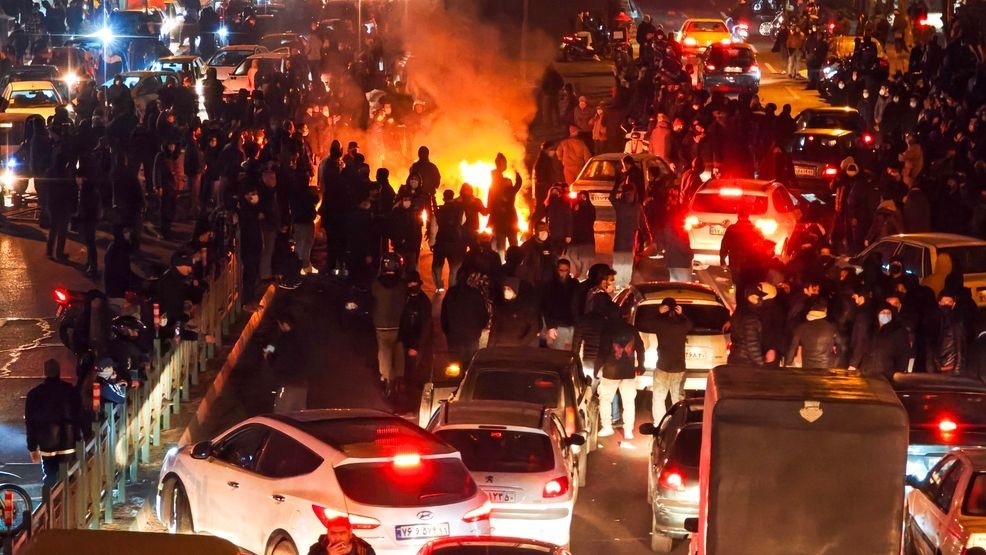
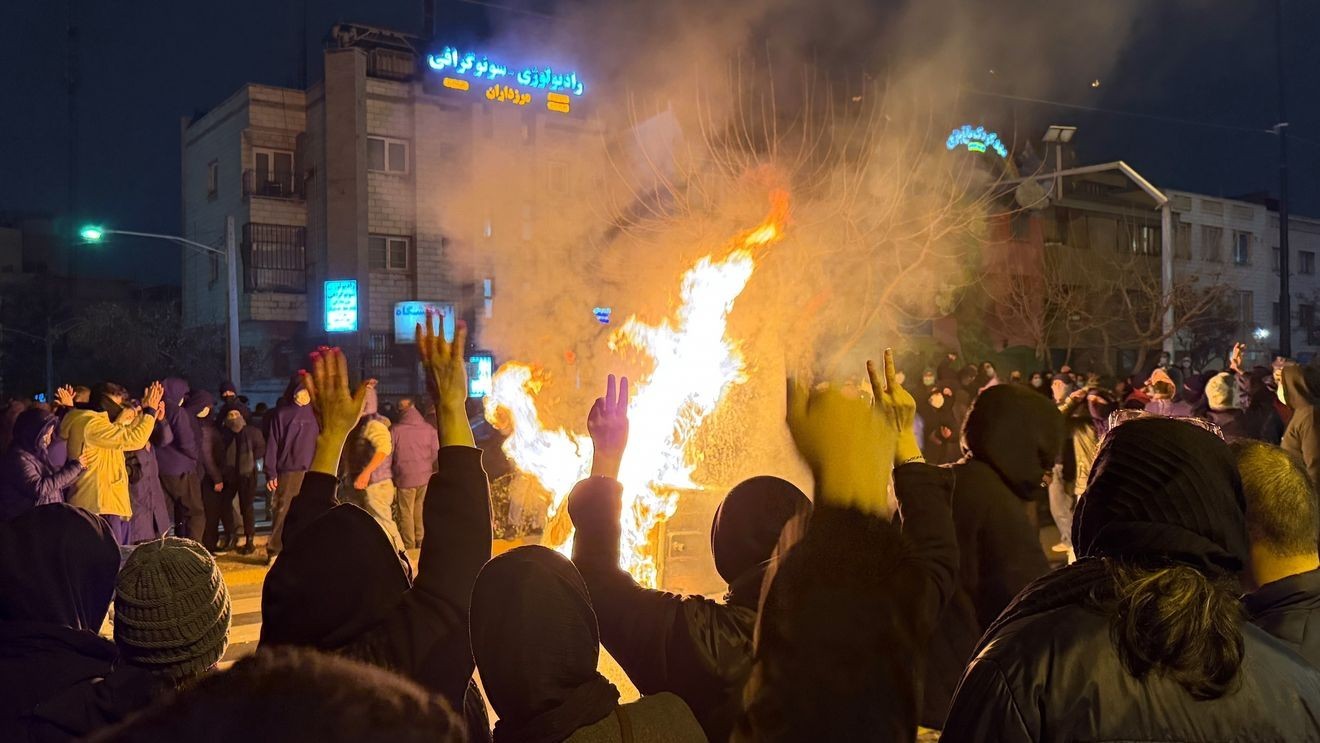
People gather during a protest on January 8, 2026, in Tehran, Iran. (Photo by Anonymous/Getty Images)
Bazaar merchants and shopkeepers in Tehran, student groups, journalist syndicates, and more made their anger with the government heard.
Even religious people, devout people who formerly were considered to be the base of the regime, have joined the protests, Banai said.
This isn’t like the sporadic protests touching on narrow economic issues that have taken place in Iran over the last couple of decades, Banai said.
This is an uprising that spans disparate social classes, he said.
“To have … an out-and-out opposition from across the country, not ethnic minorities, not women protesting the hijab, but a cross-section of society domestically is rare,” he said. “And it’s really a crescendo point, but at the time when Iran has now been kind of in open war with Israel and the United States since June.”
Iran’s regime is somewhat isolated within the region.
Its terrorist proxies have been weakened.
Its long-supported Bashar Assad regime in Syria is gone.
And Iran isn’t getting help from Russia and China – American adversaries that Banai said have had friendly but very “transactional” relations with Iran.
The Chinese, for example, have “treated Iran as a gas station, bartering its oil for cheap electronics, Chinese electronics and really junk products into Iran,” Banai said.
And Russia is in no position to help Iran as it deals with the war in Ukraine.
Banai said American actions have always influenced change in Iran, and this time is no different.
He said American pressure, particularly from the Trump administration, has put the Iranian regime in the perilous position it’s in now.
Banai said the U.S. doesn’t need to drop bombs on Iran. America doesn’t need to neutralize an Iranian threat to outsiders.
And there’s nothing left for the U.S. to sanction in Iran, which Banai said is why Trump announced that America would put extra tariffs on any country that does business with Iran.
But Banai said espionage, jamming the communications ability of the repressive regime, or even taking out leaders of the violent crackdown would advance the ball for Iranian protesters.

 National Headline