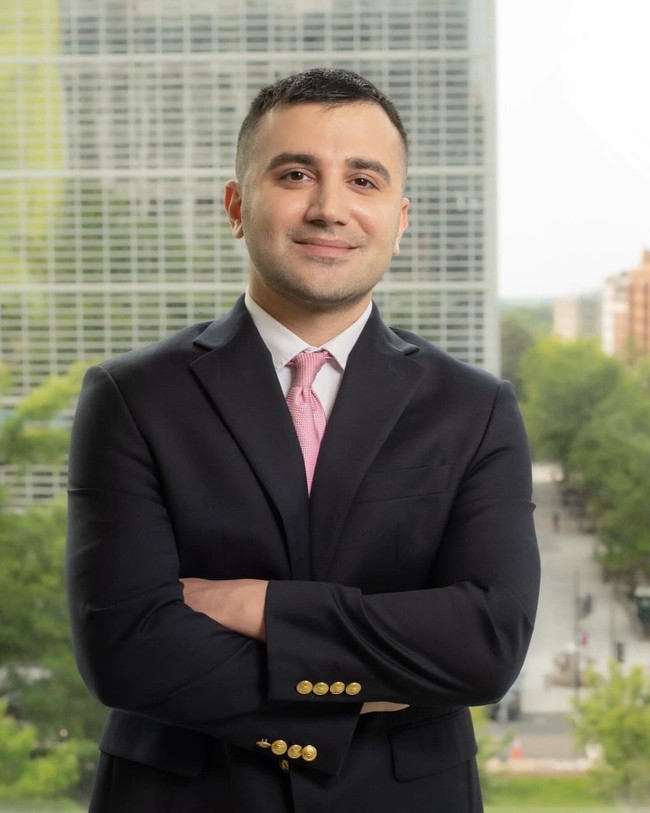
Iran expert Navid Mohebbi has lived a life most Americans couldn’t imagine. As a young man in Iran, he risked everything to speak out against the Islamic regime.
Advertisement
Today, Mohebbi advises the U.S. government on Iran policy and works as an advocate for democracy in Iran.
Growing up in Iran, he watched content from Voice of America, he was exposed to the ideas the United States represented. This motivated him to become a blogger writing about politics and human rights. He was an ardent critic of the regime, which came with a steep price.
“I was arrested in Iran because of my advocacy work three times and ultimately I was handed a three year sentence and I had to basically flee the country,” he told me. After spending two years in Turkey waiting for asylum, he came to the United States in 2013 and attended George Washington University and the University of Massachusetts, studying international relations and security studies.
“Watching voice of America as well as many other diaspora based in Los Angeles broadcasting to Iran… that actually opened my eye to what’s happening in Iran,” he said.
Mohebbi stressed that understanding modern Iran means knowing its history. The 1979 revolution, backed by the U.S. government, created the current Islamic Republica after overthrowing the Shah.
The revolution had many Iranians feeling hopeful. But that hope soon turned to dread as the regime unveiled its true nature.
Advertisement
“Before the revolution we had political freedom, we had social freedoms, individual freedoms. Women didn’t have to wear the hijab. We had a very friendly relationship with Israel and United States,” Mohebbi noted.
Unfortunately, the revolution was led by authoritarians who believed in total government control.
“The majority of Shah’s opponents were Marxists and Islamists who didn’t even believe in democracy, human rights, women’s rights,” Mohebbi explained.
Today, Iran faces massive protests and unrest. The demonstrations began in late December, but “quickly turned into a political movement to bring down the regime,” Mohebbi said.
He pointed out that since 2017, Iranians have been fighting for change.
The death toll has shocked international observers. Mohebbi noted that “about 12,000 to 20,000 protesters were killed. He compared the trauma to how Americans felt after the 9/11 terrorist attacks.
What many don’t realize is how much Iranians favor the United States. Over the years, we have seen plenty of videos in which people chant “Death to America.”
However, these people do not represent the average Iranian, according to Mohebbi. “I would say it’s one of the most pro-west pro US society in the Middle East,” he said. Unlike the government’s anti-American chants, ordinary Iranians hope for American support during this crisis.
Advertisement
Mohebbi emphasized that Iranians are not asking the federal government to invade Iran as it did in Iraq and Afghanistan.
“This is a regime change led by Iranian people but with the international support,” he explained. This could include military aid, providing internet access through services like Starlink, strengthening sanctions against the regime, and possible airstrikes aimed at crippling the regime’s ability to oppress protesters.
Yet, the media coverage surrounding Iran has been disappointing. “You don’t see much emphasis on regime change…they try to downgrade the scope of this protest,” Mohebbi said, speculating that it could be a partisan issue, with some unwilling to support action in Iran because it might benefit the Trump administration.
Still, Mohebbi remains hopeful, noting that “each time these protests are gettting bigger and bigger and bigger.”
You can watch the interview here:
[embedded content]
Editor’s Note: Do you enjoy Townhall’s conservative reporting that takes on the radical left and woke media? Support our work so that we can continue to bring you the truth.
Join Townhall VIP and use promo code FIGHT to receive 60% off your membership.

 National Headline