
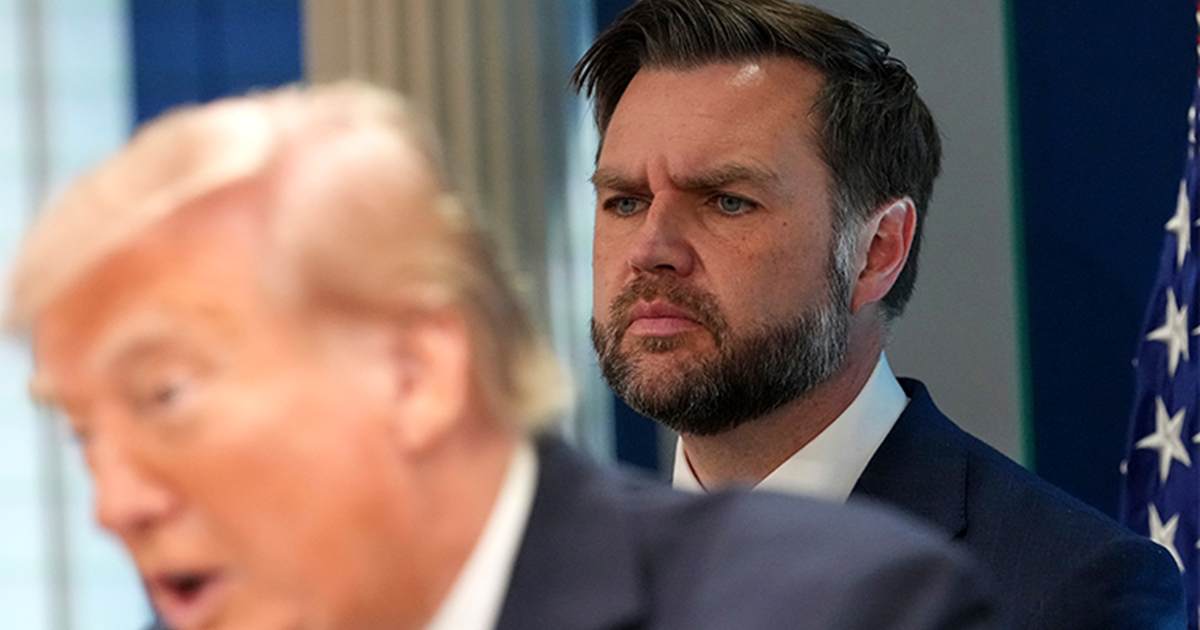
Vice President JD Vance is being credited as the driving political force behind Jensen Huang’s reinstatement as NVIDIA CEO on Monday. The administration waged an unprecedented 72-hour pressure campaign, one that not only pushed for Huang’s return but also sought to ease concerns that he posed a genuine risk to national security.
Vance is, of course, well connected in Silicon Valley. But that connection has also revived some of his views that deserve scrutiny, most notably a claim made to an Intercollegiate Studies Institute audience at the Catholic University of America, that “there is no meaningful distinction between the public and the private sector in the American regime.” And unfortunately, context doesn’t make this any better.
The conversation took place in May 2023 on a panel titled “Regime Change and the Future of Liberalism.” JD Vance appeared alongside Kevin Roberts, head of the Heritage Foundation, and Patrick Deneen, a Notre Dame political scientist who calls himself a conservative.
Deneen argues that America should stop prioritizing the individual and start prioritizing the collective good, as defined from a conservative viewpoint. That means individualism, representative government, economic freedom, and other stalwart pillars of American conservatism are, in his view, things to be overcome. Vance shares Deneen’s worldview, and he was at the event to promote Deneen’s book, “Regime Change: Toward a Postliberal Future.”
In doing so, he appeared to blur long-established distinctions in a way that seems to justify government power over a sector conservatives have traditionally sought to protect from it.
Recommended
JD Vance identifying himself as part of “the postliberal right” and saying, “there is no meaningful distinction between the public and the private sector in the American regime” at a May 2023 ISI event with his friends Patrick Deneen & Heritage Foundation president Kevin Roberts: https://t.co/EGPQ5IQjNH
— Jason Hart (@jasonahart) August 7, 2025
One of the hangovers, one of the really bad hangovers from that sort of uniparty that Patrick Deneen talked about is this idea that there is this extremely strong division between the public sector and the private sector. You know, the public sector, there’s the necessary evil of government. We want to limit it as much as possible because to the extent that we don’t limit it, it’s gonna do a lot of terrible things. And then you have the private sector, sort of that which comes from spontaneous order. It’s organic, it’s very Burkean, and we want to let people sort of do as much free exchange within that realm as possible. And in the reality of politics, as I’ve seen it practiced, the way that lobbyists interact with bureaucrats, interact with corporations, there is no meaningful distinction between the public and the private sector in the American regime. It is all fused together. It is all melded together. It is all, in my view, very much aligned against the people who I represent in the state of Ohio.
I will give you a couple of examples here. One, when I talk to sort of more traditionalist economic conservatives, what Patrick would call economic liberals, when I talk to these guys about, for example, why has corporate America gone so woke, I see in their eyes this desperate desire to think that it’s all just coming from the [Securities and Exchange Commission]. That there are a couple of bad regulations at the SEC, and that in fact [BlackRock CEO] Larry Fink would love to not be a super woke driver of American enterprise, and that Budweiser has no desire to put out a series of advertisements that alienate half their customer base. They’re just being forced to do it by evil bureaucrats. And there is an element of truth to that. The element of truth is that the regime is the public and private sector. It’s the corporate CEOs, it’s the H.R. professionals at Budweiser, and they are working together, not against one another, in a way that destroys the American common good. That is the fact that we are dealing with.
In simpler terms, conservatives have often blamed corporate wokeness, like the Bud Light controversy, on government pressure, arguing that companies went along or else faced greater regulation and control. Vance rejects that explanation. He argues instead that CEOs are in league with the people pushing woke, DEI, and other progressive causes. If the line between the public and private sector disappears, government has a duty to exercise greater power over the private world, and the only way to stop any of this is through government itself.
That cuts against a long-held Republican belief, that government usually makes problems worse, is often their root cause, and that more trust belongs with private individuals, businesses included.
If you agree with the vice president, that’s fine, but his story deserves a closer look. He blames lobbyists for fusing the public and private sectors, yet he never asks why businesses find lobbying worth their time and money in the first place. They do because government is eager to involve itself in matters it has no business touching, and it readily lets lobbyists sway its actions and decisions. You may blame private companies for pushing progressive causes, but the root cause is a longstanding tradition of economic interventionism, which is what makes lobbying so potent. Remove that, and most of the problem disappears.
Why prescribing more intervention to cure a problem created by intervention is even a credible opinion, is absurd.
Furthermore, anyone who agrees with the vice president, and perhaps the vice president himself, harbors socialist tendencies. A policy need not seize the means of production to qualify as socialist. Conservatives have long argued that greater government control over the economy is a step in that direction. They cannot insist that the public and private sectors are one, call for more government power over business, and still claim to favor free markets over socialism. People should be honest about what they support: simply a form of “conservative” socialism.
There is a reason socialism is on the rise. It’s so-called champions against it are advocating their own version. Republicans have their own conservative price controls and their own excuses for intervention. They admit socialism may be bad, but insist socialism for critical industries is good. They claim free markets failed because of crony capitalism, but insist crony capitalism is good for industries that need tariffs. No major political party believes in free markets anymore.
Think about that as the vice president is seeking to run for president in 2028, because his election would be the full embrace of conservative socialism.
Whatever your reasoning for defending the Trump administration’s version of socialism, my response is but a quote from Milton Friedman: “Underlying most arguments against the free market is a lack of belief in freedom itself.”
 National Headline
