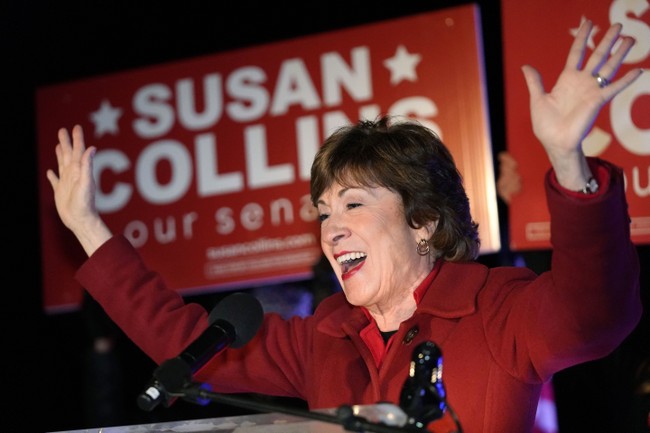
Maine’s 2026 Senate race is heating up as longtime Republican Sen. Susan Collins faces mounting pressure from both ends of the political spectrum. While she has supported conservatives on some key votes, many grassroots Republicans remain frustrated by her repeated willingness to side with Democrats on major issues. Her primary challenger, Dan Smeriglio, a staunch conservative and Army veteran, is running on a bold platform that emphasizes restoring traditional values, securing the border, and supporting President Donald Trump’s America First agenda. Meanwhile, Collins has distanced herself from Trump, voting against several of his high-profile nominees and opposing his second-term tax and spending package, which included significant cuts to bloated federal programs.
Advertisement
Democrats are also eyeing this seat, hoping to flip it in their favor. However, Collins has proven that she knows how to win tough races with the Senate majority potentially at stake.
Collins is a rare Republican voice in deep-blue Maine and has repeatedly outperformed GOP expectations in statewide races. Despite Maine being a reliably Democratic state, former President Joe Biden carried it by a wide margin in 2024; however, Collins has survived by building cross-party appeal. Unseating Collins has historically been a challenging task for many Democrats to accomplish. In 2020, Democratic nominee Sara Gideon raised $74 million and spent $62 million, only to lose to Collins by over eight points. Democrat Gov. Janet Mills, who is term-limited, is seen as Collins’ strongest challenger.
Collins raised $2.4 million between April and June of this year, closing the quarter with $5.3 million on hand as she seeks a sixth term.
Republicans currently hold a slim but decisive 53–47 majority in the Senate. Since senators serve six-year terms, about one-third of the chamber faces re-election every two years. For Democrats to flip control in 2026, they will need to hold onto every seat they currently have, which could be an uphill battle, especially in states such as Georgia and Michigan.
Advertisement
 National Headline
