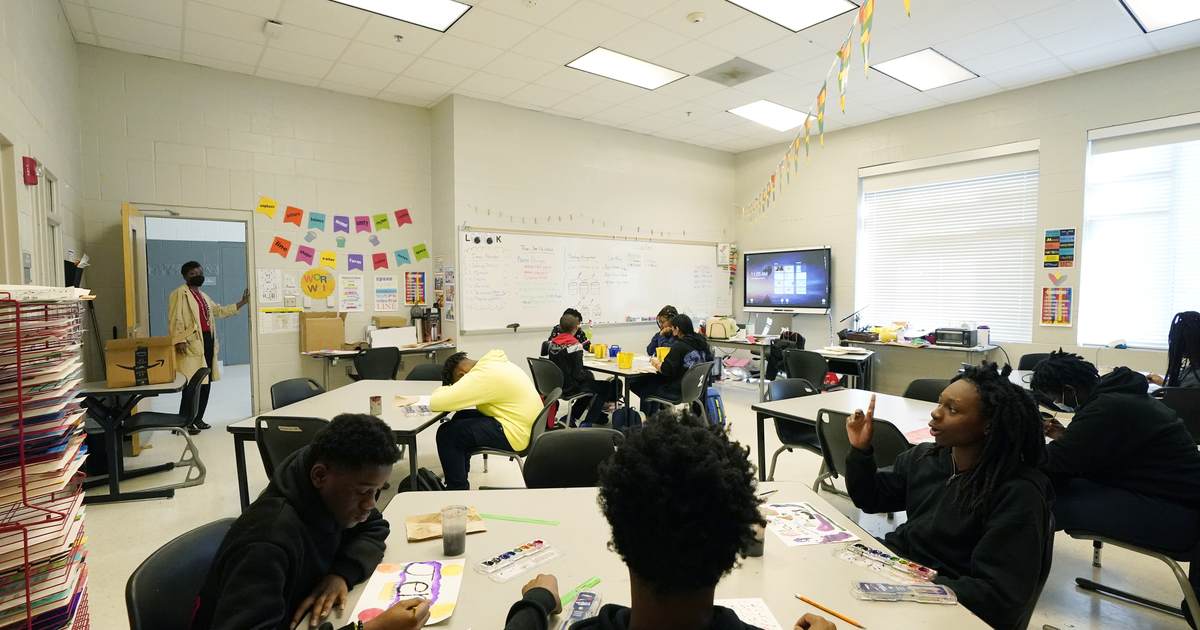
“There’s a bunch of kids in my class that have F’s in reading, and I’m probably going to pass them — I’ll bump it up to a D and call it a day. I don’t know of anyone who’s been able to keep anyone back. We’re just setting kids up for failure,” one middle school teacher told the Philadelphia Inquirer. It is no secret that the public education system is a disaster from its social propaganda to its failing literacy rates, but the root of the problem is not underfunding or inequality, as many headlines and policy proposals would have you believe. Teachers in Philadelphia are warning of an accountability crisis that just might reveal what’s really wrong with the education system.
Many teachers in the Philadelphia School District are reporting that, despite the district being officially “committed to excellence,” they are pressured to pass students who would typically fail or be held back. Some reportedly gave failing grades that were overridden by the administration, making it nearly impossible to hold students responsible for lackluster effort or failure to demonstrate a mere understanding of material.
One teacher who spoke with the Inquirer mentioned the “No Child Left Behind Act,” signed during the Bush Administration, as a marker for the subtle shift, saying it hasn’t always been this hard to fail a student. “When the pressure was on the schools to show promotions and graduation rates, and the district was so focused on showing data, it shifted grading, and now it’s a joke,” the teacher said.
The report comes just a month after a video out of Philadelphia Preparatory Charter showed high schoolers unable to comprehend or read simple sentences, sparking dialogue online about failing literacy rates across the country.
🚨Shocking: A Philadelphia high school student reportedly faces disciplinary action after exposing classmates’ reading struggles.
What’s the real issue, the content of the video, or the literacy crisis it highlights? pic.twitter.com/JXIcKIQBcE
— SurgePhilly (@Surge_Philly) May 4, 2026
The Future Ready PA Index for the charter school reveals astoundingly low proficiency rates across all subjects. For the 2024-2025 school year, just 18.4 percent of students were proficient in English Language Arts, even lower than the statewide average of just 49.9 percent. Math proficiency was reported at a shocking 6.8 percent — nearly 39 percentage points below a statewide average which also fails to crack 50 percent.
Graduation rates are telling an entirely different story, however. The school boasts its four-year and five-year graduation rates for the 2023-2024 school year at 97.8 and 100 percent — every single student received a diploma on the five-year track. Meanwhile, fewer than 1 in 5 students could read proficiently, and fewer than 1 in 15 were proficient in math. The statewide averages reflect this pattern with only about 50 percent proficiency rates, yet 88 and 90.5 percent of students graduate on the respective tracks.
The report from the Inquirer explains this phenomenon, and teachers are fed up. One teacher spoke of the administrative pressure to inflate grades at the end of the term, saying, “There’s all this pressure from the district to increase the graduation rate — there are so many layers to it. I know that it happens in a lot of places. It’s not just our school. But this year, it was huge margins and huge numbers.” Reportedly, all of the teachers who spoke with the Inquirer expressed long-term concern for students, who are not developing critical life-skills and do not meet grade-level standards on state testing, especially when coming from low-income, poverty ridden neighborhoods.
Their concerns are grounded in reality. According to a report from the American Sociology Association, only 11 percent of low-income, first-generation students, of which Philadelphia schools serve a significant portion, had earned a bachelor’s degree within six years of enrolling, compared to 55 percent of continuing-generation students. Those students now have no college degree, and presumably, a mountain of debt to their name. All the while, administrators boast about their schools’ success in preparing low-income kids for college. That is not progressive, or beneficial to minorities and low-income communities — it keeps them entrenched in the same, government-reliant system that they started in.
The incentive to pass students who are not properly equipped with the skills is directly harming their future and the country’s future, as the problem is not confined to Pennsylvania. Only 35 percent of high school seniors performed at or above the reading proficiency level, with fourth and eight graders reflecting even lower rates, as reported by USA Facts. Teachers are speaking up about it, but administrators continue to ignore the alarms so that they can keep their jobs and pretend like their schools are succeeding. The public education system needs massive reform, and it does not start with funding — it starts with a change in priority.
 National Headline