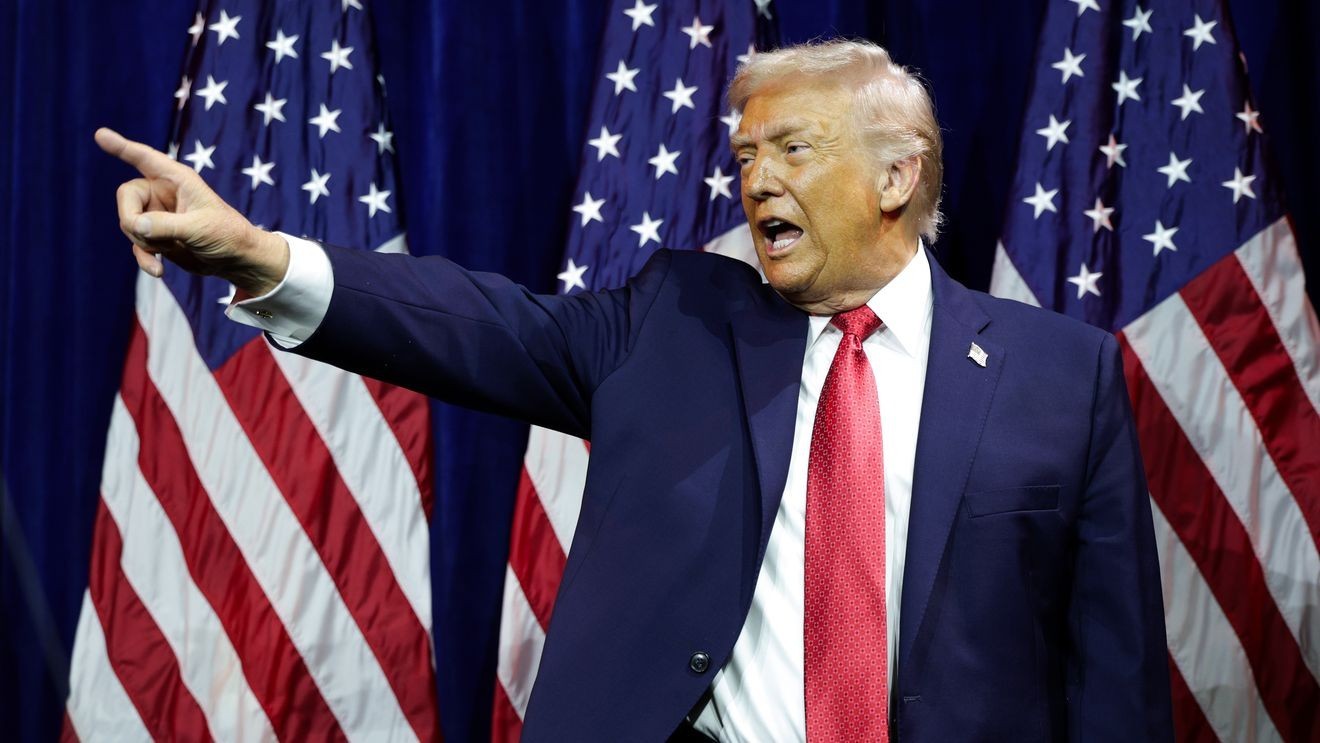
(TNND) — With the Supreme Court’s decision on tariffs looming, President Donald Trump has been talking up his key policy, crediting tariffs for improving American national security and bringing the country a windfall of revenue.
“We’re getting rich because of tariffs, by the way,” Trump said Tuesday at a retreat with House Republicans. “I hope everyone understands that. They hate to report. We’ll have over $650 billion poured into our country, or coming in shortly, because of tariffs.”
Trump shared a similar message a day earlier on social media, while calling the upcoming Supreme Court tariff decision “one of the most important ever.”
And Trump proclaimed Tuesday on social media, “THANK YOU YOU MISTER TARIFF!!! PRAY THAT THE UNITED STATES SUPREME COURT ALLOWS OUR COUNTRY TO CONTINUE ITS UNPRECEDENTED MARCH TOWARD UNPARALLELED GREATNESS!”
At question is Trump’s power to use the International Emergency Economic Powers Act as his authority to impose the tariffs.
The Supreme Court heard oral arguments in the case in early November.
The high court hasn’t announced when a ruling will come, but justices are reportedly prepared to announce opinions in some pending cases this Friday.
“It does look like it is a concerted effort to convince the Supreme Court that this is needing to happen,” James Knightley, ING’s chief international economist, said of Trump’s promotion of his tariffs. “Now, as you say, we don’t have an exact date as to when this (will) come. We know it’s going to be quite soon though in all likelihood.”
Knightley noted that countries have signed trade deals with the U.S., which leaves in question the status of those if the Supreme Court rules against the administration.
“But, of course, I guess the issue is they’re not the people that actually pay the tariff,” Knightley said. “It’s the importing U.S. companies that pay the tariff.”
And, he said, American consumers shoulder at least some of the cost of tariffs.
In a recent paper, Harvard and the University of Chicago economists determined 94% of the tariffs are being passed through to U.S. firms.
But tariffs have not resulted in big consumer price hikes in the U.S. The annual rate of inflation, as last measured by the consumer price index, was just 2.7%.
Knightley said the effective rate of tariffs is about 18%, up significantly from about 2.5% before Trump’s tariff announcements last year.
However, the realized rate of tariffs has been substantially less, only about 11%.
Importers could be trying to evade tariffs, he said.
It could be that customs officials have a lot more on their plates now and aren’t able to effectively check every crate to make sure it matches the itinerary.
Importing businesses are making substitutions and changing their supply chains to lessen the impact of tariffs.
And there could be some “margin squeeze” going on, where American businesses are trying to absorb as much of the higher prices as they can, so they don’t drive away customers.
“There is this anxiety, there’s this fear about what it means for household finances and household spending power,” Knightley said of tariffs. “But the data suggests that it’s not been as impactful as we’d feared, as economists had feared. And it may soon be over.”
Federal Reserve Chair Jerome Powell recently said the inflation impact from tariffs might peak in the first quarter of this year if there aren’t any new announcements.

FILE – Hezzi Ramim (R) helps Linda Lynn Levy look for a toy in his A to Z Toys store on May 7, 2025, in Miami Beach, Florida. (Photo by Joe Raedle/Getty Images)
Mark Hamrick, Bankrate’s senior economic analyst, said tariffs are seen as carrying a one-time price adjustment for consumers.
“And I do think the pig has been slowly moving through the python in that regard,” he said.
Still, Hamrick said tariffs are the same as a new tax on Americans.
And that’s added stress to the ongoing concerns over affordability.
“There’s no way that you can construct an argument that says tariffs are a solution for affordability challenges,” Hamrick said. “So, the administration obviously leans on the revenue-creation part of the dynamic. But my point about that is that, well, that is a tax that you are collecting.”

FILE – A truck passes stacked shipping containers at the Port of Los Angeles on Sept. 26, 2025, in Los Angeles. (Photo by Mario Tama/Getty Images)
Both Knightley and Hamrick brought up the $2,000 tariff checks floated by the administration. Both, however, voiced skepticism that Americans will actually see that money.
Knightley said the idea for the rebate checks will seemingly get scrapped if the Supreme Court rules against the tariffs.
And Hamrick said that Congress holds the power of the purse. Congress, he said, doesn’t seem inclined to send out rebate checks on the tariffs.
Knightley said there are other factors playing important roles in the affordability picture for Americans, even if tariffs juice the price of imported goods.
Lower energy prices and lower housing rents both help, though slower wage gains might keep people from feeling like they’re gaining ground.
Knightley said it’s hard for him to argue that tariffs have been good for American consumers. At best, they’ve not been the headwind many feared they would, he said.

 National Headline