
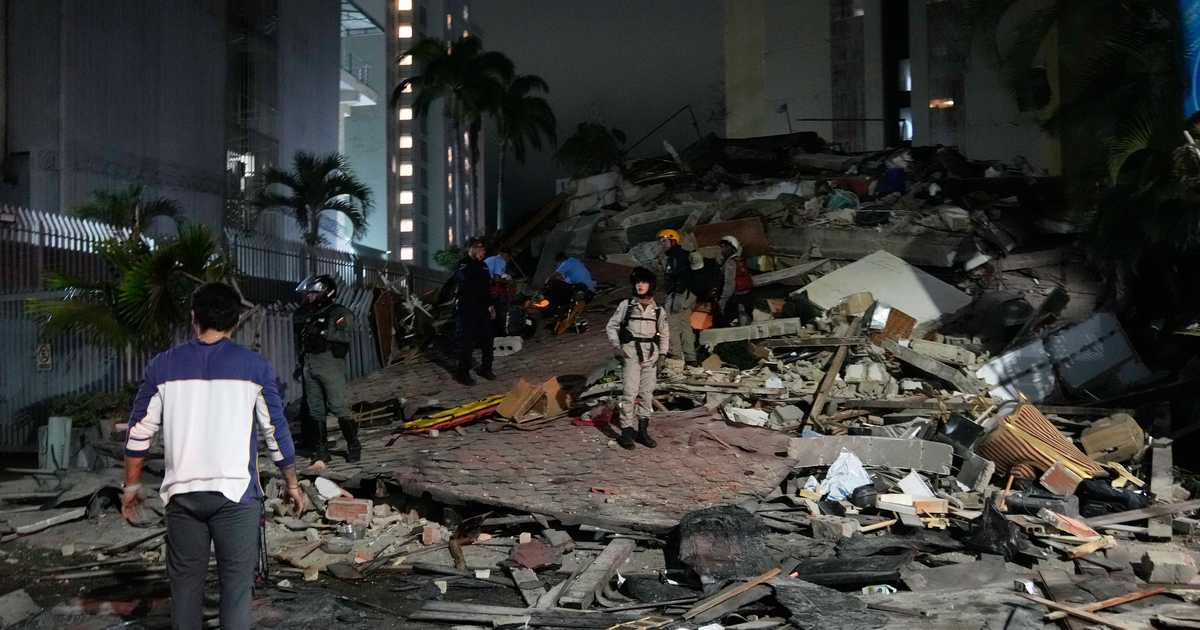
On Wednesday night, Venezuela was struck by two major earthquakes that devastated the capital, Caracas. Rescue efforts are underway, with the United States sending teams to assist, but the outlook remains grim.
Advertisement
From the beginning, the U.S. Geological Survey estimated that between 10,000 and 100,000 people could have been killed during the event. For now, the official death toll remains under 1,000—specifically 589—but everyone knows it’s expected to increase. Currently, 2,980 people have been reported injured. At least 50,000 are missing. Government recovery efforts have been criticized for being too slow (via NYT):
Colombia dispatched a joint search-and-rescue team along with more than 12 tons of humanitarian aid to Venezuela this morning aboard two C-130H Hercules aircraft in response to the earthquake. pic.twitter.com/D3mrPQQ4vW
— Breaking911 (@Breaking911) June 26, 2026
VENEZUELAN EARTHQUAKE UPDATE: At least 589 people have been killed and 50,000 remain missing following the earthquakes in Venezuela, according to authorities. pic.twitter.com/pvCg8b7XkP
— Breaking911 (@Breaking911) June 26, 2026
Anger growing against the regime in Venezuela from stopping people trying to provide aid to survivors in the most hard-hit areas after the earthquake.
Security forces have stopped trucks with aid and entire aid convoys. https://t.co/n3jM62bcec
— Visegrád 24 (@visegrad24) June 26, 2026
Crazy footage out of Venezuela after the earthquake. pic.twitter.com/rg3sBiInCF
— Open Source Intel (@Osint613) June 25, 2026
The scale of destruction in Venezuela is hard to comprehend.
The death toll is likely to climb significantly over the coming days pic.twitter.com/S4L5CUTSUT
— Visegrád 24 (@visegrad24) June 25, 2026
Survivors heaved mountains of bricks and cement with their bare hands across Venezuela’s earthquake-shattered north on Friday, hushing each other to listen for whispers of life and praying for help in reaching people still trapped under the ruins.
At a small hospital in La Guaira, the worst-hit state, Juan David Arsia, 17, said he had spent 21 hours under rubble. “I was there with my mom and I could hear her screaming,” he said. “I would yell to her, ‘Don’t give up, mom, have faith — don’t give up!’”
From under the wreckage, his tibia and fibula fractured, he could hear neighbors calling for help, he said, until the sounds stopped in the middle of the night. Hours later, he again heard people moving above the rubble and began shouting, leading neighbors to find and pull him and his mother free.
Rescue teams from at least seven countries are racing to help Venezuela in its search and recovery efforts after the devastating twin earthquakes on Wednesday, but they face stark hurdles even getting to the disaster zone. The 7.2- and 7.5-magnitude quakes damaged the international airport where they would have landed, split open roads they would have sped down and overwhelmed Venezuela’s hollowed-out emergency services.
The country’s infrastructure had already been weakened by corruption and a decade-long economic depression. With little heavy machinery to clear rubble and few medical supplies to help the wounded, many survivors found themselves on their own.
Many lacked even a safe place to rest, with more aftershocks across the north jolting the remains of what had been apartments, offices and livelihoods. Faced with the choice of unstable building facades or sleeping in public plazas or by a highway, many residents chose to stay outside.
They also face monumental loss: President Delcy Rodríguez said on state television on Friday that the death toll had risen to 589, with some 3,000 injured. Hundreds of people are still believed to be trapped and missing.
Ms. Rodríguez announced that she would “militarize” La Guaira, the state north of the capital and the area hardest hit. The Venezuelan military were in the state to help, and workers had cleared many roads in the area, she said, but she did not specify what it would mean for the territory, or whether soldiers would patrol the streets or impose a curfew.
[…]
The quakes have disrupted telecommunications and internet connectivity in some areas, and many people are still struggling to reconnect with family members or friends. Many are searching online for those who are unaccounted for. On one site, nearly 50,000 people have been reported missing.
Advertisement
Just horrific.
Aerial footage of the destruction in Venezuela. It looks like a nuclear device detonated. Complete destruction. Unreal.
🙏✝️🇲🇽❤️ pic.twitter.com/Z06xc2r9tq https://t.co/mO4qTG6Y2v— Buzz Patterson (@BuzzPatterson) June 27, 2026
Editor’s Note: Do you enjoy Townhall’s conservative reporting that takes on the radical Left and woke media? Support our work so that we can continue to bring you the truth.
Join Townhall VIP and use promo code FIGHT to receive 60% off your membership.

 National Headline