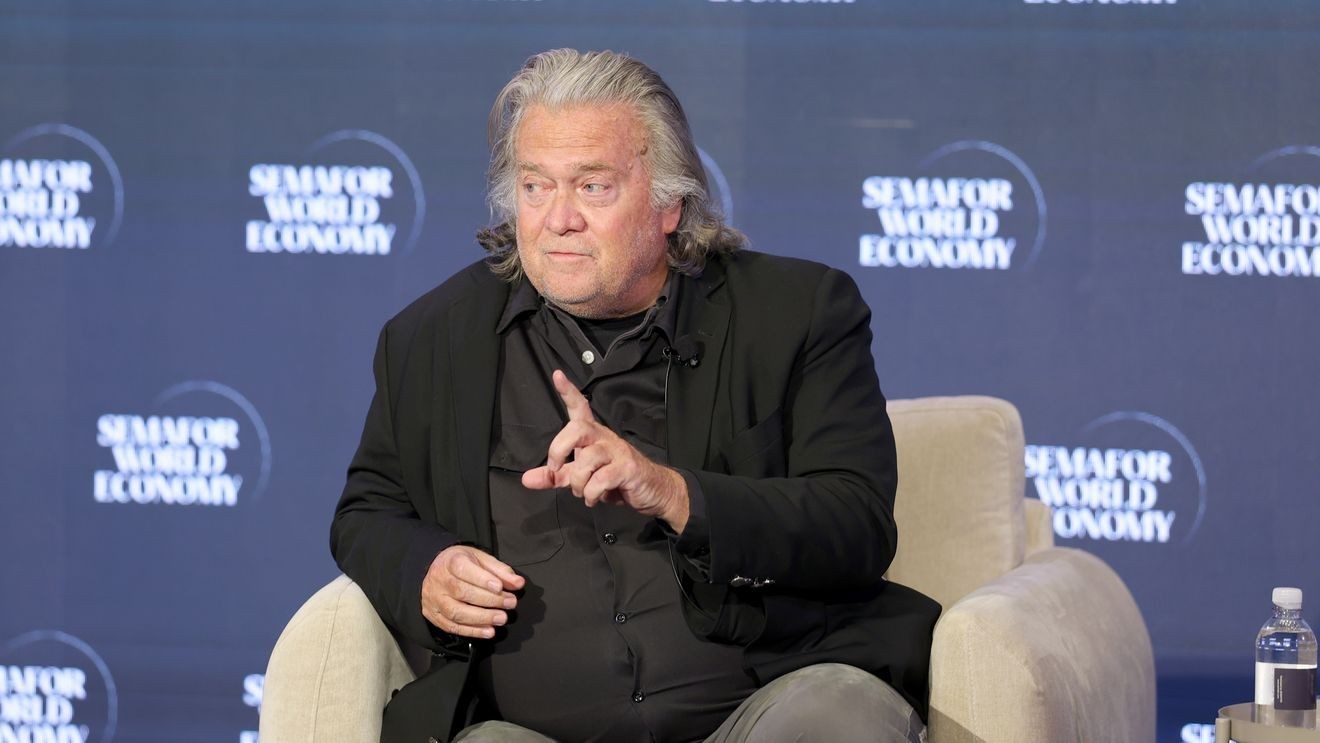
(TNND) — Steve Bannon and 60 others, including more allies of President Donald Trump, signed a letter urging the president to ensure that “potentially dangerous” cutting-edge artificial intelligence systems are fully vetted by the government before allowing their release to the public.
Frontier AI models present potential threats to American security, children, workers and “way of life,” the letter from Humans First said.
Humans First, which describes itself as a conservative social movement, sent the letter on Friday to Trump. Among the signatories are Humans First Chairwoman Amy Kremer, a political activist and Trump supporter, and around three dozen church leaders.
Bannon told Axios that “mandatory testing and government approval” is a “must” for AI.
The letter sounds an alarm over AI’s rapid advancement and the threats that emerging systems could pose to cybersecurity, critical infrastructure, financial systems, election integrity, biosecurity and more.
America should lead the world in AI innovation, the signatories said. But they urged responsible innovation.
And they wrote that no private corporation – the AI developers – should have unchecked power to release untested systems on the public.
The coalition behind the letter from Humans First asked Trump to issue an executive order requiring mandatory testing, evaluation, vetting and government approval of frontier AI systems before they are released.
“America did not become the greatest nation in the world by allowing unelected elites to experiment on the public without safeguards or accountability,” the letter reads. “America First means American strength, American security, and the protection of our people first.”
The letter might raise some eyebrows among administration insiders, said Daniel Schiff, a policy scientist and the co-director of the Governance and Responsible AI Lab at Purdue University.
Schiff said it remains to be seen which of the laundry list of AI concerns might resonate most with conservatives, but he expected continued attention and advocacy to hold some sway over policymakers.
“Will this letter by itself move things? That’s another question,” Schiff said. “But that there is a coalition that is organizing, that it has money, is working within states, that can fund candidates, that can talk to church groups, that’s testing its messaging – there’s a bunch of venues where these kinds of groups and their messaging can start to push back from the local to the national levels.”
Trump’s White House has released an AI action plan, and the president has signed multiple executive orders to accelerate innovation.
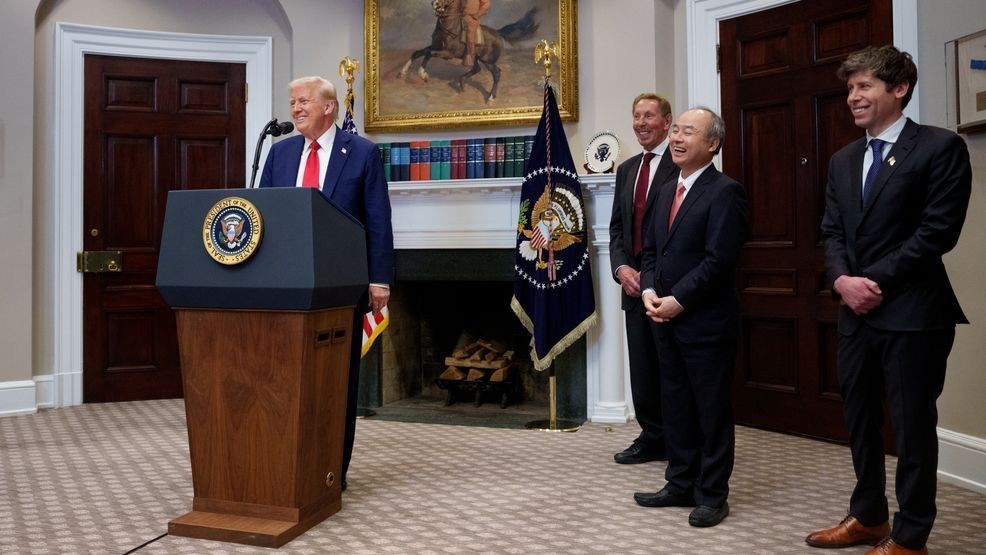
FILE – President Donald Trump, accompanied by (L-R) Oracle co-founder, CTO and Executive Chairman Larry Ellison, SoftBank CEO Masayoshi Son, and OpenAI CEO Sam Altman, speaks during a news conference in the Roosevelt Room of the White House on January 21, 2025, in Washington, D.C. (Photo by Andrew Harnik/Getty Images)
Trump has sought to remove roadblocks to AI innovation and the economic activity that it generates. His executive orders have been intended to fast-track the construction of data centers, promote the export of American AI technology, and tamp down state restrictions on AI.
Schiff said national AI policy has been a “bit wishy-washy.”
There have been consistent bipartisan concerns about U.S. innovation and competition with China. But recent policy decisions – especially around China, export controls and regulation of major AI companies – have been shifting, he said.
“It’s not clear that there’s yet a fully consistent federal strategy,” Schiff said.
The last several administrations have sought to maximize innovation and minimize regulation for AI, though pro-innovation rhetoric has gotten stronger under Trump’s current term, Schiff said.
The letter raised concerns about AI companies experimenting on the American public.
Schiff said those worries arise from AI companies’ willingness to radically disrupt really important social structures, such as education and labor.
“People are increasingly concerned about the power of the AI systems, and I think along with that, the power of the AI companies,” Schiff said.
Schiff said there aren’t enough guardrails on AI companies, and he said most computing and policy experts would see it the same way.
“There are not just immediate security concerns and threats that some groups worry about like (chemical, biological, radiological and nuclear) risks, but there’s widespread concern about labor disruption and misinformation,” Schiff said. “And each of these items on their own is enough to suggest the need for serious societal discourse and decision-making.”
 Local Story