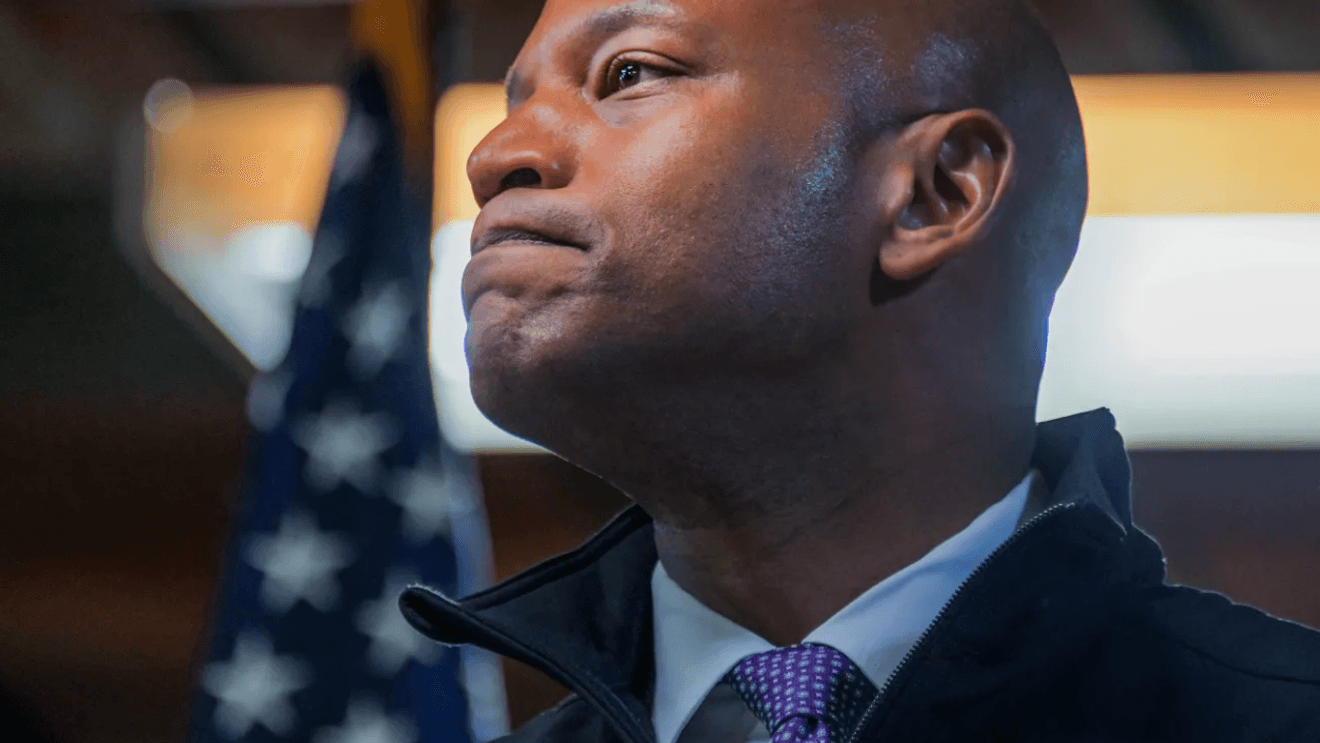
Maryland Gov. Wes Moore went on CNN Thursday morning and answered the central question plainly; however, what he said was not true.
Asked by Kate Bolduan whether he had misstated, mischaracterized or misrepresented his military service, Moore replied, “I have never mischaracterized my military career,” which is a false statement.
Moore then tried to use institutional silence from the Army as vindication.
“Do you know who’s not questioning my accounts?” Moore asked. “Do you know who’s not questioning my integrity? The United States Army. Do you know who’s not questioning my accounts or integrity? The 82nd Airborne.”
The Army is not a fact-checking organization for a sitting governor’s memoirs, campaign statements or television interviews. An Army airborne division is not going to issue a public character assessment about a former junior officer’s political biography.
The Army releases records. The records speak for themselves.
And the records are precisely the problem for Moore, which is perhaps why the governor has refused to release them fully.
Spotlight on Maryland, however, has obtained through Freedom of Information Act (FOIA) requests a substantial portion of Moore’s official military personnel file, though the Army continues to withhold some documents that should be clearly releasable under the FOIA. Spotlight is considering litigation against the Army to force the release of some documents.
The issue, however, has never been whether the Army questions Moore’s integrity. It’s whether the record supports the claims Moore has made about his service.
For more than six weeks, Spotlight has revealed inconsistencies between Moore’s public accounts of his Army service and the available record. Spotlight’s reporting is not speculation. It is not an attack on Moore’s service. It is based on expert analysis, military records, timelines, Moore’s own writings and interviews, and repeated requests for basic corroboration that Moore and those closest to his military story have refused to provide.
Now, after a Baltimore Banner article that largely copies reporting Spotlight has already done, Moore is attempting to reframe the issue as though he is merely the target of bad-faith attacks. That is not what the record shows. In fact, the Banner story, despite giving Moore substantial room to explain himself, confirms many of the core findings first reported by Spotlight.
Even the Banner’s headline concedes the point: “Moore’s military service is not in doubt. His storytelling is.” That has been Spotlight’s point since the beginning.
Spotlight does not dispute that Moore served. But service does not entitle a public official to embellish the record, particularly when that record, based on significant fabrications and perhaps lies, has become central to his political biography.
The issue is not whether Moore served in a combat zone. The issue is whether he repeatedly misled the public about the nature of that service. On that question, Moore’s own words have caused the problem.
In a May 8, 2022, post on X, Moore wrote: “When I was an Army captain and led soldiers into combat in Afghanistan, we lived by a simple principle: Leave no one behind.”
That is not an ambiguous campaign shorthand. It is a specific claim that Moore, as an Army captain, led soldiers into combat.
Spotlight asked Moore and his former superior officers to substantiate that claim. We asked for basic evidence: spot reports, witness accounts, award documentation, after-action reports, names of soldiers he led, anything that would show Moore led soldiers in combat engagements. They have refused to provide it, leading one to wonder why.
Moore was not serving as an infantry platoon leader or a special operations officer leading patrols into hostile terrain. He was a brigade-level staff officer working in information operations at Forward Operating Base Salerno. That is important work, but it’s not the same as leading front-line soldiers in firefights.
Moore’s public narrative, however, has repeatedly suggested something more.
And one man who could corroborate Moore’s story is his mentor, personal friend and deputy commander in Afghanistan, retired Lt. Gen. Michael R. Fenzel, who has refused to speak on the record regarding Moore’s deployment. According to the Banner, Fenzel cited his “post-Army employment” with the Turner Construction Company, based in New York City, as the reason he cannot publicly address Moore’s military service.
In his 2015 book, “The Work,” Moore wrote vividly about his first experience being shot at in Afghanistan, describing bullets and shells, divots jumping from the ground, fear flooding his body and a response with “overwhelming force.” In a 2021 interview with David Rubenstein, Moore said that within days of arriving in Afghanistan, he saw his “first firefight.” Those are not vague recollections of danger in a war zone. They are accounts that strongly imply direct-fire combat.
Yet Spotlight’s May 31 article found no documentary evidence that Moore experienced combat in Afghanistan as he has described it. He was not awarded a decoration for such a firefight. He was not awarded the Combat Action Badge (CAB) for a direct-fire engagement. The CAB documentation available to Spotlight — released by Moore himself — relates to a Dec. 9, 2005, indirect-fire incident at FOB Salerno, when three rockets landed on the base and no one was injured.
The distinction is not technical. It is central. Serving honorably in Afghanistan is not the same as leading soldiers through firefights. Being on a base that received rocket fire is not the same thing as bullets buzzing past one’s ears while leading paratroopers in a tactical response. Traveling outside the wire with a security element is not the same thing as commanding troops in a firefight.
Moore and his defenders keep trying to collapse these distinctions. Veterans know better. And non-veterans active on social media are catching on as well.
The Banner story also reported that a Marine who traveled with Moore claimed one convoy “took some shots.” The Army usually keeps records of such engagements. If it happened, where is the documentation? Where is the Combat Action Badge for that direct-fire incident? Where are the reports, the witnesses, the date, the location, the mission, the unit involved, or the names of soldiers Moore says he led? One vague recollection, offered two decades later and routed through Moore’s damage-control effort, does not erase the documentary void.
And on CNN, when Bolduan pressed Moore on the combat claim, Moore did not directly answer the question. He pivoted to his role in information operations and again tried to speak broadly about leading soldiers in a combat environment. The issue is not whether Afghanistan was dangerous. The issue is whether Moore told the public that he personally led soldiers in direct combat engagements, which the record does not support.
Moore’s own interview with the Banner makes that gap even more obvious. He acknowledged he had never been ordered to lead offensive missions in Afghanistan, while saying, “I was scared over there.”
Many service members were scared in Afghanistan. Fear is understandable. It is also not proof of the combat story Moore has told for years.
The same pattern appears in the Banner’s retelling of Moore’s treatment of a fallen soldier, Army 1st Sgt. Tobias “Toby” Meister.
In his book, “The Work,” Moore wrote that while attending his grandfather’s funeral, he looked into his grandfather’s casket and also saw Toby, as he grieved both men in a cathartic moment of loss. It is powerful prose, but chronologically impossible.
Moore’s grandfather’s funeral was held Dec. 17, 2005, while Meister was still alive. Meister was killed 10 days later on Dec. 27, 2005. Moore could not have been mourning Meister’s death at his grandfather’s funeral.
This is not a mistake in editing. It is a problem with facts. The Banner acknowledges the timeline does not work. Moore’s explanation was that the passage reflected poor editing and the effects of stress, grief and time on his memory. But Moore’s answer asks readers to accept that a major emotional scene in a nonfiction book, built around two deaths, was misremembered badly enough to place the visage of a man still living in a casket.
There is another problem: Moore’s claimed closeness with Meister remains unsupported.
Spotlight spoke with retired Army Staff Sgt. John Pfeiffer of Kerrville, Texas, Meister’s friend and 321st Civil Affairs Brigade colleague, who deployed with him to Afghanistan. Pfeiffer said Moore and Meister could not have known each other personally in any meaningful way.
“There was no intersection of time and place for Toby and Moore to have met in any way and get to know each other,” Pfeiffer said.
When Spotlight read Pfeiffer the passage from Moore’s 2015 book, in which Moore describes Meister as a close friend and places his death inside the emotional scene of his grandfather’s funeral, he scoffed at the assertion.
“What kind of person picks a guy like Toby, who was the best of the best, and then personally capitalizes on him being killed?” Pfeiffer said.
Pfeiffer also wondered whether Moore had ever personally reached out to Meister’s family to express his condolences regarding Toby’s death.
Moore’s new Banner account goes even further. He recalled speaking with Meister by satellite phone about a convoy route, a conversation Moore said Meister told him should be taken “offline.”
Pfeiffer says such operational coordination would not have gone through Moore, a brigade-level information operations lieutenant located more than 200 miles away. Convoy route planning would have gone through either the Asadabad Provincial Reconstruction Team (PRT), which Meister’s Civil Affairs team was supporting, or the S3 operations section of the 2nd Battalion, 3rd U.S. Marine Regiment, the Combined Task Force-Devil infantry battalion responsible for operations in this area.
Moore’s story asks the public to accept an emotionally compelling narrative that is unsupported by the military realities surrounding it.
The Banner also attempted to “fill in the gaps” about how Moore reached Afghanistan. But here too, its reporting confirmed what Spotlight and The Sun have already reported: Moore’s path was highly unusual.
Moore was an Army reservist working in London when his mentor and close friend, then-Lt. Col. Fenzel coaxed him to deploy. He was Moore’s mentor, friend and, later, a groomsman in his wedding. That relationship is consequential because Fenzel helped arrange Moore’s path to Afghanistan and then placed himself in Moore’s supervisory chain of command.
The Banner quoted retired Lt. Gen. Douglas Stitt, then a major serving as the brigade personnel officer, as saying Moore’s route to deployment was “nontraditional” but not illegal, immoral or unethical. Spotlight never claimed the by-name request itself was illegal or immoral. The question is how unusual the arrangement was, how Moore was employed once he arrived, and whether Fenzel’s personal relationship with him should have raised concerns about favoritism outlined in the Army’s command policy.
The Banner also repeats the idea that Moore spent seven months in Afghanistan. That is not accurate. His time in the country was roughly six months. Moore has, over the years, given public accounts suggesting he spent 10 months, 11 months, or even 13 months in Afghanistan. Those accounts do not match the record.
The same broader pattern appears in Moore’s 2006 White House Fellows application, where he claimed military honors he had not received. Moore listed the Bronze Star before it had been awarded. He has called that “an honest mistake.” His friend and mentor, Fenzel, said it was lost paperwork. But Moore has acknowledged that before leaving Afghanistan, he learned he had not received the Bronze Star. If that is true, why did he not correct the White House Fellows application?
Moore now says he wants the public to see his records, including what he called on CNN his “privately available records.”
If Moore has records proving he led soldiers into direct-fire combat, he should release them. If he corrected his White House Fellows application after learning he had not received the Bronze Star, he should produce the correction. If his account of his relationship with Toby Meister is accurate, he should identify corroborating witnesses beyond those assembled by his own political staff.
Instead, Moore has chosen selective disclosure. He gave the Banner access. He gave CNN denials. He gave the public emotional explanations. He has not given Spotlight answers to the written questions we have repeatedly asked in writing.
That is not the transparency Moore claims he is all about.
The Banner’s article also does something revealing. It takes reporting first developed by Spotlight, repackages much of it, then allows Moore and his allies to cast the scrutiny as politically motivated or unfair. But the facts do not become less true because Moore dislikes who reported them first. Nor does a newer online outlet get to launder six weeks of Spotlight reporting into a softer narrative and call it a full accounting.
The core fact remains that very little of Moore’s account of this military service matches the record. In fact, much of Moore’s account is false, and the record supports that.
Reporting on this is not a smear. It is accountability.
This accountability goes directly to the question Bolduan asked Moore on CNN.
Has he mischaracterized his military service?
The record says yes.
The question now is whether Maryland’s governor will keep answering with polished denials or finally release the records that could support the stories he has been telling for years.
Until he does, his problem is not Spotlight, The Sun, Sinclair, CNN, FOX News, the Banner or any other media outlet.
Moore’s problem is the record.
Drew Sullins can be reached at dpsullins@sbgtv.com. Spotlight on Maryland is a joint venture by FOX45 News, The Baltimore Sun and WJLA in Washington, D.C. Send story tips to spotlightonmaryland@sbgtv.com or call our hotline at (410) 467-4670. Follow us on X at @SpotlightMDNews, and on Instagram and Facebook at Spotlight on Maryland.

 Local Story