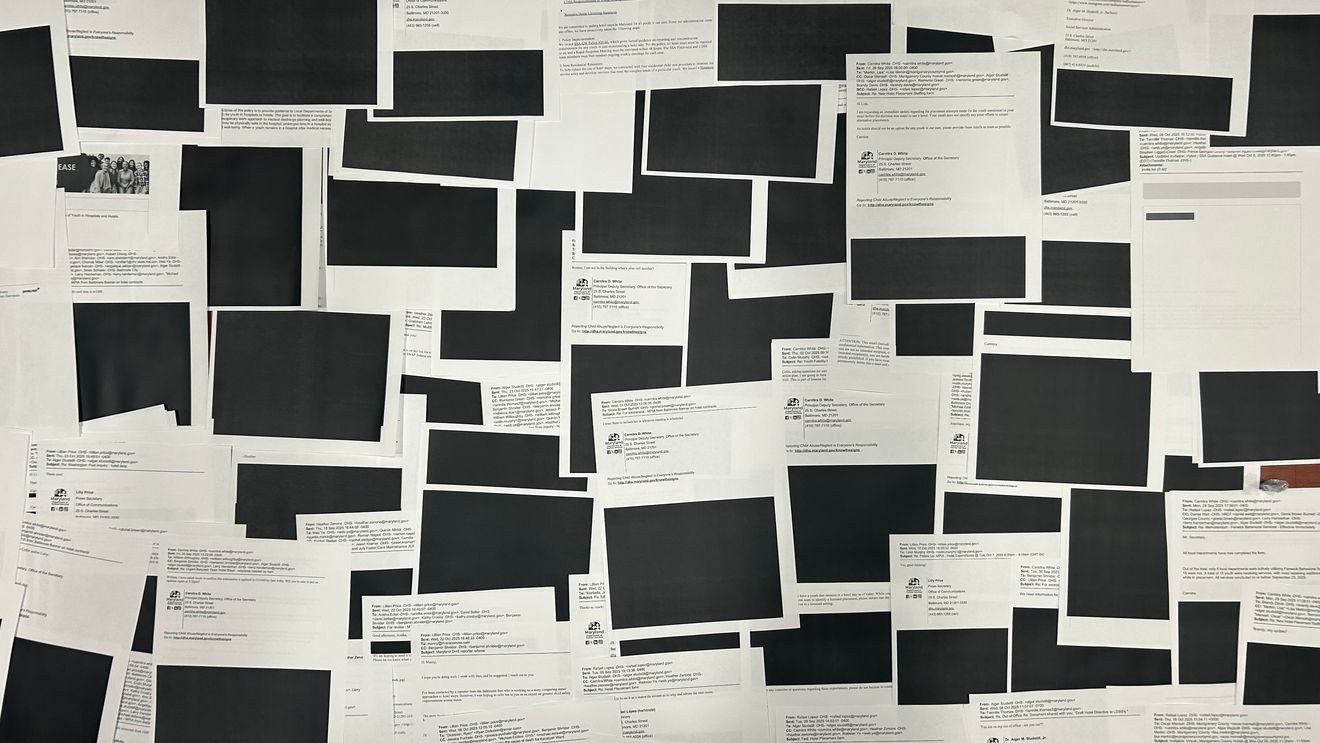
BALTIMORE (WBFF) — The Department of Human Services continues to be in the spotlight following the release of more than 600 emails through a public records request shedding light on the agency’s response to the suicide of a child in the state’s care that sparked a shift in the foster care system in Maryland.
Kanaiyah Ward, 16, was found dead in a Baltimore City hotel on September 22, 2025. Her death was ruled a suicide from an overdose stemming from the active ingredient in Benadryl. Ward was supposed to be under adult supervision, and her death raised serious questions about the state’s foster care system and oversight.
ALSO READ | Lawmakers pass ‘Kanaiyah’s Law’, other foster care reform after teen’s death
Emails obtained by FOX45 News revealed DHS was made aware of Ward’s death in the afternoon of Sept. 22, despite the authorities knowing about the teen’s death for hours prior. The next day, Sept. 23, a staffer replied in the morning and noted that then-DHS Secretary Rafael Lopez wasn’t notified of Ward’s death and asked whether a rapid response meeting had been scheduled.
What was said in the first email detailing Ward’s death isn’t clear due to significant redactions from DHS.
Questions were also raised about getting “any additional information from” Fenwick Behavioral Services, the contractor hired to provide the one-to-one services for Ward. In the following hours, meetings were held and the medical examiner’s report was provided for staff. Because Ward was originally from Prince George’s County, support was offered to the local social services department following Ward’s death.
“The loss of Kanaiyah has impacted us all. We were checking in on staff most of the day yesterday, and provided information for EAP services,” the staffer from Prince George’s County wrote in an email on Sept. 23, 2025. “The reality of this tragedy will be settling in today so any additional resources you can provide will be appreciated.”
On Sep. 24, FOX45 News reached out to DHS regarding Ward’s death. Internal emails show discussions unfolded about how to respond, and the governor’s team was looped in about the request for information. Contents of what exactly was discussed among DHS staff have been redacted. Later that day, FOX45 News broke the news of Ward’s death.
The emails also show that DHS cut ties with Fenwick Behavioral Services, the contractor responsible for Ward’s supervision, two days after her death. Despite this, DHS Secretary Rafael Lopez expressed frustration over an apparent slow response in severing the contract with Fenwick, emphasizing the need for urgency and accountability. Again, however, redactions from DHS make it difficult to know exactly what was being said.
“Any [Local Department of Social Services] that did not respond by the deadline and did not notify us in advance of a delay/need for more time have failed to respond with the urgency and accountability we expect,” Lopez wrote on Sept. 29.
An email dated Sept. 27 highlights the frustration that appears to be building within the agency when it comes to accurate data tracking. With a subject line of ‘New Hotel Placement Staffing form,’ the body discusses the various ways DHS tracked hotel placements.
Let’s stop! Having multiple spreadsheets creates confusion. We are using the information from CJAMS as that is the system of record, the staffer wrote.
I always want to state here that there MUST be a renewed sense of urgency and creativity to end hotel placements, the email stated.
On Sept. 26, there was confusion about how many children were in hotels in Prince George’s County. One email showed a spreadsheet indicated there were five, but a staffer noted the previous day’s number “indicated 3 youth.”
“I need to know what information is correct,” the staffer wrote. “As you can imagine we are getting incoming questions and need to report accurately.”
DHS staff were instructed to use a new data tracking system by September 15 to avoid further confusion, but issues persisted. On September 30, a week after Ward’s death, internal emails highlight continued confusion over the number of foster care children in hotels.
On Sept. 30, one email indicated the “list provided does not match what’s in CJAMS,” referring to foster care children in Montgomery County.
“We requested this information to be updated on Thursday,” the DHS staffer wrote. “Please have your team update the information by COB today.”
Another email, with a subject line ‘Daily Hotel Placement update’ dated Sept. 30, noted the total number of children was “2 more than what was reported last week.”
“I am confused,” the staffer wrote. “Did Montgomery County add another youth since last Friday?”
The rest of the email is redacted.
According to Lilly Price, a DHS spokesperson, staff was required to use “our computer system of record, CJAMS, to document hotel stays,” but reiterated that the practice of placing foster care kids in hotels ended in November 2025.
“This progress was made possible because we modernized our data systems, revised outdated policies, and provided staff with proper training over a period of 18+ months of hard work,” Price said via email statement.
Price directed FOX45 News to an online data dashboard that was launched in December 2025 “to demonstrate our commitment to data transparency.”
“We continue to improve our work to align with national best practices,” she added.
On Oct. 22, DHS announced a major policy shift: the end of hotel placements for foster care children in Maryland with a deadline of November 24 for moving children into “more appropriate” placements.
The agency’s handling of Ward’s case and the broader issue of hotel placements for foster children have drawn criticism and led to calls for reform. Del. Mike Griffith, R-Cecil and Harford Counties, announced plans to introduce legislation in the fall of 2025 named after Ward that called for the end of hotel placements, along with other unlicensed settings, including homeless shelters.
After he announced his intent to introduce Kanaiyah’s Law during the 2026 legislative session, DHS announced the hotel placement ban. Griffith said he believes his legislation pushed the agency to ban the practice.
“It shouldn’t have taken that for DHS and the people within DHS to identify that these practices shouldn’t have been happening,” he said during an interview with FOX45 New In Depth with Mikenzie Frost. “With that being said, when we brought this legislation forward conceptually, the folks within DHS came right to the table and worked with us and we’re very eager to help craft this law and solve these issues.”
It shouldn’t have taken a young girl to take her life. But it did, and we met the moment, Del. Griffith said.
Kanaiyah’s Law ended up passing the General Assembly, though the unlicensed settings language ended up in another bill sponsored by House Speaker Joseline Pena-Melnyk. Del. Griffith’s bill creates a foster care ombudsman and ties guardianship assistance program funding to criminal background checks.
“I feel like this is what being a member of the General Assembly is supposed to be about, right? I think it’s a beginning and a very strong beginning. There’s a lot of momentum and a lot of scrutiny right now,” Griffith said.
We gotta make sure that we’re focused on the tragedy around Kanaiyah’s suicide and the events that led up to that. We never want to put that out of our minds, and this is a great opportunity to, to the extent we can, honor her memory, Griffith added.
The legislation passed the Senate on the final day of session, and Griffith gave some credit to the relentless coverage from FOX45 News.
“You obviously are the first one to really report a story and keep it going, [that] is what makes sure it doesn’t fade away,” he said. “You specifically, did not let this go, and I think that is a very large driver, if not the largest driver, why this thing got done.”
ALSO READ | House panel advances ‘Kanaiyah’s Law’ to boost background checks, create ombudsman
Gov. Wes Moore has yet to sign either bill into law, but the pieces of legislation aren’t expected to face hurdles.
The challenges now rest with the agency itself as DHS is without a permanent leader. Lopez resigned earlier this year, citing health concerns. His departure followed months of Republicans calling on Gov. Moore to replace Lopez as the head of DHS.
“A lot of people within the department know there are a lot of eyes on them. That gives me some optimism that this is the turning point,” Griffith added.
In addition to the legislation passed during the 2026 session, Gov. Moore and his administration approved more than $1 billion to be spent over the next five years to help expand foster care placements around Maryland.
“That’s huge investment, a huge commitment,” Griffith said.
While the state may have a $70 billion budget, the delegate said, and argued he doesn’t agree with all of the spending, putting more funding toward foster care children in Maryland is “our responsibility.”
“If we’re going to make a major investment it should be in something that’s actually the state’s responsibility, which is these kids. And that investment, hopefully, will put the unlicensed sitting conversation to bed, no pun intended, once and for all.”
Follow Political Reporter Mikenzie Frost on X and Facebook. Send tips to mbfrost@sbgtv.com.
 Local Story