MARYLAND (WBFF) — The Maryland General Assembly’s passage of the amended Community Trust Act sparked significant controversy, with Republican lawmakers expressing concerns about public safety, but now there are questions about implementation if the plan is signed into law.
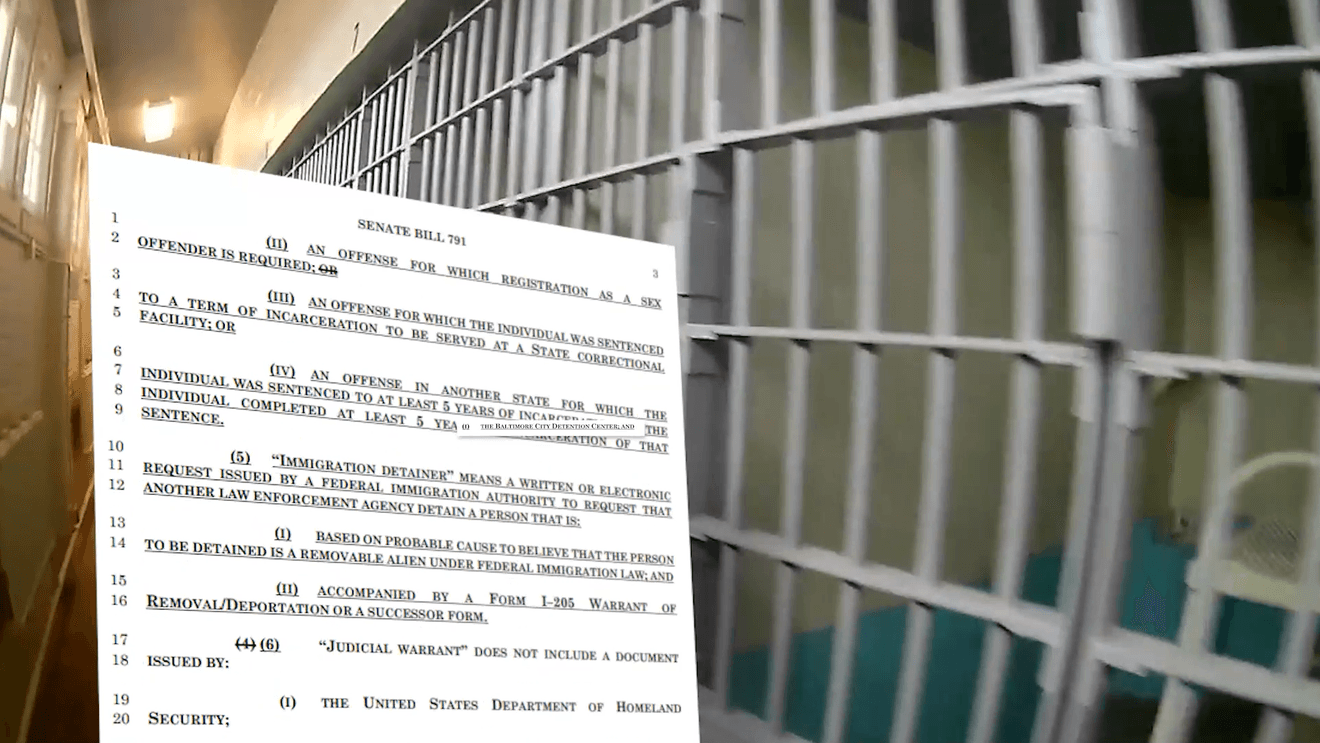
The Community Trust Act, SB 791, seeks to curb cooperation between local law enforcement and federal immigration authorities. The passage of the plan on the final day of the 2026 session came after lawmakers already banned formal 287(g) agreements in the state.
ALSO READ | Critics blast ‘sanctuary state’ push as lawmakers pass Community Trust Act in final hours
Under the legislation, which has yet to be signed into law by Gov. Wes Moore, a felony conviction or a judicial warrant must be present before local law enforcement could communicate with ICE about someone’s immigration status. The legislation also outlines that law enforcement can notify ICE of someone who is detained in a correctional facility if that person would be on the sex offender registry, sentenced between 12 and 18 months in a state prison, or committed an offense in another state that resulted in at least five years served in prison.
However, Sen. Justin Ready, a Republican, argued not every offense that’s serious is a felony, and the legislation doesn’t go far enough to protect public safety.
“If ICE picks up a repeat drunk driver that’s been convicted multiple times of drunk driving and a whole long rap sheet, but no convicted felonies, they can’t call ICE,” Ready said.
The language of the legislation makes mention of a facility in Baltimore that’s closed – something analysis noted in the fiscal note as well.
“[Baltimore City Detention Center] was closed in 2015 and demolition of the facility was completed in 2021,” the analysis indicated.
FOX45 News reached out to the Department of Public Safety and Correctional Services to ask how it’s preparing for implementation, especially since the legislation passed as an emergency bill, meaning the regulations and restrictions would take effect immediately upon Gov. Moore’s signature.
Questions were also posed to DPSCS from FOX45 News about exclusion of some facilities in the bill’s language; a response has yet to be received.
In early April, Gov. Moore stood with law enforcement agencies on the Eastern Shore as they touted a massive drug bust: approximately 90 pounds of cocaine, along with weapons and cash were all seized, and several suspects arrested.
The Worcester County Sheriff’s Office Criminal Enforcement Team and the Wicomico County Sheriff’s Office Joint Community Action Team, along with several federal, state, and local partners, concluded the long-term investigation following a coordinated operation targeting narcotics distribution networks across the Eastern Shore and surrounding regions.
“This dope is being supplied by the Jalisco Cartel,” Christopher Goumenis, DEA special agent in charge, said. “The President has deemed them to be a foreign terrorist organization.”
Yes Marylanders, you have terrorist organizations in your community, DEA Special Agent in Charge Christopher Goumenis added.
FOX45 News also asked DPSCS if coordination such as the one on the Eastern Shore would be allowed under the Community Trust Act language. Again, FOX45 News has yet to receive a statement from DPSCS.
Supporters of the bill, primarily Democratic lawmakers, argue that it ensures due process.
“When there is a felony or a serious charge, the detention center or local law enforcement should and can call ICE,” House Speaker Joseline Pena-Melnyk said during a previous interview with FOX45 News.
Legislative analysts have warned that the bill could jeopardize federal funding for the state. This concern is underscored by a recent executive order signed by President Trump, directing the Department of Justice and Homeland Security to evaluate “sanctuary” states and potentially cut federal funding.
But critics, including Jeremy Beck, co-president of immigration group NumbersUSA, argued the legislation hinders coordination, which he said is crucial for enforcement actions.
“Let’s just be clear about it up front. This is not about improving standards. It’s about blocking enforcement – period,” Beck said. “It doesn’t matter what area of enforcement you’re in. If you want it to be effective and work, you have to have good collaboration and cooperation. And again, this bill just says, nope, the opposite, because their goal is not better enforcement. It’s no enforcement.”
A spokesperson for the Department of Homeland Security argued the policies passed by lawmakers in Maryland impact public safety.
“When sanctuary politicians outlaw state and local law enforcement cooperation, they make their communities less safe. 7 of the top 10 safest cities in the United States cooperate with ICE,” the spokesperson said via statement. “When politicians bar local law enforcement from working with DHS, our law enforcement officers have to have a more visible presence so that we can find and apprehend the criminals let out of jails and back into communities.”
These politicians must stop releasing criminals into our communities and playing Russian roulette with American lives, a DHS spokesperson told FOX45 News.
FOX45 News also reached out to the Office of Attorney General, asking several questions about the language in the bill itself. However, the questions were not especially addressed in the statement sent to FOX45 News.
“All bills passed by the Maryland General Assembly are reviewed by the Office of the Attorney General for constitutionality and legal sufficiency,” OAG Spokesperson Kelsey Hartman said. “That review is standard practice and applies to all passed legislation.”
Follow Political Reporter Mikenzie Frost on X and Facebook. Send tips to mbfrost@sbgtv.com.
 Local Story