The Chris McKay Show
6:30 pm - 7:00 pm
MARYLAND (WBFF) — Students are returning to classrooms this week across many Maryland school systems. Classrooms, which in recent years have received billions of additional dollars in funding. Last school year, on average, Maryland schools spent $21,814 per pupil. But as the funding surges, academic results continue to fall short of the goals set by the state.
Project Baltimore attended a recent Maryland State Board of Education meeting and spoke with State Superintendent of Schools Dr. Carey Wright, and Maryland State Board of Education Vice President Dr. James Bell.
Our questions concerned the academic goals for the 2025/2026 school year set by education leaders in 2024. And those goals were not met.
“Not one of the goals that we can see has been met academically. Should taxpayers and parents be concerned about that?” Project Baltimore’s Chris Papst asked Dr. Wright and Dr. Bell.
“I think they need to be paying attention to the direction that the scores are heading, and the scores have all been heading up,” responded Wright.
“The goals that were set aren’t met at this point,” added Bell. “But you have to continue to do things to try and meet those goals.”

Project Baltimore spoke with Maryland education leaders after a recent Maryland State Board of Education meeting (WBFF)
ALSO READ | As funding soars, Maryland students post modest gains on state testing
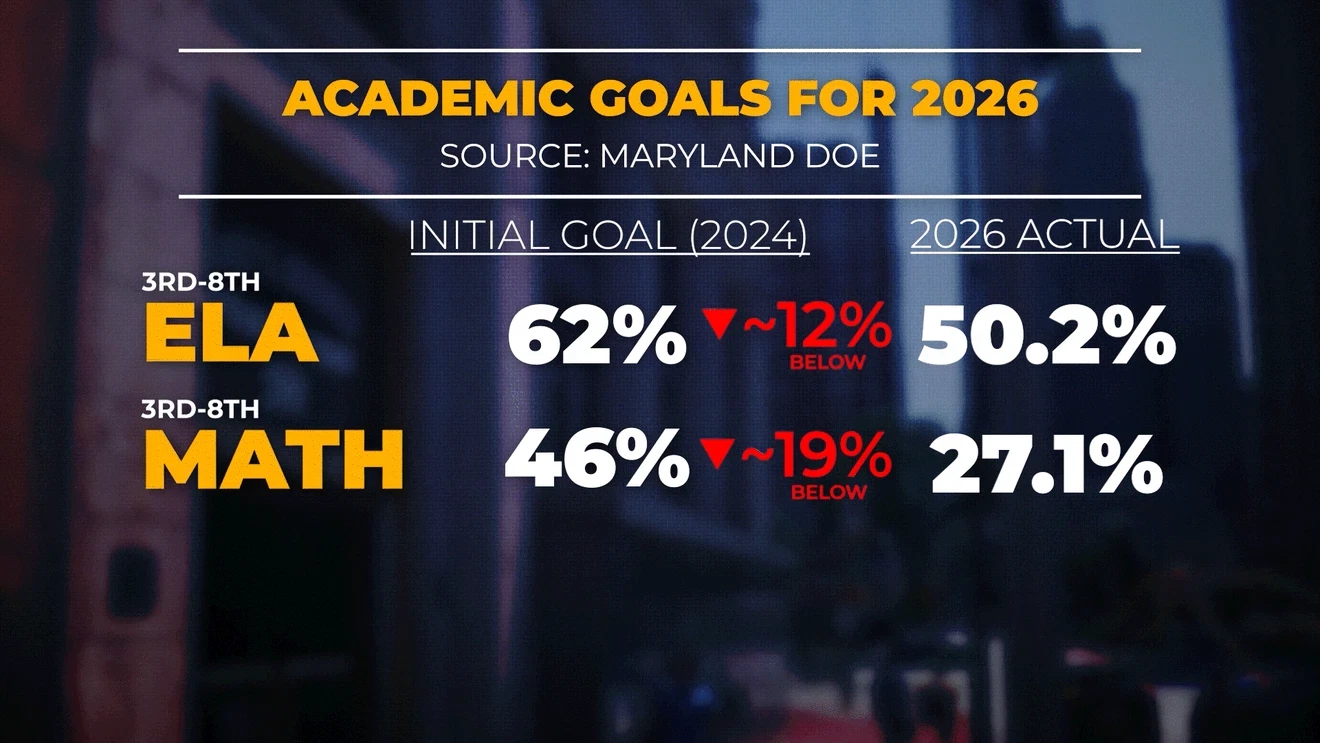
The academic goals the State wanted to reach by the end of the 2025/2026 school year, which were initially set in 2024, are as follows: 62% proficiency for third through eighth grade English Language Arts, and 46% proficiency for math in those same grades.
One year later, in 2025, the state revised the goals, lowering the numbers to 57% in ELA and 37% in math.
In July 2026 the results were released. Mayland students did not come close to meeting any of the goals. In ELA, 50.2% of students tested proficient. In math, 27.1% of students tested proficient. Overall, in ELA the state fell short of its initial goal by 12 percentage points. In math, the state fell short of the initial goal by 19 percentage points.

In 2025, the state revised the 2026 goals, lowering the numbers to 57% in ELA and 37% in math. In July the 2026 results were released and Maryland students did not come close to meeting any of the goals (WBFF)
“We were setting aspirational goals because we had so far to climb,” stated Wright. “My concern is, are we making incremental progress? And the answer to that question is yes, we are. And whether we meet an exact number or not, that is not the most concern to me, as are we heading in the right direction.”
From 2024 to 2026, overall math and English proficiency rates have increased by about three percentage points. But during those three school years, taxpayers have increased school funding by nearly $1.5 billion annually, largely due to the Blueprint for Maryland’s Future.
Passed in 2021, the Blueprint pumps billions of additional dollars into public education promising significant results.
In 2026, according to data from the Maryland State Department of Education, Maryland schools received $15.5 billion from local and state taxpayers and none of the academic goals set by the state were met – which Dr. Wright said she’s not concerned about.

School funding has incresaed by nearly $1.5 billion annually, largely due to the Blueprint for Maryland’s Future (WBFF)
ALSO READ | Changing tests, unclear results: Why MD struggles to measure long-term student success
“I’m not the least bit concerned about that,” said Wright.
“Why set goals then?” Papst asked.
“Well, you set a goal for everything in life,” Wright responded. “It guides your work and it focuses your attention. If we were setting a goal and consistently not meeting it, that’s on us then to reexamine the why. Why are we not meeting it.”
“You’re not meeting the goals,” said Papst.
“Right,” agreed Wright.
“I am kind of confused. Why set a goal if you’re saying that not meeting it is not a big deal?” Asked Papst.
“So, if you are setting a goal personally and you didn’t meet it, wouldn’t you want to ask yourself why did I not meet that goal?” Wright countered.
“I think that’s what I’m asking you,” Papst replied.
“We set goals to make sure that we’re making sure that we, our kids are moving toward those goals,” Wright responded. “It’s the way I’ve done my entire career. You’ve got to set a goal because otherwise you have no idea where you’re headed and you have no idea if you’re going to get there or not. If you don’t have a goal in life.”
In 2024, education leaders set academic goals for 2026 saying it was enough time for the Blueprint to have an impact on progress and growth.
Follow Project Baltimore’s Chris Papst on X and Facebook. Send news tips to cjpapst@sbgtv.com
 Local Story