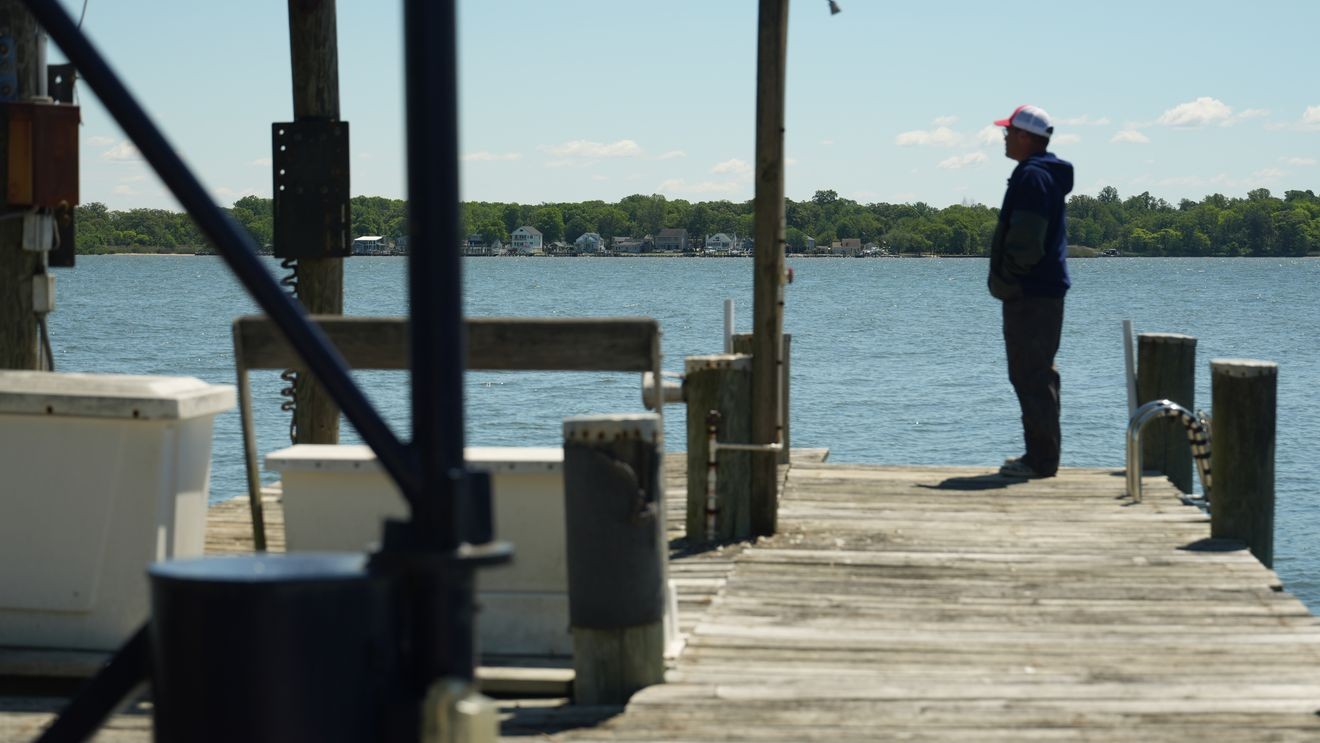
MARYLAND (WBFF) — Pasadena resident CJ Canby can’t open his door at night in summertime without a swarm of midges flying in his face.
“Biblical proportions” of midges, small, non-biting insects that several Marylanders say have recently increased, are one effect of poor management of Baltimore City’s Patapsco and Back River Wastewater Treatment Plants, Canby claims.
ALSO READ | Hampden neighbors demand relief for damages caused by sewage back-ups
The city says there are several other environmental factors at play.
The plants dump millions of gallons of treated water per day into waterways feeding the Chesapeake Bay, including nutrients that can help midges thrive.
“They’re not doing what needs to be done,” Canby said. “That’s the public outcry.”
Other Marylanders in the vicinity of the Back River plant have complained about terrible smells, and Canby also worries about the impacts of wastewater on wildlife in the bay, where he’s been catching crabs for decades.
“The crabs are not living their best life,” Canby said. “They’re not able to do what they need to do to thrive, so that they can reproduce well.”
Concerns like these inspired Del. Robin Grammer, a Baltimore County Republican, to sponsor legislation during the recent legislative session, which would have required the state to provide a public explanation whenever something goes wrong at one of the wastewater plants. The bill was co-sponsored by two Democrats and passed the House but didn’t advance in the full Senate.
Grammer blames the Maryland Department of Environment for dragging its feet on discussions, causing delays that he says ultimately killed the bill.
“These agencies – they don’t want these additional requirements, this additional oversight,” Grammar said. “Anytime you try and tell them what to do, they’re going to fight you on it, and that’s what happened.”
MDE opposed the legislation in their March bill testimony, saying it would require them to create an entirely new, costly program to monitor 532 wastewater plants across the state. MDE told Spotlight on Maryland that discussions with committee members allowed them to later drop their opposition, and that the bill “was able to advance quickly” afterward.
Baltimore’s Department of Public Works told Spotlight that algal blooms and midge swarms are “influenced by a number of environmental factors, including elevated temperatures, stormwater runoff, and nutrient loads from multiple regional sources — not wastewater treatment plants alone.”
DPW added that “midge larvae occasionally found within treatment plant process flows are a different species than the insects residents are experiencing in surrounding communities.”
Regarding Grammer’s legislation, DPW said it was concerned about high costs and few benefits, adding that it “supports transparency and environmental compliance and already reports required information to regulators in accordance with state and federal law.”
“The department remains open to working with legislators and stakeholders on practical approaches that strengthen public communication while avoiding unnecessary costs for customers,” DPW spokesperson Jennifer Combs said in an email.
The ‘infamous red light’
The Patapsco and Back River plants have been under a consent decree since 2023, requiring them to flip on a warning light whenever there’s a problem at one of the plants, but without providing any specific information about what went wrong.
“The consent decree required things like the infamous red light. Well, that helps us understand when there is some kind of failure event, but what does that mean?” Grammer said.
The lack of information can lead some to draw the wrong conclusions, according to Sam Weaver, who co-founded the Maryland Waterways Foundation that works on cleaning up the bay. Grammer’s legislation “would take away the stigma that everybody thinks that they’re dumping raw sewage into the river, when they’re just bypassing one filter,” Weaver said.
Weaver said he believes the recent influx of midges stems partly from wastewater plants and partly from over-fishing of wildlife that feeds on midges, in addition to nutrient-rich clay runoff. Weaver added he had a positive impression of the Back River facility after taking a recent tour.
DPW and MDE told Spotlight they are reevaluating how the warning lights should be used, with DPW acknowledging public “confusion” surrounding the light signals.
“The warning lights mandated by the 2023 consent decree illuminate for 24 hours after any bypass of the complete treatment process, whether or not the bypass creates an immediate water safety concern,” MDE spokesperson Jay Apperson said in an email.
Calls for transparency
Some say more transparency is needed. Canby pointed to recent inspection reports of the Patapsco plant, which show the plant exceeding permitted levels of nitrogen and phosphorous within the past year.
“It’s sad that the bill that was in place to add more transparency, to add more clarity to what’s going on, was shot down,” he said.
MDE told Spotlight in a statement that they “hear the community’s concerns” about nutrient pollution and that the Patapsco facility “is inspected regularly.” MDE added that “there has been improvement, but much more needs to be done.”
DPW said while there have been elevated nutrient levels, “all wastewater discharged from the facility continued to be disinfected and dechlorinated before entering the Patapsco River.” They also provided a 2025 performance summary showing the Patapsco facility “slightly” exceeded it nutrient limits, while the Back River facility was within permitted limits.
“As one of the region’s largest and most complex treatment facilities, the Patapsco plant must continuously adapt to changing weather conditions, fluctuating system flows, and the demands of aging infrastructure,” DPW spokesperson Mary Stewart said in an email. “The City continues to make targeted investments in maintenance, infrastructure upgrades, and operator preparedness to support reliable plant performance and protect water quality.”
‘Legitimate concerns’
Midge issues are cropping up in areas that do not receive discharge from the Back River Plant, including Middle River and Bear Creek, according to Ellen Kobler, Baltimore County’s Department of Environmental Protection and Sustainability. Additionally, the department’s public midge reporting tool shows numerous concerns about midges coming from outside Baltimore County, including the Baltimore Harbor and Anne Arundel County shoreline, Kobler noted.
The midges reported in the harbor could possibly stem from wastewater since water in the Patapsco River flows both north and south, said Alice Volpitta, a water quality scientist with Blue Water Baltimore, which took legal action leading to the 2023 wastewater consent decree.
Volpitta said people living near wastewater treatment plants have “legitimate concerns” about midges, algal blooms, and odors, and that excessive amounts of nutrients being discharged from the plants “are absolutely contributing to algae blooms.”
Regarding midges, she said it’s hard to “definitively pinpoint” the source of the problem.
“I think the wastewater treatment plants are almost like the most obvious place to look for problems,” she said. “But unfortunately, we just don’t have enough information yet.”
Authorities have been investigating odor concerns, DPW and MDE told Spotlight. DPW added that wastewater facilities “can be a potential source” of odors, along with “multiple possible contributing sources.”
Baltimore City has been supporting water quality alongside Baltimore County and the Maryland Department of Agriculture, including treatment for midge larvae, DPW said.
MDE said $86.5 million in the upcoming fiscal year budget has been “programmed” for projects at the Patapsco plant, which includes $24 million in Bay Restoration Fund Grants, in addition to Water Quality State Revolving Fund loans.
Have a news tip? Contact Brooke Conrad at bjconrad@sbgtv.com or 443-578-2126, or contact the Spotlight team at SpotlightOnMaryland@sbgtv.com or 410-467-4670. Spotlight on Maryland is a joint venture by The Baltimore Sun, FOX45 News and WJLA in Washington, D.C.
 Local Story