SUITLAND, Md. (7News) — It’s the Smithsonian the public never sees.
The museum behind the museum, a million square feet of artifacts in Suitland, Maryland, where science comes to life.
Namely, the 65 million Smithsonian artifacts stored in the labs and what staff refer to as the “pods” at the Museum Support Center.
RELATED | Smithsonian exhibit looks at role of first ladies in America’s 250 year history
“Dedicated in 1983, it started out with about four pods, each about the size of a football field and about three stories tall,” Museum Specialist Ella Haigler Wright said.
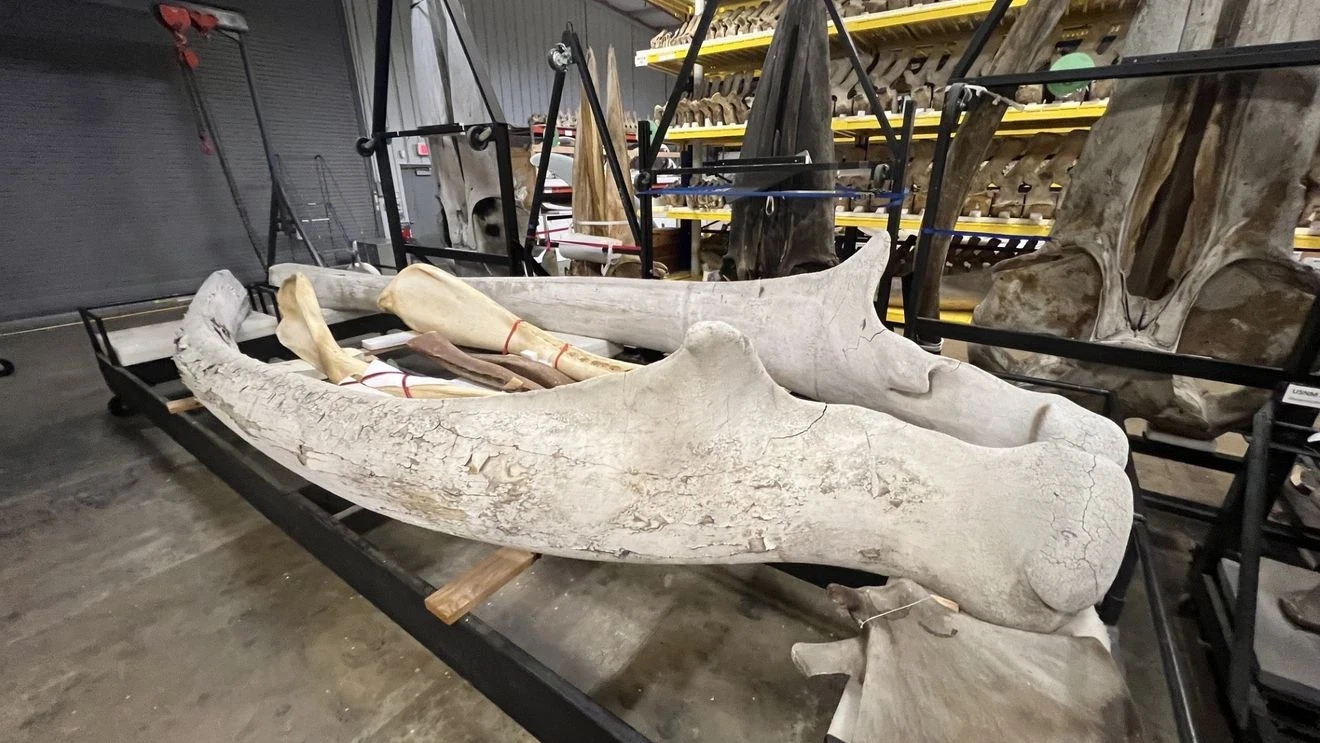
Inside, the collection spans nearly every scale imaginable, from microscopic cell samples on slides to massive whale bones.

A line of whale bones stored at the Smithsonian’s Museum Support Center. (7News/Megan Clarke)
7News was invited to see a hangar full of whale bones.
“This is where we house the world’s largest marine mammal collection.” Museum Specialist Teresa Hsu said.
SEE ALSO | New Smithsonian exhibit celebrates America’s 250 Anniversary through nature
A tall yellow shelving unit supported an entire whale spine, and the skull of the largest whale stood tall near a back wall.
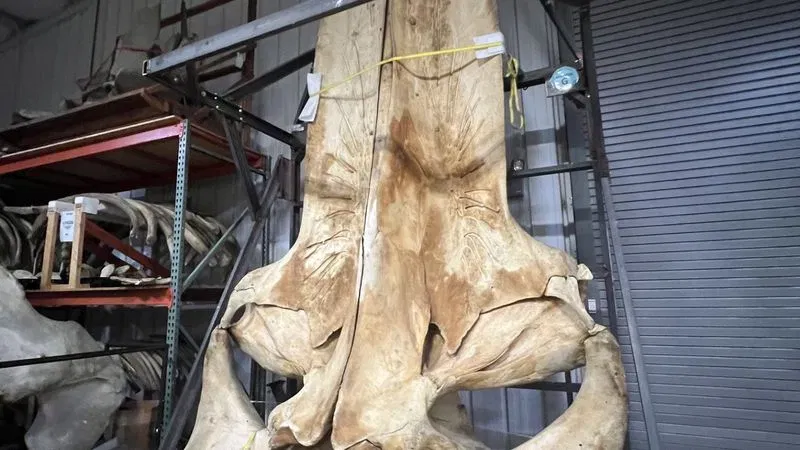
The skull bone of the largest whale. (7News/Megan Clarke)
In this collection, scientists study baleen samples — the long, floss-like pieces that hang from a whales mouth filtering ocean water as the whale feeds.
Hsu showed the 7News crew a piece of baleen larger than her.
“Something as large as this, it can capture up to 15 years-worth of its life history,” Hsu said.
The bones and specimens, like those sealed and protected in jars in the nation’s largest wet collection, are not preserved solely for posterity.
The site also contains libraries and labs, facilities for discovery.
“We have visiting researchers from all over the world, they come to do research, they come to do conservation work,” Haigler Wright said. “When we have researchers over here, even though they are taking in our collections, taking measurements, scanning them, we are also learning from them.”

A photo of a massive lobster donated to the Smithsonian by a restaurant. The creature is now housed in the Smithsonian’s Museum Support Center in Suitland, Maryland. (7News/Megan Clarke)
Possibly the gem of the center is the U.S. Antarctic Meteorite Collection, which is made up of large metal containers filled with nitrogen gas that maintain a cold temperature.
“A lot of mysteries of the universe are being stored inside these glove boxes,” Research geologist and Curator of Meteorites Cari Corrigan said.
READ MORE | Capitol Cornerstone’s whereabouts still baffle historians, scholars, amateur sleuths
Inside are meteorites recovered from Antarctica, offering researchers clues about the formation of our solar system and even the composition of Earth’s interior.
“When the solar system was first forming, these particles all just came together, accreted together, to form the asteroids, so there are particles in here that are as old as the solar system, something like 4 and a half billion years old,” Corrigan said.
It is emotional and when you start to think about how old the solar system is and how small we are right,” Corrigan said. “And we think of the ingredients that so long ago had to come together to get us to where we are today.
Today, they’re painstakingly preserved here in Suitland, protected for research, discovery and, ultimately, for all of us — relics of the past, keeping the mission of the Smithsonian, alive.
“We go get them and keep them in these condition, so they can remain pristine for researchers for decades to come,” Corrigan said.

 Local Story