KINGSVILLE, Md. (WBFF) — A $2.5 billion question: Was this year’s Baltimore County’s school budget legally approved?
The Maryland State Department of Education says yes, but one state senator disagrees and he’s now asking the Attorney General to weigh in.
Baltimore County resident Amy Adams had hoped a new report from the Maryland State Department of Education would provide clarity regarding how Baltimore County Public Schools fiscal year 2027 budget was approved.
“I think concrete answers would be good for everybody,” said Adams.
Unfortunately, Adams says, that’s not what happened, “No.”

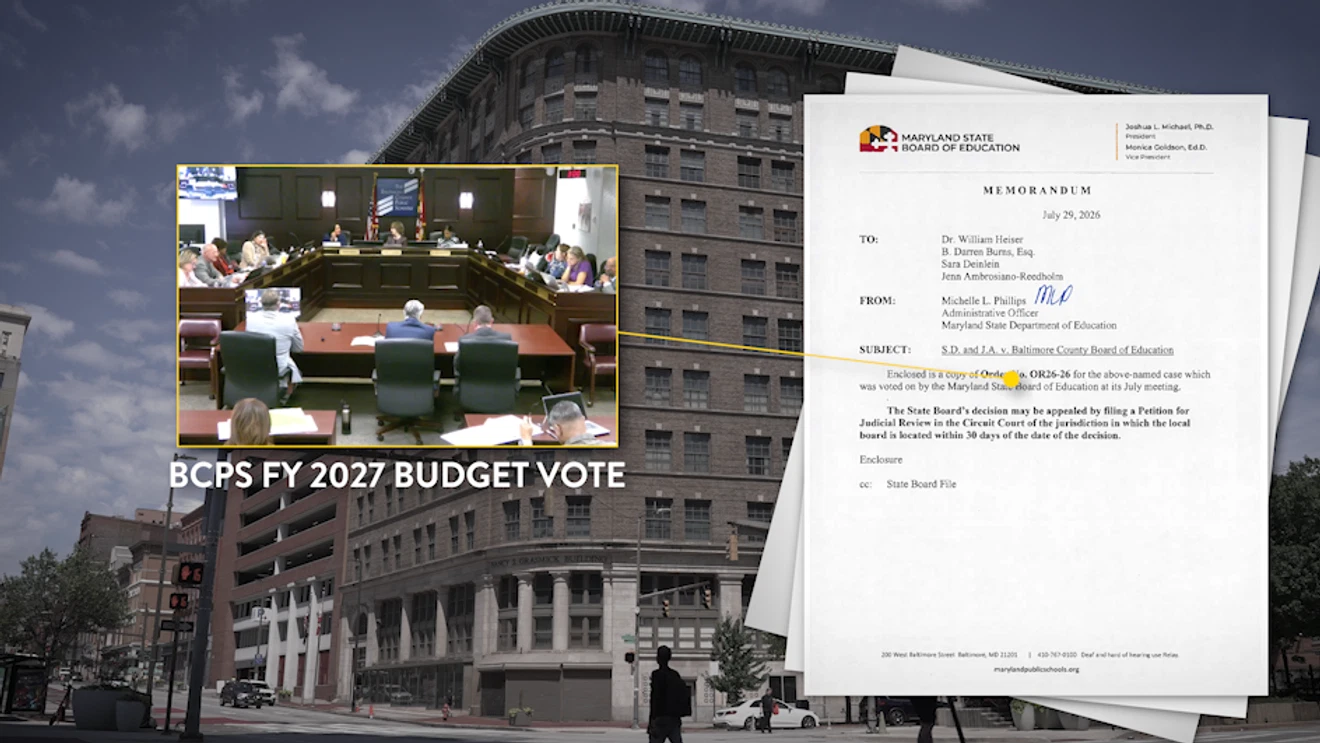
The report from the Maryland State Department of Education concerning the legality of the Baltimore County Public Schools budget vote (WBFF)
The Maryland state legislature, in 2014, passed a law stating Baltimore County school board members “may not be a candidate” for “local, State or federal government.” The language passed unanimously and was signed by then Governor Martin O’Malley.
ALSO READ | $2.5 billion Baltimore County school budget takes effect as legal appeal awaits decision
Now, fast forward to February 2026. The Baltimore County Board of Education voted 7-4 to approve a $2.5 billion budget for this school year. Board Member Robin Harvey was one of the seven “yes” votes, required for approval.
But, as Project Baltimore first reported in March, Harvey, prior to the vote, registered as a candidate for the Maryland House of Delegates. Later in March, following FOX45 News’ reporting, Adams’ group, The Baltimore County Parent and Student Coalition, along with multiple county parents, filed an appeal with MSDE challenging the legality of the budget vote. On July 29, the state issued its findings.
“I felt like it was a little contradictory to itself,” stated Adams.
MSDE dismissed the appeal stating its was filed too “late” and outside the statutory window to appeal a school budget.
However, MSDE also explained, “While Ms. Harvey should have resigned her board seat before filing her candidacy and could have faced removal from the local board if she failed to do so, (state law) lacks the specificity needed to invalidate a vote.”
“Within the explanation, it just kind of leaves us scratching our head,” remarked Adams. “This structure of who’s eligible to cast votes if they’re planning on resigning to seek election in another office is confusing.”

State Senator J.B. Jennings, who represents Baltimore and Harford Counties, co-sponsored the 2014 bill (WBFF)
Remember, the law says a Baltimore County school board member “may not” be a candidate for state office. And without Harvey’s vote, the budget does not pass. In its report, MSDE said the law does not ‘act as an automatic disqualifier.’ So, what does this law actually mean? To get that answer, we spoke with the person who co-sponsored the original bill.
“She needed to resign immediately,” said State Senator JB Jennings, who represents Baltimore and Harford Counties. “That vote should not have been taken. Her vote should not have counted.”
Jennings co-sponsored the 2014 bill which established the law that he says was intended to prohibit sitting Baltimore County School Board members from also being candidates for state office.
“The idea was you don’t want people who serve on the Board of Education, which is a nonpartisan board focused on education, who are now a candidate for office, to use their seat as a platform,” Jennings explained.
ALSO READ | Dispute over $2.5B school budget vote continues after ‘technicality’ leads to dismissal
This concept does exist in Annapolis. Legislative staffers, for example, must resign before running for state office. Jennings said the legislature wanted similar rules to apply for Baltimore County’s school board.
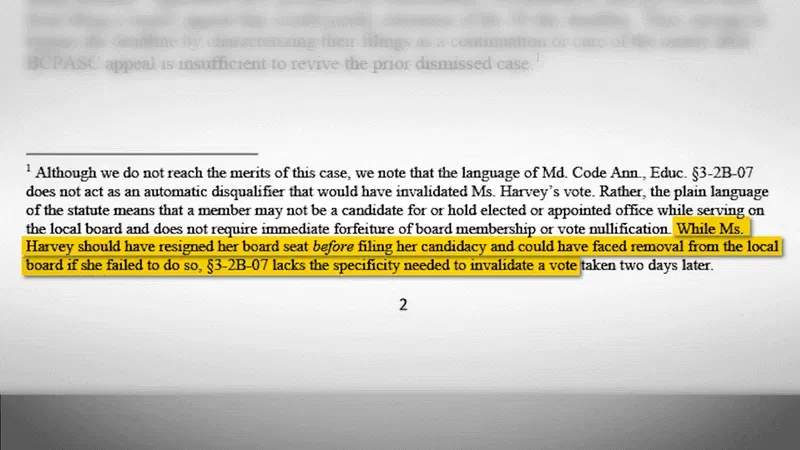
MSDE explained, “While Ms. Harvey should have resigned her board seat before filing her candidacy and could have faced removal from the local board if she failed to do so, (state law) lacks the specificity needed to invalidate a vote.” (WBFF)
“Are you concerned about the way the budget was passed that future issues could arise from it?” Asked Project Baltimore’s Chris Papst.
“Absolutely,” replied Jennings. “Because somebody could always use that and say, hey, this budget was passed out of legal standards and therefore it shouldn’t be in effect.”
The contested budget has been enacted. It took effect on July 1.
“I think the problem is they got caught,” remarked Jennings. “The train was so far down the tracks that they were like, we can’t pull this thing back. It’s a mess. It’s unchartered territory.”
Jennings, on Tuesday, wrote a letter to Maryland Attorney General Anthony Brown requesting a “legal interpretation” regarding the 2014 law – asking if Ms. Harvey’s participation in the February 23 board vote was permissible.
We’ll keep you posted.
Follow Project Baltimore’s Chris Papst on X and Facebook. Send news tips to cjpapst@sbgtv.com
 Local Story