MARYLAND (WBFF) — Maryland education leaders, on Tuesday, released the latest round of state test results, known as MCAP, the Maryland Comprehensive Assessment Program. But beyond the numbers, there’s another issue drawing attention.
State leaders are now acknowledging it’s become difficult to answer a basic question: Are Maryland students making long-term academic progress?
When analyzing the 2026 MCAP scores during the board meeting Tuesday, there was an obvious concern – first brought up by board member Dr. Peggy Carr.
“I’d like for you to talk a little bit about 2019 and why we are not looking at 2019. 2019 is the pre-pandemic year,” stated Carr. “Why are you not making that comparison?”
Every year, Maryland public school students in third through eighth grade along with some high schoolers take state proficiency tests in math and English Language Arts. The results can help provide long-term assessments to compare student outcomes. But in Maryland, long-term comparisons are difficult because the state keeps changing the test.
ALSO READ | As funding soars, Maryland students post modest gains on state testing
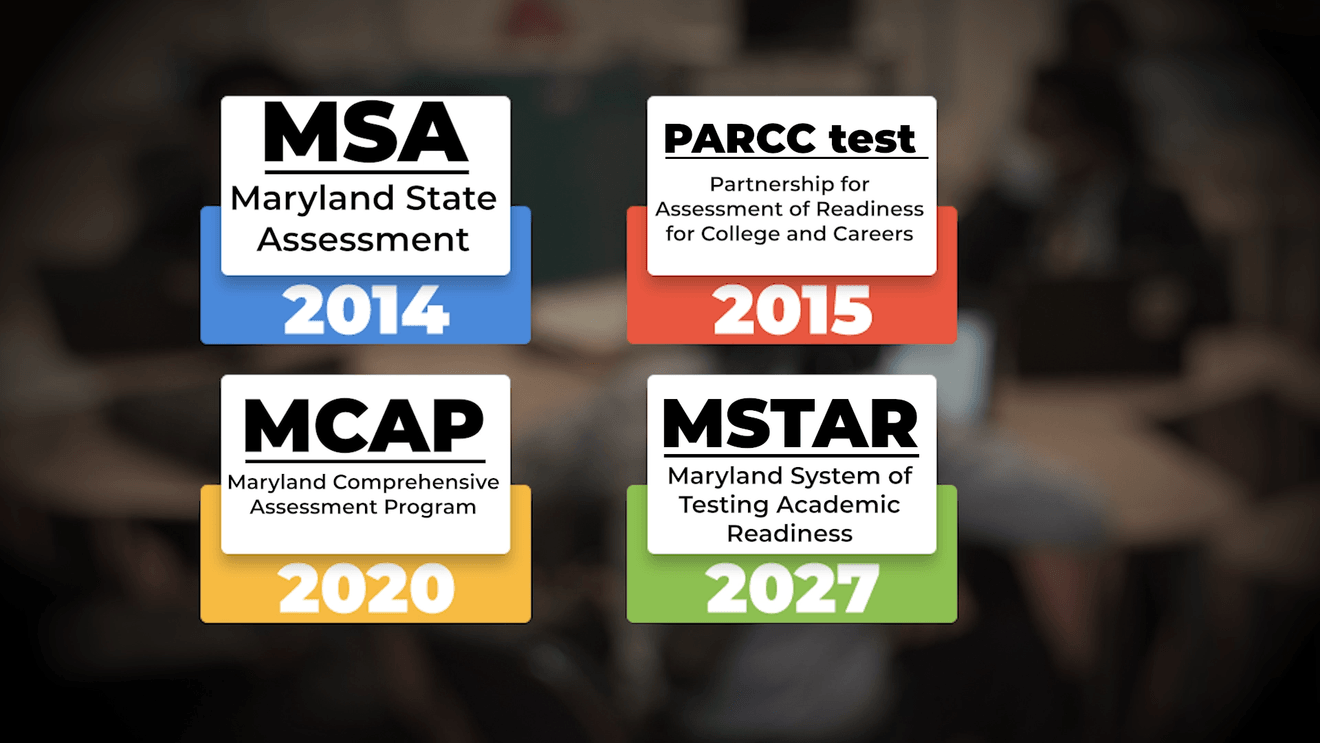
Maryland, since 2014, has used three different standardized tests with a fourth starting next year. In 2014, Maryland students took the MSA (Maryland State Assessment). In 2015, the state adopted the PARCC test (Partnership for Assessment of Readiness for College and Careers). In 2020, Maryland switched to MCAP (Maryland Comprehensive Assessment Program). And next year, Maryland is moving to MSTAR (Maryland System of Testing Academic Readiness.)
Here’s the concern: Maryland has invested billions of additional dollars into public education since 2019 – before the pandemic. Have Maryland students academically recovered since then? Are students testing better than 10 years ago? We don’t know because the test has changed.
Fox45 News asked Maryland Superintendent of Schools Dr. Carey Wright if that’s a problem.
“You do not want to keep changing a test. I’ll agree with you 100%,” said Wright. “What we’re trying to do is to get a consistent test that we’ve got confidence in, that we’ve got confidence that is reliable, that it is valid.”
Project Baltimore, last month, spoke with Dr. Lance Evans, the Mississippi State Superintendent of Education.
Dr. Lance Evans is the Mississippi State Superintendent of Education.
ALSO READ | BOOST demand rises as Maryland awards fewer educational scholarships to families
“We’re not chasing the next educational silver bullet,” said Evans. “While students are having to take the assessments, assessment is really about adult accountability.”
Mississippi has used the same state test since 2015. Evans says that consistency allows his state to hold school systems, teachers and students accountable. And it appears to be working. According to the Baltimore-based Annie E. Casey Foundation, Mississippi schools are ranked 16th nationally, while Maryland is ranked 20th. Compare that to 10 years ago, when Mississippi was ranked 47th and Maryland was 13th.
“We know what works in our state,” explained Evans. “So we’re never going to change.”
Wright was the Mississippi State Superintendent of Education in 2015 when that state’s current test was adopted. She told Project Baltimore her intention is to create similar stability in Maryland.
“What we’re hoping to do now then is to bring this consistency that you’re talking about, starting with a new MSTAR over the next 5 to 10 years,” said Wright.
State Board of Education President Dr. Joshua Michael told Project Baltimore that the current MCAP test had significant problems, it was too long and didn’t match updated state academic standards, and therefore it needed to be replaced. He says he hopes MSTAR will finally be the state test in Maryland for years to come.
“We want a test that is going to stand the test of time. But I would say we’re in a similar spot to where Mississippi was in 2015,” concluded Michael.
Follow Project Baltimore’s Chris Papst on X and Facebook. Send news tips to cjpapst@sbgtv.com
 Local Story