ANNAPOLIS, Md. (WBFF) — Maryland is preparing to spend up to $109.4 million on a new statewide voting system, setting up a costly election overhaul that uses similar machines as the state continues to confront large structural budget gaps for the rest of the decade.
This large-scale purchase would mark nearly a quarter of a billion dollars in taxpayer expenditures on state election equipment since 2002.
The Maryland Board of Public Works approved the contract on July 22 with Omaha-based Election Systems & Software (ES&S). The initial award is approximately $84.9 million, with two two-year renewal options that could increase the total to roughly $109.4 million over nine years.

Nearly visually identical, the Maryland Board of Public Works approved a $109 million procurement to purchase new voting machines from Election Systems & Software (ES&S) that will be operational for the 2028 elections. (Steve Pierce/Spotlight on Maryland)
The equipment is intended to be ready for the 2028 presidential election.
Procurement documents reviewed by Spotlight on Maryland show eight vendors were solicited, four submitted proposals, and ES&S received the highest overall technical ranking from the evaluation committee in a unanimous final decision.
The timing of the nine-digit purchase puts two competing realities side by side: Maryland’s existing voting equipment is nearing the end of its useful life, according to the Department of Legislative Services (DLS), while the state’s long-term spending continues to outpace projected revenue.
The nonpartisan DLS projected late last year that Maryland’s structural deficit could grow from about $1.2 billion in fiscal year 2027 to $3.7 billion by fiscal year 2030.
Susan Greenhalgh, a senior advisor with the voter advocacy group Free Speech for People, testified against the contract at the board’s July meeting.
“This contract will commit Maryland to a voting system that is still under development at a premium price with potential unforeseeable costs,” Greenhalgh said.
When asked why the governor ultimately voted to approve the contract amid significant budget shortfalls forecast for the coming years, a spokesman for Moore said they were referring all media inquiries “to legal review” amid a personal defamation lawsuit the governor is facing.
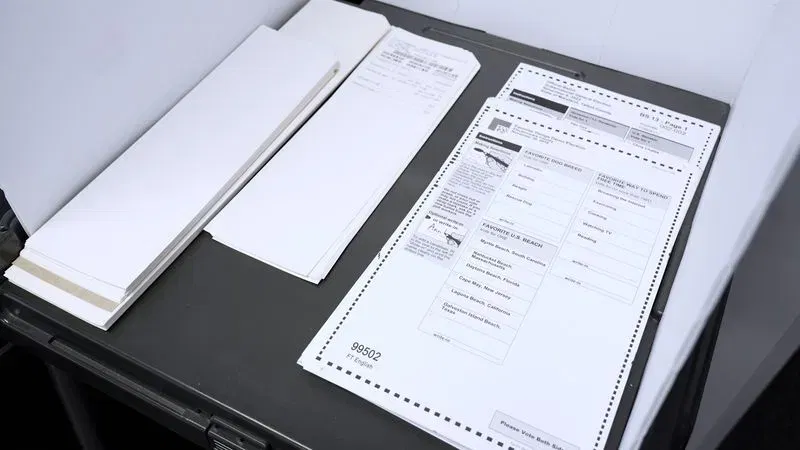
Test ballots printed by the Maryland State Board of Elections to sample new voting machines the agency is expecting to roll out by the 2028 elections. (Steve Pierce/Spotlight on Maryland)
Last Monday in Annapolis, Spotlight on Maryland asked Jared DeMarinis, the state administrator of elections, whether now is the right time to make such a significant purchase given the state’s financial condition.
“Yes,” DeMarinis said.
The veteran elections official compared the current equipment to an aging cellphone. DeMarinis said the existing system remains safe and secure for the current election cycle. However, he warned that by 2028, the machines will be roughly 13 years old and increasingly vulnerable to wear.
The Maryland State Board of Elections (SBE)’s purchase is the latest chapter in more than two decades of costly changes to how Marylanders cast ballots for local, state, and federal elections.
At the end of former Gov. Parris Glendening’s term, Maryland began rolling out Diebold AccuVote touch-screen machines in 2002, first in four jurisdictions representing about one-third of registered voters, according to state records.
By 2006, at the end of former Gov. Bob Ehrlich’s time in Government House, all of Maryland’s 24 jurisdictions had implemented the uniform election systems.
The AccuVote system was a fully digital platform that eliminated paper ballots. In the mid-2000s, after the state hired consultants and academic teams from Johns Hopkins and Princeton universities, severe software vulnerabilities were identified.
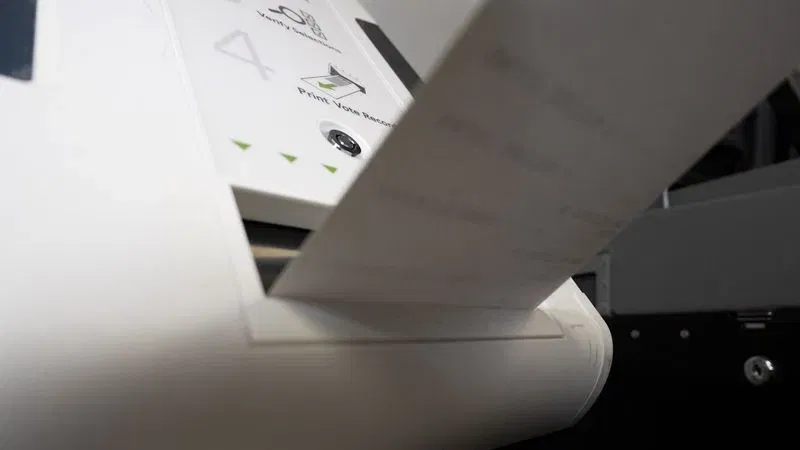
Nearly visually identical, the Maryland Board of Public Works approved a $109 million procurement to purchase new voting machines from Election Systems & Software (ES&S) that will be operational for the 2028 elections. (Steve Pierce/Spotlight on Maryland)
The studies found problems included easy unauthorized access to the voting database and memory cards, as well as the ability to manipulate vote tallies. The studies showed that malicious code could easily bypass or alter encryption and audit logs, rendering them unreliable.
State lawmakers voted in 2007 to discontinue the AccuVote system and require a voter-verifiable paper trail. That legislation ultimately led Maryland back to a paper-based optical scanning system for the 2016 elections.
In 2014, ES&S announced that its contract for the paper-based voting system was valued at $28.14 million. Fiscal notes show that Maryland had already spent approximately $90 million on Diebold for the earlier electronic voting system.
Paper ballots, DeMarinis said, are essential.
When you have paper, you can always check it because you have something that the voter verified and actually cast themselves,” DeMarinis said.
DLS said in its fiscal year 2027 budget analysis that the current ES&S voting system is nearing the end of its life. The agency estimated the broader replacement project could cost between $100 million and $125 million.
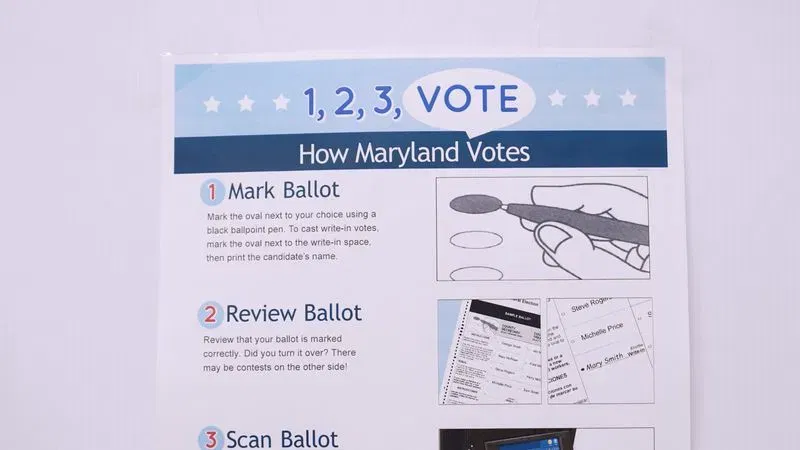
Ballot marking instructions supplied by the Maryland State Board of Elections. (Steve Pierce/Spotlight on Maryland)
Between the Diebold system procurement, costing Marylanders $72.6 million, ES&S’s initial 2014 contract of $28.14 million, and the latest procurement for the 2028 elections, Marylanders could have spent $210.14 million over the past 25 years.
With ES&S’s new machines the state is acquiring looking nearly physically identical, Spotlight on Maryland pressed DeMarinis on what will actually change for the voters.
“For the voter,” DeMarinis said, “their experience will probably be negligible.”
Voters who mark paper ballots by hand will still fill in ovals and feed ballots into a scanner. Those using accessible ballot-marking devices will still make selections electronically, print a paper ballot and then submit it for processing by the scanner.
Test ballots printed by the Maryland State Board of Elections to sample new voting machines the agency is expecting to roll out by the 2028 elections. (Steve Pierce/Spotlight on Maryland)
The biggest visible difference, DeMarinis said, is speed. The new scanners process ballots faster and include updated security features. He also said the current accessible ballot-marking equipment will no longer be manufactured, limiting Maryland’s ability to replace units as they fail or add machines.
Ronza Othman, the president of the National Federation of the Blind of Maryland, said her organization was allowed to test the new equipment and found its accessibility features are generally strong.
She also cautioned against treating the new machines as a solution to a broader voting-access problem, she said, that remains.
No, frankly, the new device is not going to solve the problems we have been experiencing,” Othman said.
Pointing to her own experience as a blind voter, Othman said she remains concerned about ballot privacy and election integrity for the state’s disabled voters.
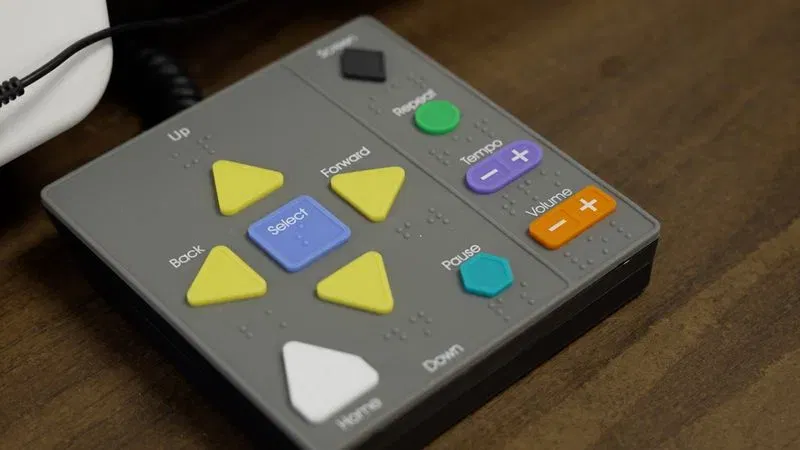
An accessibility voting pad for new election machines was approved by the Maryland Board of Public Works on Wednesday, July 22, 2026. (Steve Pierce/Spotlight on Maryland)
“We don’t have confidential ballots,” Othman said. “I don’t know if someone has changed my ballot without my knowledge because I’m not the last person who touched it before it was submitted.”
“I don’t know what’s on it. It could be gobbledygook,” she added.
Do you have any tips or information related to this story? Send news tips to gmcollins@sbgtv.com or contact Spotlight on Maryland’s hotline at (410) 467-4670.
Follow Gary Collins on X and Instagram. Spotlight on Maryland is a collaboration between FOX45 News, WJLA in Washington, D.C., and The Baltimore Sun.
 Local Story