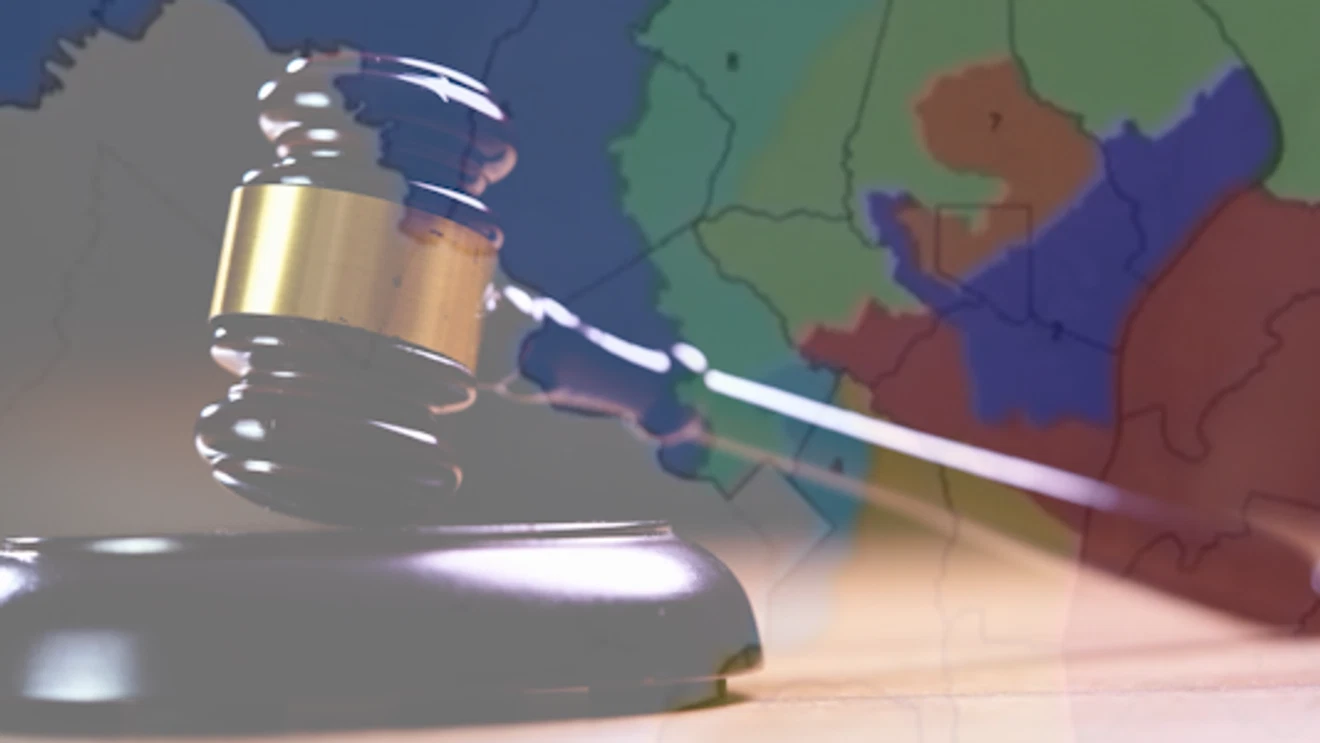
BALTIMORE (WBFF) — A legal battle over Maryland’s proposed congressional redistricting amendment is heading to the state’s highest court after two circuit court judges, appointed by governors from different political parties, ruled the measure should not appear on the November ballot.
The Maryland Supreme Court is expected to hear arguments on Thursday, the same day the State Board of Elections is scheduled to begin printing ballots.
The rulings have also brought renewed attention to the political makeup of the state’s judiciary.
For supporters of Question 3, the argument is that Maryland voters should ultimately decide whether to amend the state Constitution.
“The Democrats in Annapolis have sought from day one to bring this question to one and only one person, and that is the voter of the state of Maryland to ask them what they want their constitution to look like,” said Del. Kris Fair, a Democrat and supporter of the amendment.
But before voters can weigh in, the courts must determine whether the General Assembly followed the required process for placing the question on the ballot.
Anne Arundel County Circuit Judge Robert Thompson, who was appointed by former Republican Gov. Larry Hogan, ruled last Wednesday against the ballot question.
“Because the legislature did not follow the very laws it enacted, the court finds the enactment of HB2100 to be legally deficient,” Judge Thompson wrote in his order.
Thompson also raised concerns about the ballot language. The state appealed his decision to the Maryland Supreme Court.
Days later, Dorchester County Circuit Judge S. James Sarbanes, appointed to the bench by former Democratic Gov. Martin O’Malley, also ruled against Question 3.
Judge Sarbanes found problems with the General Assembly’s compliance with election law deadlines and wrote that “the language is misleading and does not provide voters with adequate information or an explanation for an informed vote.”
Republican Sen. Chris West, one of the plaintiffs challenging the measure, called Sarbanes’ decision “a complete win for Maryland voters as well as for the rule of law in this state.”
Sen. West said the fact that two judges appointed by governors from different parties reached similar conclusions strengthens the opponents’ argument.
“Two independent judges in different counties reached the exact same conclusion,” West said, arguing the amendment is constitutionally flawed, and the ballot language is misleading.
However, Del. Fair rejected the idea that the rulings should be viewed primarily through the political affiliation of the governors who appointed the judges.
“The criticism on the ruling itself is just that it’s not based in the constitutional facts of Article 14 of our state constitution, whether regardless of who the appointee was,” Fair said.
The political makeup of the Maryland Supreme Court, however, is drawing attention as the case moves forward.
Five of the court’s seven current justices were appointed by Hogan. The other two were appointed by Democrats, O’Malley and Gov. Wes Moore.
“There’s no ignoring the fact that five of the justices are appointed by Governor Hogan,” Fair said.
He argued the Supreme Court’s decision could establish an important precedent about the relationship between state law and the Maryland Constitution.
“To uphold that ruling from the lower courts would be to basically upend that entire model and say that state laws are on par with the state constitution,” Fair said.
For West, though, Question 3 does more than clarify existing law as supporters and the Democrats in the General Assembly argued.
“Sure, the voters are told that it just clarifies the law. It does no such thing,” West said. “It does much more than clarify the law. It empowers gerrymandering on steroids in Maryland.”
As written, Question 3 changes the state’s constitutional rules surrounding congressional redistricting.
The Supreme Court’s decision will come under a tight deadline. The court is scheduled to hear arguments Thursday, while the State Board of Elections is expected to begin printing ballots that same day.
For Fair, that means Marylanders need an answer quickly.
“We need a Supreme Court to act because they are the ones that have the ability to make the final rule and be able to make that determination rather quickly to provide clarity to the entire Maryland public,” Fair said.
Maryland Supreme Court oral arguments are set to begin at 9 a.m. on Thursday, Sept. 3, 2026.
Follow Political Reporter Mikenzie Frost on X and Facebook. Send tips to mbfrost@sbgtv.com.
 Local Story