BALTIMORE (WBFF) — The Maryland Attorney General’s Office is providing new guidance on how law enforcement agencies should interpret the state’s new Community Trust Act law, clarifying when officers are allowed to share information with federal agencies.
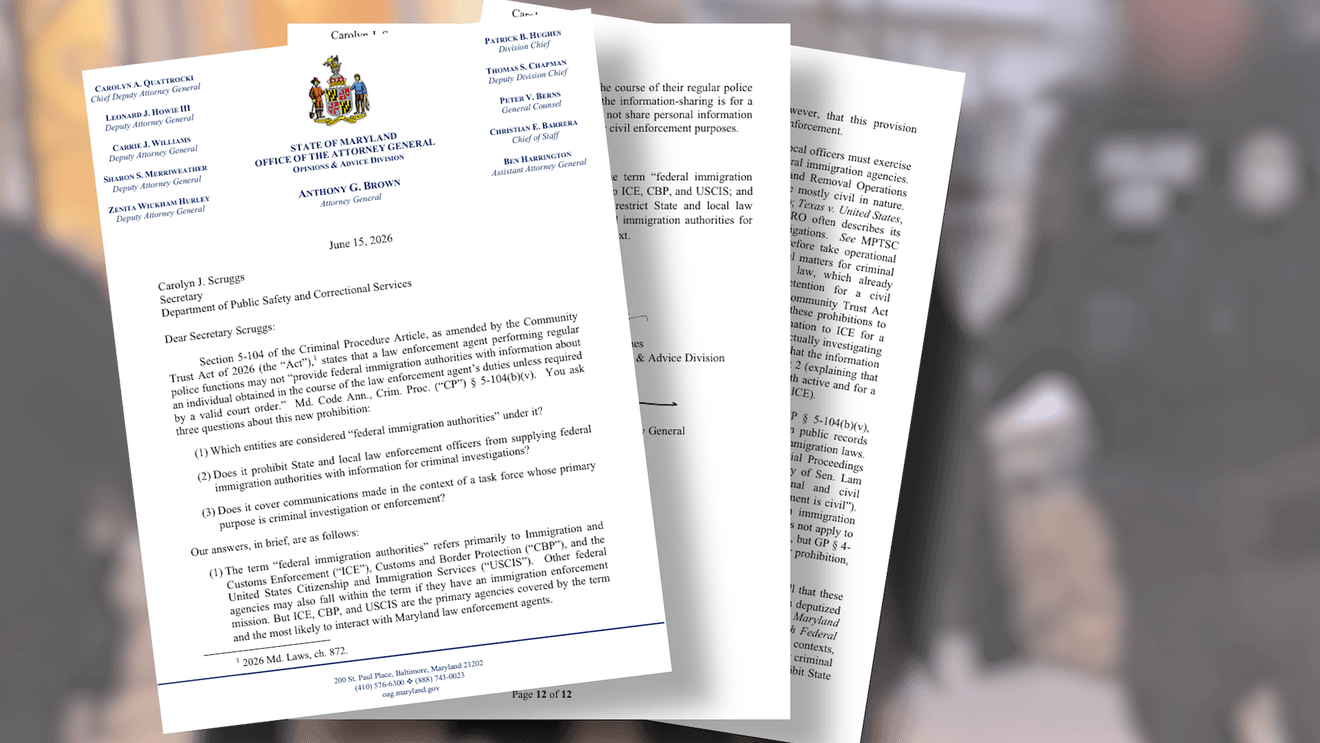
The June 15 letter, obtained by FOX45 News, addresses several unanswered questions raised by the law – including which federal agencies are covered by the prohibition of cooperation with local law enforcement, and whether joint task force investigations may continue.
According to the letter, which was addressed to Department of Public Safety and Correctional Services Secretary Carolyn Scruggs, the term ‘federal immigration authorities’ primarily refers to Immigration and Customs Enforcement, ICE, Customs and Border Protection, CBP, and U.S. Citizenship and Immigration Services, USCIS.
ALSO READ | Here’s who voted for the Community Trust Act
The OAG noted other federal agencies may fall under the definition if the agency has an immigration enforcement mission.
When Gov. Wes Moore allowed the Community Trust Act to become law without his signature, he noted concerns with implementation and indicated Attorney General Anthony Brown and his legal team would need to issue more guidance.
At issue is a provision in the Community Trust Act that prohibits law enforcement officers performing regular police functions from providing federal immigration authorities with information obtained during the course of their duties unless required by a valid court order.
While the language of the law raised questions about whether it could restrict communications with federal immigration agencies in criminal cases, the Attorney General’s Office concluded that lawmakers did not intend for the provision to interfere with criminal investigations.
“The legislative history and the practical consequences of the competing interpretations favor reading the Act not to restrict communications that pertain to criminal investigations,” the letter states.
ALSO READ | Fox Undercover: Community Trust Act to Become Law
As a result, state and local law enforcement officers may continue sharing information with ICE, CBP, USCIS, and other federal immigration authorities when the information is relevant to a criminal investigation, according to the guidance.
The opinion also addresses participation in joint federal-state task forces. It concludes that Maryland officers serving on task forces may continue sharing information with federal partners for criminal investigations. However, if federal immigration officials are participating in those task forces, state and local officers remain prohibited from sharing information for civil immigration enforcement purposes.
The Attorney General’s Office emphasized that officers must exercise caution when interacting with federal immigration agencies. Because immigration enforcement activities often involve both civil and criminal matters, officers must verify that a request is tied to a legitimate criminal investigation before sharing information.
The opinion further notes that Maryland law continues to restrict cooperation in civil immigration enforcement efforts and limits the sharing of certain personal information for those purposes.
Follow Political Reporter Mikenzie Frost on X and Facebook. Send tips to mbfrost@sbgtv.com.

 Local Story