FREDERICK COUNTY, Md. (WBFF) — As state regulators consider the fate of the proposed Maryland Piedmont Reliability Project, landowners in Frederick County are speaking out after surveyors wanted to dig more than 60 holes on their property.
Jessica and Chris Thompson live on a 50-acre farm in Frederick County, along the route of the 67-mile, high-voltage transmission line.
Previously, a federal judge ruled in favor of the developers, Public Service Enterprise Group, allowing surveyors access to private property in order to complete land surveys that were deemed necessary as part of the application process with the Public Service Commission.
ALSO READ | With survey data incomplete, timeline of the controversial transmission line is in flux
The Thompsons said they have complied with the court order, and have previously allowed surveyors on their land. However, they said they were notified on Monday of the surveyors’ attempt to dig about 65 holes on their property as part of an archeological survey. Jessica Thompson said the holes could be roughly 18 inches wide and up to roughly two feet deep.
It feels like our constitutionally protected property rights, our private property rights are completely trampled over and overlooked,” Jessica Thompson said.
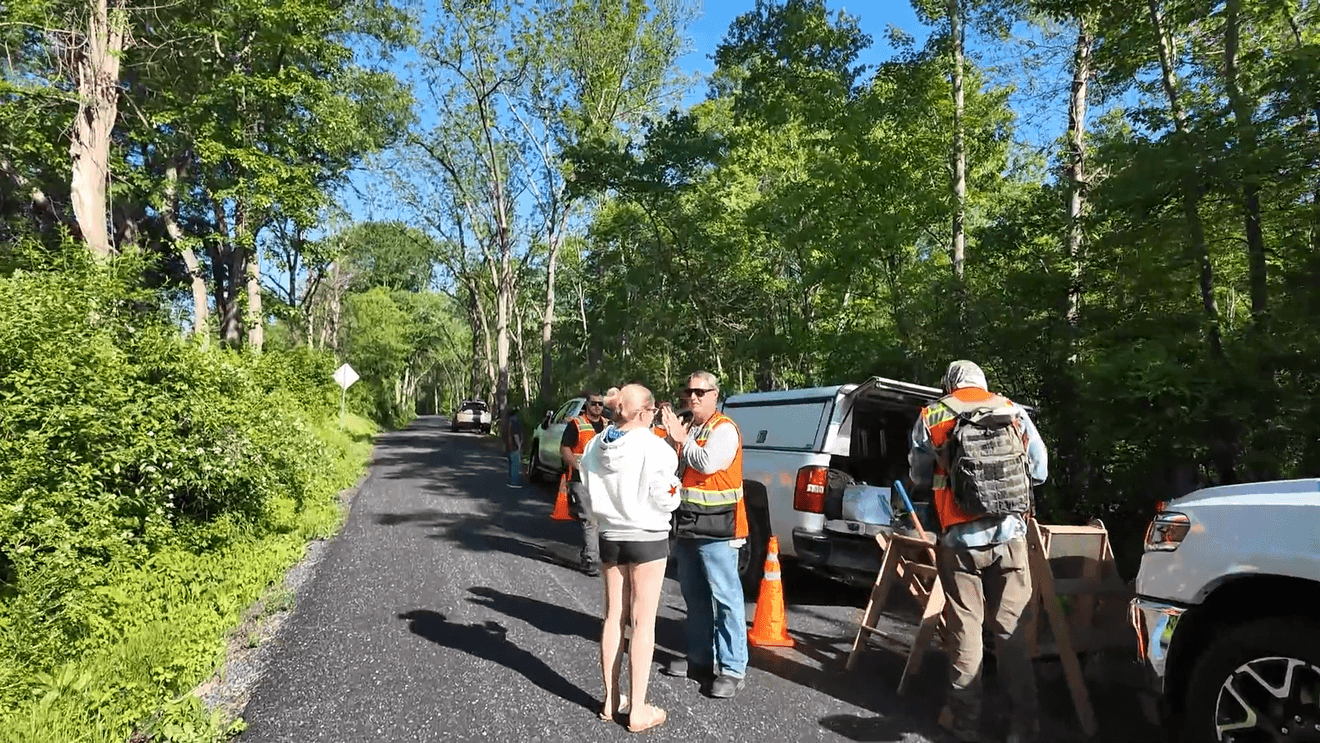
When surveyors showed up Tuesday morning, they were swiftly turned away.
“We immediately felt like this was out of the scope of that court order and definitely invasive and could cause permanent harm to our land,” Jessica Thompson said.
On May 19, the Thompsons’ attorney filed a motion to clarify the preliminary injunction. The filing says the PSEG sought the ability to “perform non-invasive field surveys.” Of several surveys that were listed, the filing said the “The Maryland Historical Trust is the agency with specific oversight of archaeological surveys,” and had not designated the Thompsons’ land as a “parcel of concern that warrants an archaeological survey.”
“I just felt sick because we are told by PSEG that they’re not going to do these things, and they represent in court that they’re not going to be invasive, they’re not going to cause permanent damage, it will only be temporary, and then in real life we’re faced with these things,” Jessica Thompson said.
ALSO READ | Proposed bill could change notice requirements for transmission projects in Maryland
Thompson said the digging could damage trees in the wooded area on their property, which is used for hunting, along with other disruptions to the land. She said they also have plans to build homes on their property for their children, which could be impacted by the survey.
The filing says consultants have warned them that “any physical excavations or disruptions to the surface of the land, no matter how temporary or how small” poses the risk of invalidating perc testing, and result in the loss of homesites and subdivision rights, which could be costly.
“We want the other landowners to know that as we do these things and fight back, we have all of us in mind,” Jessica Thompson said.
We hope that by us standing up and others that we can come together and, and do what’s right here, and protect our legacies, and our farms, and our hard work, and our homes, and our kids.”
A spokesperson from PSEG declined to comment due to litigation.

 Local Story