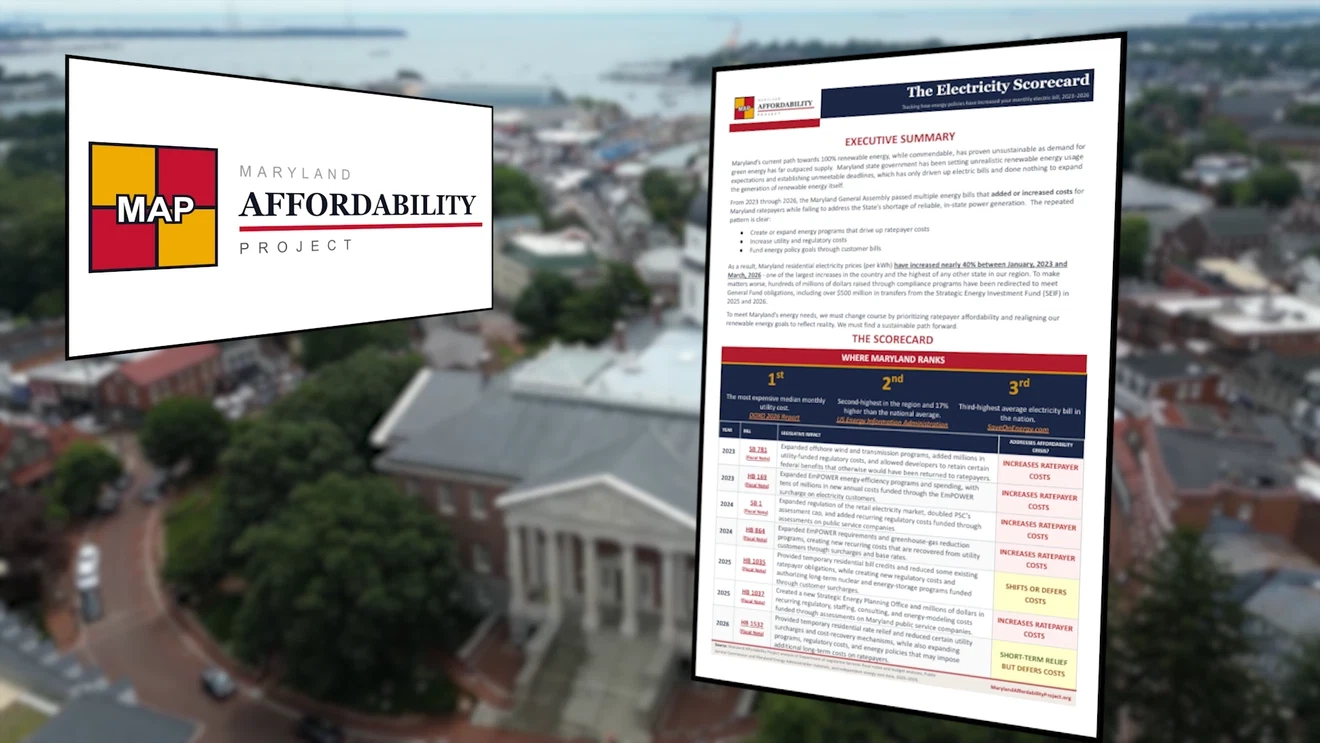
BALTIMORE (WBFF) — A new Maryland advocacy group is pointing the finger at policies coming from Annapolis for rising electricity prices in Maryland, arguing lawmakers have approved policies that add costs for ratepayers.
The Maryland Affordability Project released what it calls an energy scorecard, examining seven pieces of legislation passed between 2023 and 2026. The group, led by Randy Altschuler, argues five increased costs for Maryland ratepayers, while two provided short-term relief but shifted or deferred other costs.
“They keep passing laws that are driving up the costs of living in Maryland for people,” Altschuler told FOX45 News.
Among the legislation criticized in the scorecard is a 2023 expansion of Maryland’s EmPOWER energy efficiency program, which the scorecard says expanded spending by tens of millions of dollars annually, funded through a surcharge on electricity customers.
It also points to 2024 legislation expanding EmPOWER requirements and greenhouse-gas reduction programs, with costs recovered through utility surcharges and base rates.
ALSO READ | Consumer advocates raise concerns over BGE’s latest $156 million rate hike request
However, some of the legislation highlighted in the scorecard has also provided relief to customers.
A 2025 law provided residential bill credits while also authorizing nuclear and energy-storage programs, while the 2026 Utility RELIEF Act provided temporary residential rate relief and reduced some utility surcharges and cost-recovery mechanisms. The Affordability Project argues those measures shift or defer costs rather than solve Maryland’s underlying affordability problem.
Altschuler argues state mandates are still contributing to the problem.
“We’re creating mandate after mandate that’s driving up costs,” he said when asked about other factors affecting electricity prices.
The group’s analysis does not establish how much of Maryland’s overall increase in electricity prices can be directly attributed to those individual state policies. Other factors, including regional electricity supply and demand, transmission and PJM market costs, can also affect what customers ultimately pay.
ALSO READ | Gov. Wes Moore evolves on data centers as Amazon project surges ahead
Altschuler also argues Maryland needs to generate more of its own electricity.
The group takes sharp aim at the recent funds pulled from the Maryland Strategic Energy Investment Fund, or SEIF. The fund is a pot of money funded primarily from the Regional Greenhouse Gas Initiative and Alternative Compliance Payments. The money can support programs including energy efficiency, clean and renewable energy, and energy assistance.
The Affordability Project said $230 million was transferred from the SEIF in 2025 and another $292 million in 2026. The group argued the money was used to cover other broader budget needs rather than intended purposes.
“When we take that money, over $500 million over the last two years, and we don’t use it for the intended purposes, it’s the worst of both worlds,” Altschuler said. “We’re paying more and we’re getting nothing in return.”
Gov. Wes Moore’s team pushed back on the criticism of the use of SEIF, tying the debate to actions taken by the Trump Administration.
Rhyan Lake, a spokesperson for Gov. Moore, said the Trump Administration has canceled projects in Maryland “that would have driven cleaner, faster, and cheaper energy to our grid just because our state didn’t vote for him.”
Lake’s statement did not specifically explain the decisions behind the more than $500 million in transfers.
ALSO READ | Maryland data center debate intensifies as local rules diverge
Altschuler said his group isn’t calling for Maryland to abandon its transition toward cleaner energy. Instead, he argues policymakers need to balance those goals against what customers can afford.
“I think we need renewable energy, but we also have to be realistic,” Altschuler said. “You can drive to more renewable energy. We can become greener. At the same time, we can also reduce the cost that our ratepayers are paying.”
Moore’s office argues that the two goals are not mutually exclusive.
“Governor Moore is proving we can walk and chew gum at the same time — delivering relief for families while making record investments in clean energy — all without raising taxes or fees this year,” Lake said.
For Altschuler, the test heading into the next legislative session is whether lawmakers put affordability at the center of future energy decisions.
“They have to think about affordability,” he said. “They have to make sure that they keep their eye on the ball, which is how do we make it easier and less expensive to live in our state? We need leadership for that.
Follow Political Reporter Mikenzie Frost on X and Facebook. Send tips to mbfrost@sbgtv.com.
 Local Story