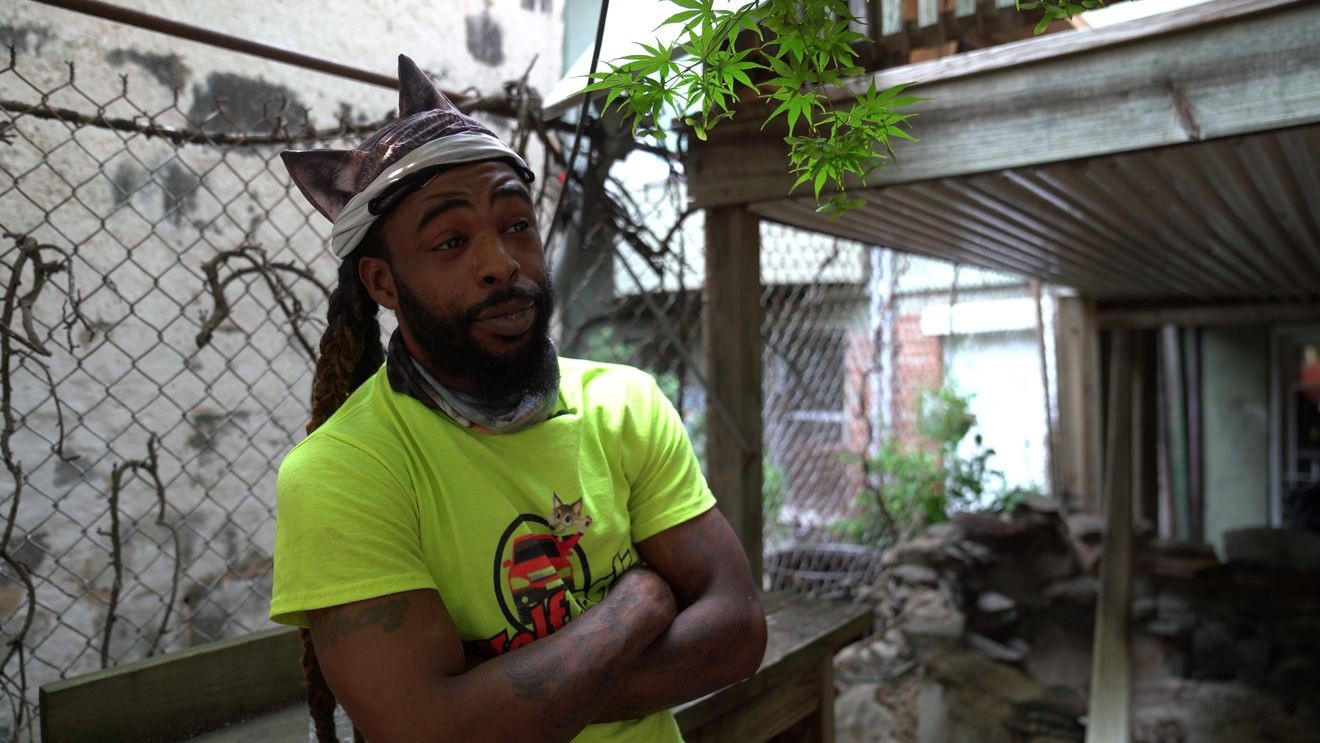
BALTIMORE (WBFF) — When property owners call Sanchez Deandre Lewis, they are often already locked out.
The Maryland contractor, known as “Mikey,” says unauthorized occupants have halted renovation projects, presented leases that owners and property managers do not recognize, and prevented his crews from entering houses they were hired to clean or repair.
His response is a service he markets as “Squatter King Removal.”
Me and my wolves, we go above and beyond to get these houses back,” Mikey said, referring to a crew he calls the Wolf Pack.
Mikey says his team does not assault or physically carry occupants from properties. Instead, he describes removing doors and windows, disrupting access to the building and creating conditions intended to persuade suspected squatters to leave.
“Police said we can’t remove somebody, so lawfully, the only thing we can do is what we could do,” Mikey said. He characterized the approach as making an occupant’s life difficult enough that remaining inside is no longer practical.
The tactics occupy a legally precarious space. Maryland generally requires property owners seeking to remove unauthorized occupants to use the courts, including wrongful-detainer proceedings. Self-help measures can carry legal risks, particularly when an occupant claims to be a legitimate tenant.
Mikey maintains that his company operates within the law. He said his crew stops short of physical removal or assault and is hired by property owners or managers seeking access to buildings they say have been unlawfully occupied.
It’s like street justice,” Mikey said.
Sporting a hat with vertically extending wolf ears, Mikey on Monday showed Spotlight on Maryland one of his latest projects in Baltimore’s Mt. Vernon neighborhood, amid dozens of squatter eviction videos of his company conducting its business.
From boarding squatters inside properties to towing their vehicles, and even using bear spray and smoke bombs as defensive measures when entering properties occupied by purported unauthorized residents, Mikey said his team is determined to resolve a property owner’s squatter problem.
Mikey showed Spotlight on Maryland a text with a new customer that reached out during the interview.
“I neverrrr guarantee we going get someone out but I damn sure can guarantee my wolves not going stop once they get $$,” Mikey wrote to the customer. “I jus was telling someone how the property managers are apart of the problem to [sic].”
According to Mikey, the region’s ongoing squatter problems stem from highly organized actors, including some defunct property managers.
His unconventional business grew from a more conventional contracting operation.
Mikey said he began rebuilding his life six years ago after leaving prison, when he was homeless and living in a hotel room. He acknowledged briefly selling drugs before buying a pickup truck and beginning a trash-removal business.
“The first year, I did probably $100,000 on my pickup truck,” Mikey said. “I didn’t touch no drugs no more.”
The father of a 5-year-old daughter said demolition jobs, property cleanouts and eviction-related work followed. Over time, he said, suspected squatters increasingly prevented his crews from completing assignments.
We would get jobs, and we would get there, and people wouldn’t let us in that we know for a fact didn’t belong there,” Mikey said.
Some occupants showed what Mikey described as fraudulent leases. Property owners and management companies, he said, often did not recognize the names or documents.
“We would get at least 20 cleanouts and only do one,” Mikey said. “All these people showing fake leases. The owners not knowing who they is. The property managers not knowing.”
Mikey said those encounters led his company to develop a separate removal service. Base charges begin at approximately $2,000, he said, with prices increasing based on the number of occupants, the property and the perceived difficulty of the assignment.
His company grades cases by “levels.” Mikey said the most extensive operation involved about 50 people responding to a property in Washington, D.C.
The service has emerged amid documented disputes across Maryland in which property owners said police declined to remove occupants after questions arose about residency or tenancy.
Spotlight on Maryland for more than a year has reported on cases from Baltimore to Bethesda involving changed locks, disputed leases, delayed court proceedings and owners unable to immediately regain possession of their properties.
In Southwest Baltimore, University of Maryland School of Medicine professor Ze Wang said he returned from vacation in January to find strangers unloading belongings into his home. Wang said a woman presented police with a lease signed by a person he did not know.
He remained displaced for 59 days, sometimes sleeping in his office, and later reported more than $80,000 in estimated damage. Text messages provided by Wang also showed a demand for $5,000 to vacate the property.
In Bethesda, Tamieka Goode was convicted in January of charges connected to her occupation of a $2.3 million house. The case became part of a broader debate over fraudulent leases, police authority and the distinction between criminal trespassing and civil landlord-tenant disputes.
Ian Chen, a neighbor of the mansion, filed criminal trespassing charges with the court commissioner against Goode and her partner, Corey Pollard, after Montgomery County Police Department officials told him and other neighbors that the couple had established residency despite being squatters.
He said he commends efforts like Mikey’s and those of his wolves.
Services like that would be positive contributions to our communities by helping protect property rights and giving owners a practical solution to an ever-growing problem,” Chen said
Goode is expected to return to court later this month to appeal her prior conviction.
In May, a Baltimore property manager said occupants changed the locks and removed a lockbox from a vacant rowhome being prepared for a tenant. Police left without removing anyone, even though the manager said the occupants produced no lease, utility bill or other proof connecting them to the property.
Maryland lawmakers responded during the 2026 legislative session by passing two laws addressing portions of the problem.
One establishes criminal penalties for intentionally creating, helping create or possessing a counterfeit real-estate lease to defraud another person. A second measure expedites certain wrongful-detainer cases involving properties listed for sale or lease and requires courts to issue a warrant within 24 hours after an owner prevails in a qualifying case.
Gov. Wes Moore signed the bills in May. Both are scheduled to take effect Oct. 1.
Del. Mike Griffith, who sponsored the counterfeit-lease legislation, said the stronger penalties could both bring offenders to justice and deter future cases.
“A person who violates this section is guilty of a felony and on conviction is subject to imprisonment not exceeding 10 years,” the new legislation says.
Mikey remains skeptical that legislation alone will resolve the delays owners experience when occupants claim residency and police determine the dispute belongs in civil court.
It’s laws changing, but nothing happening,” Mikey said. “The police show up, they want to say the same thing. They leave, and then I’m going to get a call.”
Mikey said owners should secure vacant houses and regularly monitor their properties. He also said he expects to stop offering squatter-removal services after this year, citing the dangers faced by his crews.
“Me and my team, we put ourselves in harm’s way,” Mikey said. “It’s getting to a point where it’s not even worth it.”
After that, he said, the Wolf Pack will return to regular contracting, demolition and property-cleanout work — leaving homeowners to rely on police, the courts and Maryland’s new laws.
Have you experienced or had direct knowledge of squatting or unauthorized occupancy occurring in Maryland? Do you have any tips related to this story? Send news tips to gmcollins@sbgtv.com or contact Spotlight on Maryland’s hotline at (410) 467-4670.
Follow Gary Collins on X and Instagram. Spotlight on Maryland is a collaboration between FOX45 News, WJLA in Washington, D.C., and The Baltimore Sun.
 Local Story